



Bitcoin at a Crossroads: Election Anxiety, Binance Hack Fallout and a Hawkish Fed Test Market Resolve
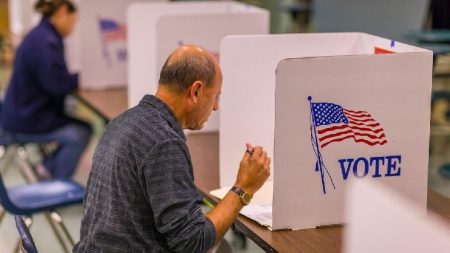
The upcoming US midterm elections are more than a political event; they are a market event. And this year, the stakes are unusually high for an economy already trying to navigate inflation, interest rate expectations and geopolitical tension. According to Thompson, a market analyst whose commentary has been widely shared across crypto trading desks, the eventual election outcome could complicate President Donald Trump’s legislative agenda over the next two years. That is not a minor detail. A congressional landscape unfriendly to the White House could slow everything from tax policy to spending priorities, injecting a fresh wave of uncertainty into financial markets. Thompson was quick to add a caution flag, however, noting that midterm polling has historically been unreliable. Every election cycle has its share of surprise results, and pre-election assumptions have a way of unraveling by the time the final votes are counted. The conclusion for traders is that the outcome remains genuinely uncertain, and that uncertainty itself is a reason to be careful. One firm that has decided to take a cautious approach is Hilbert, a research group focused on cross-market risk. The firm said its “desk is running relatively light on risk” as it monitors three major unknowns: the elections, the aftermath of the Binance hack and a US military buildup in the Middle East. That list is telling because it spans both traditional geopolitical dangers and crypto-native vulnerabilities. Any one of those factors alone would be enough to keep traders awake at night. Combined, they create a volatile and unpredictable environment. Thompson also warned that tensions in the Middle East could escalate within the next two weeks, raising the possibility that President Trump will refocus on the region once the elections conclude. If that scenario unfolds, it could shift the risk mood just as markets prepare to price in another Federal Reserve move. The convergence of these forces has made this one of the more complicated periods for crypto markets in recent memory, and Bitcoin, often viewed as a barometer for speculative appetite, is being watched closely by investors across the financial spectrum.
Because the election cycle has dominated the headlines, the US military buildup in the Middle East has received less attention than it probably deserves. That could change quickly. Thompson’s warning that tensions might escalate within two weeks is an important signal for anyone trading volatility. A military clash in the region would have immediate consequences for energy prices, which feed directly into inflation measures and central bank calculations. It could also accelerate a flight out of risk assets and into the dollar, a development that tends to put downward pressure on Bitcoin and other cryptocurrencies. The US deployment has added a layer of uncertainty that is difficult to model, especially in a region where events can shift course overnight. Markets are already thin and headline-sensitive. If an unexpected conflict emerges during the post-election window, the reaction in the digital asset space could be sharp. Some investors continue to view Bitcoin as a hedge against traditional financial instability, but in practice, the asset has often behaved like a high-beta risk position during turbulent periods. That means bad geopolitical news has the potential to trigger immediate selling, at least in the short term. For institutional desks, the combination of election uncertainty and Middle East risk is a reason to keep inventory low and wait for clarity. The interplay between politics and geopolitics has never been easy to navigate, and with Bitcoin already in a technical retreat, the system is primed for sudden movement. The next few weeks may not produce a single decisive catalyst, but they could produce many smaller shocks that cumulatively reset the market’s footing.
At the center of the current market drama is Bitcoin’s price chart. The Binance hack, which rattled the crypto world over the weekend, triggered an estimated $4,000 price move that broke the initial trend-line support. That technical break has forced traders to recalibrate. Bitcoin is now testing critical support near $78,000, a level that once served as a floor. Thompson laid out a clear map of what could happen next. The first major support zone is between $76,000 and $78,000. If that fails, the next levels to watch are $74,000 and $72,000. The tone of the market has shifted noticeably since October 9, when Bitcoin was still trading near $85,000. Short-term momentum indicators have remained negative for the entire period, suggesting that this is not a quick dip but a downward trend in motion. For traders who rely on technical signals, that persistent negative momentum is a warning. It means every rally attempt could be met with fresh supply, and buyers are not aggressive enough to reverse the move. The hacking event added fuel to the decline, but the technical position was already deteriorating before the breach became public. Now, all eyes are on the $78,000 level. A break below it would likely trigger another round of stop-losses and automated selling. The fact that Bitcoin has spent days trading below key moving averages only intensifies the pressure. The broken trend line, which had been guiding the market higher, has now become a resistance zone that needs to be reclaimed before sentiment can genuinely improve.
The options market is providing an equally clear picture of the shift in sentiment. Derivatives traders are signaling that they expect more downside, not less. Five delta puts, which are deeply out-of-the-money options designed to protect against a major drop, are currently trading at a 13-point premium to at-the-money volatility. Equivalent calls, by comparison, are trading at roughly two points of premium. This divergence is striking. It means market participants are willing to pay significantly more for insurance against a sharp decline than for upside exposure. Such positioning often emerges when professional traders believe the path of least resistance is lower. The options market’s maximum pain level, a key metric that derivatives desks use to identify where large option buyers tend to experience the most discomfort at expiration, stands near $75,000. That is below the current spot price, which suggests that gravitational pull toward that level could add another layer of downside pressure. Thompson identified $77,000 as immediate support, with $79,000 to $79,500 as resistance over the next 48 hours. If Bitcoin can hold $77,000 and reclaim $79,500, the short-term bearish narrative could weaken. But if support fails, the next stops on the downside may come quickly. The combination of technical weakness, negative momentum and defensive options positioning does not offer much comfort to bulls. In a market where leverage is easy to access, moves can be amplified in both directions, but the current options flow suggests that the market is bracing for another leg lower rather than a violent reversal.
Adding to the pressure is a Federal Reserve that appears in no mood to pivot. The latest round of economic data has come in stronger than expected, and Fed Chair Kevin Warsh has delivered comments that traders read as hawkish. As a result, interest rate futures now imply approximately a 72% to 73% probability of another rate hike in December. That is a meaningful increase in tightening expectations, and it is already affecting asset prices across the board. For Bitcoin, the connection between Fed policy and price action has become impossible to ignore. Higher rates make holding non-yielding assets more expensive in relative terms, while a firmer dollar tends to cap upside in dollar-denominated digital currencies. The crypto market has matured to the point where it trades more like a macro asset, and that means Fed expectations often matter more than hype or adoption headlines in driving short-term price movements. If a December hike is fully priced in, the real risk now is what happens after. Another increase could signal that inflation is still not under control, which would keep the pressure on risk assets well into next year. On the other hand, if economic data begins to soften and the Fed turns more cautious, Bitcoin could rally sharply on the back of relief. For now, the market is positioned for another hike, and the defensive posture across crypto reflects that reality. Traders will be closely watching every upcoming economic release for clues about whether the central bank will stay the course or find an excuse to pause. Until that path becomes clearer, the macro environment remains an anchor on speculative positioning.
The Binance hack continues to be one of the most important stories in crypto, both because of its size and because of its potential origin. Thompson said the breach increasingly appears to be linked to North Korea, although he stressed that attribution remains unconfirmed. If that connection is ultimately established, it would raise the stakes considerably, pointing to a state-sponsored intrusion at one of the world’s largest exchanges. According to Hilbert, Binance saw approximately $3.5 billion in withdrawals after reopening over the weekend. That is a massive number in absolute terms, but it needs context. The platform holds more than $170 billion in assets, which means the outflows represented a small fraction of total reserves. Most clients did not panic, but the psychological damage of a hack can be long-lasting. Every time a major exchange is compromised, the broader market is forced to revisit questions about custody risk, internal security and the industry’s ability to protect user funds. Those questions rarely disappear quickly. For Bitcoin, the convergence of the Binance aftermath, a hawkish Federal Reserve, midterm election uncertainty and potential Middle East escalation has created a deeply uncertain environment. Thompson’s technical levels give traders a useful framework, but no chart can fully capture the range of events that could unfold in the coming days. The market is likely to remain volatile, and for many participants, the most sensible strategy is simply to remain flexible. Bitcoin is at a crossroads, caught between unresolved risks and the possibility that a single piece of good news could change the tone instantly. How it navigates the next several sessions will likely define the market’s direction for the rest of the year.