






Bitcoin Surges as Market Digests Treasury’s Debt Strategy and Awaits Fed Signals
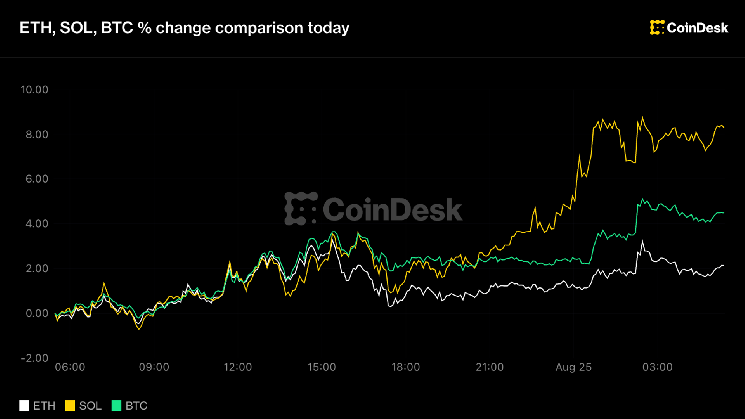
In a week marked by significant macroeconomic movements, cryptocurrency markets have demonstrated remarkable resilience, with Bitcoin leading the charge amid shifting signals from Washington and growing anticipation surrounding the Federal Reserve’s upcoming symposium. The digital asset landscape is experiencing a notable transformation as investors recalibrate their positions in response to evolving fiscal policy discussions and renewed interest in alternative stores of value.
Bitcoin’s Ascent and the Macroeconomic Backdrop
The cryptocurrency market has witnessed an impressive rally this week, with Bitcoin posting substantial gains as traders digest a complex web of fiscal and monetary developments. The digital currency’s upward trajectory reflects growing optimism among institutional investors who view cryptocurrencies as an increasingly viable hedge against traditional market uncertainties. This sentiment has been particularly pronounced as discussions surrounding government debt management strategies have intensified in financial circles.
Market participants have been closely monitoring the Treasury Department’s communications, which have signaled potential shifts in how the government approaches its debt obligations. These communications have sparked renewed interest in alternative assets, with many investors viewing Bitcoin as a digital counterpart to traditional safe-haven assets like gold. The cryptocurrency’s finite supply and decentralized nature continue to attract those seeking protection against potential currency debasement.
Solana’s Supply Debate and Network Fundamentals
Amid the broader market rally, Solana has emerged as a focal point of discussion within the crypto community. The network’s governance mechanisms are currently undergoing significant scrutiny as validators consider proposals that could fundamentally alter the token’s supply dynamics. These deliberations represent a critical juncture for the Solana ecosystem, as the outcomes could have far-reaching implications for the network’s long-term economic model.
The proposed changes encompass two key areas: a reduction in new issuance rates and the implementation of increased burn mechanisms. Should these proposals gain approval, they could reduce the daily token supply by approximately 700,000 SOL while simultaneously increasing the burn rate from 50% to 100% of base fees and priority fees. Such modifications would represent a substantial shift toward a deflationary model, potentially impacting everything from validator economics to long-term holder incentives.
The vote, which is scheduled to conclude on Thursday, has drawn significant attention from market analysts who recognize the potential for these changes to influence Solana’s competitive positioning within the broader blockchain ecosystem. The outcome could serve as a bellwether for how other networks approach similar supply-management challenges in the future.
Altcoin Performance and Market Dynamics
While Bitcoin’s performance has captured headlines, the broader altcoin market has demonstrated equally impressive momentum. Zcash has emerged as a standout performer, building on its recent gains with another positive session. The privacy-focused cryptocurrency’s continued ascent reflects growing demand for anonymous transaction capabilities, a feature that has become increasingly valuable as regulatory scrutiny of the crypto space intensifies.
Dogecoin has also maintained its upward trajectory, extending gains that have captured the attention of both retail and institutional investors. The meme-inspired cryptocurrency’s resilience continues to surprise skeptics, demonstrating the enduring appeal of community-driven digital assets in the current market environment. Tron, meanwhile, has posted more modest gains, though its steady performance underscores the diversified nature of the current rally.
The Contrarian Case: Hyperliquid’s Pullback
Not all cryptocurrencies have participated equally in the market’s advance, however. Hyperliquid’s native token has bucked the broader trend, experiencing a slight pullback even as its peers post gains. This divergence is particularly notable given the token’s strong performance over the past week, suggesting that profit-taking may be occurring among some investors who have benefited from the recent appreciation.
The varied performance across different digital assets highlights the increasingly nuanced nature of cryptocurrency markets, where fundamental factors and market sentiment can diverge significantly between different projects.
Treasury Strategy and the Debasement Trade
The catalyst for this week’s market movements can be traced to recent communications from Treasury Secretary Scott Bessent regarding the government’s approach to debt management. In statements that have resonated throughout financial markets, Bessent indicated that the department would continue its regular program of securities sales while signaling potential adjustments to the mix and tenor of Treasury issuance.
These comments have revived what market participants commonly refer to as the “debasement trade” – the strategy of holding assets outside government control as protection against the erosion of fiat currency purchasing power. Bitcoin, with its fixed supply of 21 million coins, has become the flagship vehicle for this trade, attracting investors who seek to hedge against the long-term consequences of sustained government spending and monetary expansion.
Understanding the Buyback Mechanism
Morgan Stanley’s analysis has shed additional light on the potential scope of Treasury buyback operations. According to interest-rate strategist Martin Tobias, the Treasury maintains substantial flexibility in its buyback program, with estimates suggesting the department could deploy between $80 billion and $200 billion in spare cash toward larger buybacks. This range underscores the significant firepower available to the Treasury in managing its debt obligations and potentially influencing longer-term interest rates.
The implications of such operations extend beyond traditional fixed-income markets. As the Treasury adjusts its issuance and buyback strategies, investors increasingly view cryptocurrencies as beneficiaries of these policy shifts, particularly if they result in downward pressure on the dollar or heightened inflation expectations.
The Jackson Hole Factor: Fed Signals and Market Expectations
Looking ahead, market participants are turning their attention to the Federal Reserve’s annual Jackson Hole symposium, where Fed Chair Kevin Warsh is scheduled to deliver remarks on Friday. This appearance carries particular significance as it represents Warsh’s first address at the prestigious gathering since assuming the central bank’s top position.
Jackson Hole has historically served as a platform for the Fed to signal major policy shifts, making the upcoming speech a critical event for markets across all asset classes. Traders and investors will be scrutinizing Warsh’s comments for any hints about the future trajectory of interest rates, quantitative tightening, or other monetary policy tools.
Historical Significance and Market Impact
The Wyoming resort setting has witnessed numerous pivotal moments in monetary policy history. Previous chairs have used the platform to announce major policy pivots, earning the symposium a reputation as a bellwether for Federal Reserve intentions. This year’s gathering takes on additional importance given the uncertain economic environment, with inflation showing signs of persistence while growth concerns loom in certain sectors.
For cryptocurrency markets, the Jackson Hole speech represents a potential catalyst that could either extend the current rally or introduce fresh volatility. The relationship between Federal Reserve policy and digital asset prices has evolved significantly, with crypto increasingly viewed as a sensitive barometer of monetary conditions and liquidity expectations.
Institutional Adoption and Market Maturity
The current market environment reflects the ongoing maturation of the cryptocurrency sector, with institutional participation continuing to grow. The convergence of macroeconomic factors, including debt management strategies and monetary policy expectations, has positioned digital assets as a legitimate consideration for portfolio allocation.
This evolution is evident in the changing nature of market commentary and analysis, with traditional financial institutions increasingly incorporating digital assets into their research and client offerings. The interplay between conventional finance and the emerging crypto ecosystem has created new dynamics that sophisticated investors are learning to navigate.
Risk Considerations and Portfolio Implications
Despite the optimistic sentiment, market participants remain mindful of the inherent risks associated with cryptocurrency investments. The sector’s historical volatility serves as a reminder that gains can be quickly reversed, and the regulatory landscape continues to evolve in ways that could impact market dynamics.
Financial advisors and analysts recommend a measured approach to digital asset allocation, emphasizing the importance of diversification and risk management. While the current environment presents opportunities, prudent investors recognize the need for careful position sizing and a long-term perspective.
The Road Ahead: Challenges and Opportunities
As the cryptocurrency market navigates this complex landscape, several factors will likely influence near-term dynamics. The conclusion of Solana’s governance vote, the Federal Reserve’s communications, and ongoing developments in Treasury debt management will all play significant roles in shaping market sentiment.
The intersection of traditional finance and digital assets continues to generate both opportunities and challenges. As central banks and government treasuries navigate the post-pandemic economic landscape, the role of cryptocurrencies as alternative stores of value and mediums of exchange remains a subject of intense debate and innovation.
Technological Developments and Network Upgrades
Beyond macroeconomic factors, the cryptocurrency ecosystem continues to evolve through technological advancement and infrastructure development. Layer-2 solutions, interoperability protocols, and improvements in scalability are expanding the potential use cases for blockchain technology, attracting developers and users alike.
These fundamental developments provide additional support for cryptocurrency valuations independent of market sentiment, suggesting that the sector’s growth trajectory may be driven by more than just speculative interest.
Conclusion: A Market in Transition
The cryptocurrency market finds itself at a fascinating crossroads, where traditional financial dynamics and innovative digital assets increasingly intersect. This week’s price movements reflect a market that is both responding to immediate catalysts and positioning itself for longer-term structural changes in the global financial system.
As investors await the Federal Reserve’s guidance and monitor Treasury debt management strategies, the resilience demonstrated by digital assets suggests they have become an enduring component of the investment landscape. While challenges remain, including regulatory uncertainty and market volatility, the continued evolution of the cryptocurrency ecosystem points toward growing integration with mainstream finance.
The coming weeks will likely provide additional clarity on many of these fronts, as the Solana vote concludes, Jackson Hole proceedings unfold, and market participants process the implications of evolving fiscal and monetary policies. For now, the crypto market’s ability to navigate these complex dynamics while maintaining upward momentum represents a significant development worthy of attention from investors across the financial spectrum.