





Market Pullback Eclipses Aster’s Explosive Tokenomics Upgrade
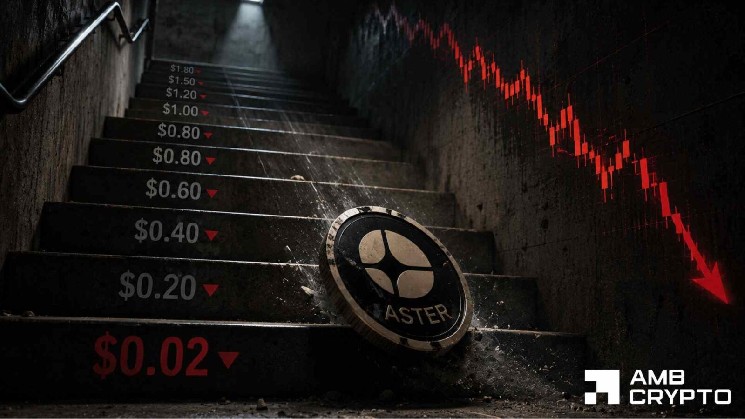
The volatile landscape of the cryptocurrency market has once again demonstrated its unpredictable nature, as the Binance Labs-backed project Aster ($ASTER) recently underwent a dramatic price correction that effectively erased its impressive weekly gains. In a sudden burst of bullish momentum, the token had previously skyrocketed by more than 28%, climbing from a baseline of $0.63 to a peak exceeding $0.82, a rally largely catalyzed by the highly anticipated unveiling of a radical system-wide tokenomics overhaul. This sudden price expansion underscored the immense speculative appetite for assets that actively reform their utility models to favor holders, but the euphoria proved short-lived as a sweeping, market-wide downside correction dampened investor enthusiasm across the board. As macroeconomic pressures and shifting capital flows triggered a broader crypto market pullback, the bullish advance of Aster collided head-on with a historical 2026 resistance sell zone, a formidable barrier where long-term holders and strategic profit-takers took the opportunity to liquidate their positions. Consequently, the token’s upward momentum was abruptly halted, forcing the asset into a steep retracement that served as a stark reminder of how macro market sentiment can effortlessly override localized positive developments, leaving retail traders and institutional market participants alike to carefully evaluate the fundamental strength of the project amid this newfound localized bearish phase.
The Hyperliquid Blueprint: Inside Aster’s Ambitious 5-Billion Token Burn
At the very core of Aster’s recent volatility lies an incredibly ambitious restructuring of its fundamental tokenomics, a strategic pivot heavily reminiscent of the successful mechanisms popularized by decentralized trading giant Hyperliquid. Under this newly minted economic framework, the Aster foundation announced its intention to channel an unprecedented 99% of all protocol-generated revenue directly into systematic market buybacks of its native token, a mechanism specifically designed to assert constant purchasing pressure on the open market while systematically reducing the outstanding circulating supply. The ultimate objective of this aggressive revenue-recycling initiative is the permanent removal of five billion $ASTER tokens from existence, an immense deflationary program that aims to fundamentally alter the supply-demand dynamics of the asset in favor of long-term scarcity. By adopting this aggressive buyback-and-burn strategy—which aligns the protocol’s financial success directly with the economic health of its underlying token—Aster is attempting to appeal toe DeFi purists and yield-focused investors who have grown increasingly weary of highly inflationary governance tokens that offer little to no real-world value accrual. However, while such a deflationary design is theoretically poised to drive massive value appreciation during sustained periods of high network usage, the real-world execution of such a model remains entirely dependent on the protocol’s ability to consistently generate substantial revenue, a metrics-driven reality that has become increasingly difficult to guarantee as trading volumes and on-chain activities fluctuate wildly in a risk-off global market environment.
Bearish Vectors and Crucial Price Floors: A Closer Look at the $ASTER Charts
  $0.82 ----------------------------- [Local Peak / Resistance]


             <-- Broader Market Correction (24% Pullback)

  $0.70 ---------------------------- [200-Day Moving Average / Relief Target]


  $0.60 ---------------------------- [June Support Level - Active Test Node]


  $0.55 -----------*----------------- [Ultimate Defensive Floor / Accumulation Zone]
An objective examination of the 12-hour technical price charts reveals a distinctly sober reality for Aster, with short-term market momentum leaning heavily in favor of the bears as sellers assert dominance over the immediate order books. Having surrendered roughly 24% of its value from its local peak, the $ASTER price has drifted dangerously close to its critical June support level of $0.60, a legacy liquidity pool that has historically acted as a reliable launchpad for buyer intervention during previous market corrections. Should the prevailing bearish pressure intensify and push the token below this pivotal anchor, market analysts warn that an extended downside slide toward the next major defensive boundary at $0.55 is highly likely, a scenario that would require a significant consolidation phase before any meaningful trend reversal could be established. Conversely, if buyers manage to mount a successful defense at the $0.60 threshold and trigger a localized relief rally, the primary upside objective sits squarely at the 200-day Moving Average around $0.70, representing a potential 16% recovery from the current support levels that could easily materialize once the highly anticipated 5-billion token burn program officially begins executing buy orders. Traders must closely monitor these specific technical markers, as a decisive daily close outside this established trading range will likely dictate the mid-term trajectory of the token, determining whether Aster will enter a prolonged period of accumulation or embark on a swift recovery back toward its multi-month highs.
The Realities of Modern Tokenization in a Fragile Macro Environment
Beyond the deterministic realms of technical chart patterns and localized support levels, Aster’s broader value proposition is intrinsically tied to the rapidly evolving theme of real-world asset tokenization, a sector that many prominent market strategists believe will serve as a primary engine of growth for the next generation of decentralized finance. By positioning itself at the intersection of blockchain utility and structured financial products, the project seeks to capture market share in an industry increasingly focused on bringing liquid, institutional-grade assets onto public ledgers. Despite the long-term optimism surrounding this paradigm shift, the short-term reality is that structural tokenization projects require substantial capital inflows to achieve sustainable network effects, a requirement that has become difficult to meet as global liquidity remains highly restricted and institutional investors adopt defensive portfolios. Because tokenization ecosystems rely on friction-free transfers of value and robust transactional throughput, they are highly sensitive to sudden drops in investor confidence, meaning that even the most innovative cryptographic platforms can find their native tokens suffering from depressed valuations when larger macroeconomic vectors turn hostile. Consequently, while Aster’s commitment to building out a robust tokenization infrastructure presents a compelling narrative for the next cyclical expansion, the platform must navigate an incredibly complex macro environment where fundamental utility is frequently overshadowed by systemic liquidity dry-spells and high-yield traditional alternatives.
The Elusive Altcoin Season: Decoding the Bitcoin Dominance and ETH/BTC Downtrend
The challenging market dynamics currently acting as a headwind for Aster cannot be evaluated in isolation, as they are reflective of a broader structural shift within the wider digital asset ecosystem characterized by the prolonged absence of a true, generalized “altcoin season.” Historically, sustained rallies across alternative cryptocurrencies have been catalyzed by capital rotating out of dominant assets like Bitcoin and into higher-beta options, a phenomenon traditionally measured by the performance of Ethereum relative to Bitcoin, as represented by the widely monitored ETH/BTC trading pair. Following a brief and promising period of expansion between the second and third quarters of 2025, the ETH/BTC ratio has entered a persistent, grinding downtrend, signaling that Bitcoin continues to aggressively command market dominance and capture the lion’s share of incoming institutional capital. This systematic concentration of liquidity in Bitcoin—buoyed by the continuous success of spot-based exchange-traded funds and its growing reputation as a geopolitical safe haven—has left the rest of the altcoin market starved of the deep capital pools required to sustain multi-week rallies, forcing assets like Aster to fight over highly fragmented, domestic liquidity and leaving most secondary protocols vulnerable to rapid, deep sell-offs at the first sign of a market-wide correction.
| Metric / Asset Trend | Recent Performance / Level | Macro Market Implication |
|---|---|---|
| $ASTER Price Action | Erased 28% gains, testing $0.60 | Highly sensitive to localized support floors amidst systemic sell-offs. |
| Bitcoin Momentum | Down approximately 18% (30-day) | Retained dominant share of market attention, stifling broader altcoin capital rotation. |
| ETH/BTC Ratio | Maintained persistent downtrend | Signals a delayed “altcoin season” as liquidity remains concentrated in BTC. |
| Tokenomics Catalyst | 99% revenue buyback / 5B burn | Serves as a fundamental mid-to-long term deflationary driver for Aster. |
Outperforming the Giant: Why Aster’s Resilience Hints at a Secular Mid-Term Rebound
While the current technical landscape presents clear challenges, a comparative analysis of recent performance reveals a surprising level of underlying resilience within the Aster ecosystem, especially when measured against the performance of the world’s largest cryptocurrency. Over the past thirty days of highly turbulent trading, Bitcoin has experienced a punishing deprecation of approximately 18%, while Aster managed to limit its relative losses to just 9%, showcasing a remarkable level of relative strength that points to a dedicated base of network participants refusing to capitulate during market panics. Although this performance still lags behind the astronomical gains seen in hyper-volatile, narrative-driven outliers like Hyperliquid’s HYPE or Worldcoin’s WLD, which have managed to post double and triple-digit returns by capturing specific speculative trends, Aster’s solid relative holding power suggests that smart money is quietly accumulating the token in anticipation of its deflationary monetary policy taking effect. Ultimately, while the short-term price action remains tied to the wider market’s risk appetite, the impending launch of the 5-billion token burn program provides a potent fundamental engine that could easily trigger a massive, independent trend reversal for Aster, establishing it as a prime leader for the next market recovery phase once macro conditions stabilize and capital inevitably flows back to high-utility, revenue-generating Web3 protocols.