



The Cost of Scaling: Cerebras Systems Faces Post-IPO Reality Check as Margin Projections Dampen Stock Surge
A High-Stakes Debut on Wall Street Unveils the Delicate Balance of AI Hardware Valuation
The transition from a highly anticipated, private unicorn to a publicly traded enterprise is rarely a smooth trajectory, a reality that silicon pioneer Cerebras Systems (NASDAQ: CBRS) learned firsthand during its first post-IPO earnings call. The Silicon Valley-based hardware manufacturer, widely celebrated for its revolutionary giant-chip architecture designed to challenge industry giants, experienced an immediate and sharp after-hours sell-off, with shares tumbling approximately 11% to settle at $201.55. This sudden plunge served as a stark reminder of the unforgiving nature of public market dynamics, where yesterday’s technological triumphs are routinely overshadowed by tomorrow’s forward-looking guidance. While the company’s backward-looking financial figures for the first quarter showcased spectacular top-line growth and operational execution that far exceeded conservative Wall Street estimates, investors quickly shifted their gaze to the horizon, reacting with visible concern to predicted headwinds in the company’s underlying profitability. The immediate drop illustrated a growing sophistication—and perhaps a burgeoning impatience—among tech investors who are no longer content with raw revenue growth alone, but are increasingly demanding clear, sustainable pathways to high-margin profitability in an increasingly crowded and expensive artificial intelligence infrastructure market.
Inside the First-Quarter Balance Sheet: Hyper-Growth Meets Operational Efficiency
To fully appreciate the market’s ambivalent reaction, one must first look at the sheer strength of the historical numbers that Cerebras delivered for its inaugural public quarter, which paint a picture of a company experiencing explosive market demand. The chipmaker announced that its first-quarter revenue had nearly doubled compared to the same operational period last year, surging to an impressive $193.4 million as hyperscale data centers, enterprise customers, and sovereign cloud initiatives rushed to secure high-performance alternative computing architectures. Beyond this robust top-line surge, the company demonstrated exceptional cost discipline and operational leverage, reporting a narrow adjusted net loss of just $2.5 million. This bottom-line performance represented an extraordinary outperformance of consensus Wall Street predictions, which had braced for a far more painful adjusted net loss of $36.75 million. The narrow loss suggested that Cerebras’ commercialization strategy was bearing fruit ahead of schedule, proving that its unique sales pipeline—built around its massive, dinner-plate-sized computing systems—could successfully translate technical novelty into substantial, multi-million-dollar purchase orders while keeping administrative and research overhead in check.
The Margin Conundrum: Why Future Profitability Projections Rattled Investor Confidence
However, the euphoria surrounding the first-quarter triumph was swiftly dismantled when management turned its attention to the upcoming second quarter, revealing a guidance framework that exposed the intense cost pressures associated with manufacturing leading-edge semiconductor systems. While Cerebras projected Q2 revenue to remain steady and slightly grow to approximately $194 million, it was the disclosure of its anticipated core gross margins that triggered the rapid sell-off in after-hours trading. The company warned stakeholders that it expects its core gross margin to compress significantly to a range of 36% to 38% for the second quarter, representing a steep decline from the comfortable 46.5% gross margin recorded in the first quarter. In the capital-intensive semiconductor industry, gross margin is widely regarded as the ultimate metric of pricing power, manufacturing efficiency, and supply chain health. This projected contraction signaled to investors that the cost of goods sold—ranging from complex silicon wafer fabrication at advanced foundries to high-bandwidth memory integration and specialized cooling infrastructure—is rising faster than the company’s near-term pricing adjustments can offset, raising difficult questions about the long-term profitability of the wafer-scale architecture.
The Volatile Journey of CBRS: Tracking the Aftermath of a Blockbuster Public Debut
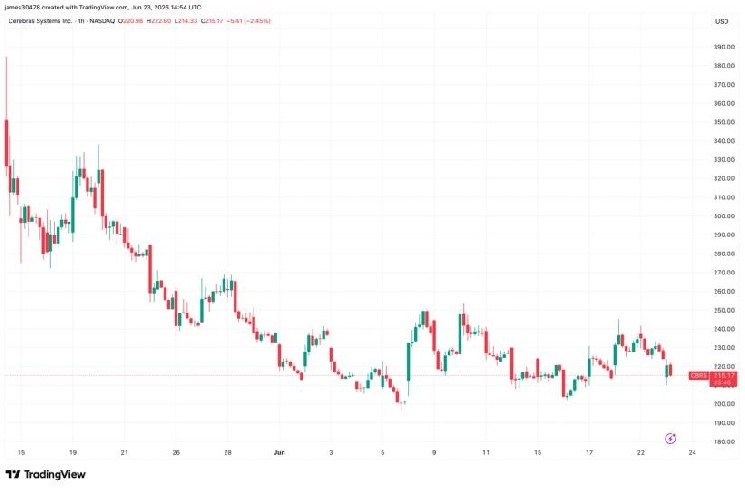
This sudden market correction marks yet another dramatic chapter in the brief and highly publicized market life of CBRS stock, which has captured the imagination of retail traders and institutional portfolios alike since its blockbusting public debut. Back in May, Cerebras successfully raised a staggering $6 billion in a highly sought-after initial public offering that price-targeted its entry at $185 per share, capitalizing on a wave of broader macroeconomic enthusiasm for artificial intelligence hardware plays. In the euphoric trading sessions that immediately followed the listing, intense speculative demand drove the stock price to a dizzying peak of $385 per share, representing a valuation that assumed flawless operational execution and rapid margin expansion for years to come. Yet, as the initial speculative gloss inevitably began to wear off, the stock began a steady retreat toward its fundamental baseline, a descent that was accelerated by the post-earnings sell-off which pushed the equity down toward the $201 mark. This ongoing stabilization process reflects a broader macro-trend where the initial artificial intelligence hype cycle is giving way to sober, mathematically driven valuations, forcing high-growth tech companies to defend their multi-billion-dollar market caps through earnings consistency rather than visionary narratives.
Navigating the Chip Wars: The Unique Architectural and Competitive Pressures Facing Cerebras
Underlying these fluctuating financial metrics is a deep-seated war for technological supremacy in the semiconductor space, where Cerebras is attempting to carve out a permanent niche in a domain currently dominated by Nvidia’s ubiquitous GPU architectures. Unlike traditional chipmakers that design small, modular silicon processors that are later stitched together on a circuit board, Cerebras’ flagship product is the Wafer-Scale Engine, a single, monolithic chip of unprecedented size designed to process vast AI models with minimal latency. While this radical design offers undeniable computational advantages in specific deep-learning workloads, it also presents monumental manufacturing, testing, and packaging challenges that directly impact production yields and manufacturing margins. Relying heavily on advanced, highly competitive foundry capacity at major factories like TSMC, Cerebras must negotiate high silicon wafer costs while absorbing the financial penalties of any manufacturing defects on such a massive scale. As competitors like Nvidia, AMD, and custom silicon initiatives from cloud giants like Google and Amazon squeeze the global supply chain, Cerebras faces rising input costs and pricing pressures that make maintaining steady, high gross margins an uphill operational battle.
Bridging the Gap: What Lies Ahead for Cerebras and the Broader AI Infrastructure Sector
As the dust settles on this initial earnings disruption, the road ahead for Cerebras Systems will be defined by its ability to resolve this margin volatility and prove that its wafer-scale architecture can scale economically as well as computationally. To restore investor confidence and drive its stock back toward previous heights, the company’s leadership must demonstrate that the projected margin dip in the second quarter is a temporary bottleneck caused by one-off supply chain investments or product mix shifts, rather than a systemic flaw in its manufacturing model. For long-term investors, the current pullback may represent a healthier, more grounded entry point into a pioneer that possess truly disruptive technology, provided the company can successfully optimize its production yields and diversify its revenue stream beyond a select few high-profile cloud clients. Ultimately, Cerebras’ post-IPO journey serves as a highly visible bellwether for the entire artificial intelligence infrastructure ecosystem, highlighting that while the global appetite for raw, accelerated computing power remains insatiable, the public markets will inevitably hold even the most innovative silicon designers to the timeless accounting standards of unit economics, margin stability, and eventual profitability.