


Crypto Traders Bet Unitree Robotics Will Be Worth $38 Billion Before Its Stock Even Starts Trading
Betting Big Before the Bell
The opening bell hasn’t rung for Unitree Robotics, but a new kind of trading floor has already made its judgment known. On Hyperliquid, a leading decentralized crypto derivatives platform, traders are pricing Unitree’s future shares at roughly $38 billion — more than four times the valuation implied by the company’s initial public offering on Shanghai’s STAR Market. The trades have become a defining story for a company that investors see as one of China’s most exciting robotics plays. Blockchain analytics firm Allium captured the moment in a report Friday, noting that pre-IPO perpetual contracts on Hyperliquid had traded between $92 and $94. Unitree, meanwhile, set its IPO price at 150.80 yuan, or $22.37, which values the Hangzhou-based robot maker at around $9 billion. The gap between those two numbers is not a rounding error. It is a massive bet on a young company that has captured the imagination of retail investors, blockchain traders and technology enthusiasts alike. In a market where the public listing hasn’t even started, crypto traders have already decided that Unitree deserves one of the most valuable robotics valuations on the planet. This is more than a speculative sideshow; it is a signal that the crypto market has begun to play a real role in setting expectations for the hottest public offerings in the technology world.
A Valuation Gap That Defies Gravity
To understand what drives that kind of confidence, look at the arithmetic. At the official IPO price, Unitree’s market capitalization is about $9 billion. But on Hyperliquid, the perpetual contracts — a type of futures-like derivative with no expiration date — imply a value closer to $38 billion. That’s a difference of nearly $29 billion before any actual public trade has taken place. For context, a $38 billion valuation would put Unitree in a price-to-sales range of approximately 150 times the $253 million in revenue it reported for its most recent fiscal year. That is the kind of multiple usually reserved for companies with massive, proven cash flows or near-monopoly positions in a market with clear long-term visibility. Unitree, despite its fast growth, is still a would-be industrial supplier in a sector that has yet to scale across the global economy. The premium implies that public-market investors will be ready to pay up immediately when trading begins. It also suggests that the limited share float and the frenzy around humanoid robotics could create a dynamic similar to other recent red-hot technology IPOs: a first-day surge that pushes the stock well above the offering price. Because the contracts trade around the clock, they reflect a global, real-time opinion, not just the mood of Chinese retail investors during exchange hours. Whether that opinion is correct, however, is far from certain. Crypto markets have a history of getting ahead of fundamentals, and perpetual contracts can be moved by participants who have no intention of ever owning the underlying shares.
The Startup Behind the Speculation
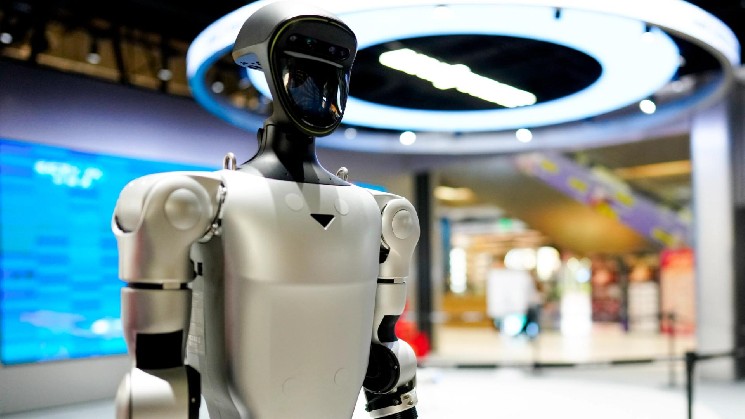
Unitree is not a company that came from nowhere. Founded in Hangzhou in 2016, it has spent the better part of a decade building robots designed for research, industrial, and consumer applications. Its lineup ranges from agile four-legged machines to humanoid robots built to operate in environments made for human beings. The company’s sales are growing at a pace that would be the envy of almost any technology startup: last year, revenue climbed 335% to $253 million, and shipments of humanoid robots surpassed 5,500 units. Those are not just impressive numbers; they place Unitree at the center of a broader race to commercialize humanoid robots. While competitors like Tesla, Boston Dynamics and several fast-moving Chinese startups are also working on mass-produced humanoid machines, Unitree has managed to combine engineering attention with a surprisingly rapid path to production. It is this combination that appears to have captured the attention of crypto traders. They are not betting on a concept alone; they are betting on a company that is already selling a meaningful number of robots. Still, in a market where patience is often in short supply, the potential perils are easy to see. Robotics is a capital-intensive business, profit margins can remain thin, and consumer robots still inhabit a relatively small niche. A valuation of $38 billion assumes not just that Unitree will continue to grow, but that the global market for humanoid robots will expand dramatically in the years ahead. That is a bold assumption, and the crypto market is putting a very large number behind it.
An IPO Frenzy With Retail at Full Throttle
The enthusiasm around the IPO itself has been just as intense. According to reports, Unitree’s offering was 8,000 times oversubscribed by retail traders — a number that is almost impossible to grasp outside the context of China’s retail-dominated markets, where larger-than-life listings are a recurring theme. The STAR Market, officially known as Shanghai’s Science and Technology Innovation Board, has become a magnet for technology listings and retail speculation. It is the kind of venue where a well-known company can debut with a dramatic jump, especially when demand vastly exceeds the available supply of shares. Trading in Unitree is expected to begin between August 17 and August 21, and the anticipation has drawn attention from global investors as well. In a normal IPO, the issue price is the starting point for negotiation; in China, the first day often becomes a spectacle of momentum trading. That dynamic is likely to be especially pronounced in Unitree’s case. The 8,000-times-oversubscribed figure suggests that tens of millions of investors would like to own a piece of the company. Since the IPO allocation process means many of them will receive only a handful of shares, they may try to buy more once trading starts. This could place upward pressure on the stock in the initial days, potentially pushing it closer to where the crypto contracts are trading. But it also means the stock may be exposed to sharp reversals if investors decide that the price has moved too far, too fast. In a market where hype and liquidity often ride in the same car, the road ahead is anything but smooth.
Pre-IPO Perps: Crypto’s Newest Bridge to Wall Street
Unitree’s listing is also a key moment for the niche market of pre-IPO perpetual futures, often referred to as “pre-IPO perps.” These products are exactly what they sound like: perpetual futures tied to a company’s expected stock price before the company goes public. They are traded on decentralized platforms such as Hyperliquid, which allow users to open leveraged bets without needing a traditional broker or clearing house. Unlike conventional futures contracts, perpetuals have no expiration date; traders can hold them for as long as they wish, as long as they maintain sufficient margin. This makes them a flexible, if highly volatile, instrument for speculating on a future listing. Allium’s report highlights how quickly this segment of the crypto derivatives market has expanded. It is driven by demand from investors who want to participate in hot IPOs before the stock exchange opening bell. In the past, pre-IPO investing was reserved for institutional funds, private equity backers and a small circle of well-connected investors. Now, anyone with a crypto wallet can take a position on companies like Unitree, expressing a view on valuation long before the official market does. That innovation comes with real risks. There are no official disclosures tied to the token price, no exchange-mandated price limits, and often very little liquidity. In a contract where sentiment can shift at any moment, a trader can be liquidated in seconds. But for a growing group of market participants, the trade-off is acceptable. They are willing to live with risk in exchange for the chance to get in early.
A High-Stakes Test for a New Market
The next few days will be a high-stakes test not only for Unitree, but for the entire pre-IPO perp experiment. If Unitree opens near the level implied by Hyperliquid traders, the contracts will have demonstrated that crypto markets can serve as a legitimate tool for price discovery in the equity world. If the stock opens closer to its IPO valuation, or somewhere in between, the bet will be reduced to a wild, after-the-fact story about a robot darling and an overly eager blockchain marketplace. Either outcome is possible. Crypto trading, especially with derivatives, is notoriously fickle. But Unitree’s case suggests that a new layer of financial infrastructure is forming around the most sought-after public listings, and it is not going away. The company itself has reason to welcome the attention, even if it cannot control the narratives playing out in crypto chat rooms. A strong opening would raise its profile, solidify its position in the global robotics race, and potentially unlock more capital for its growth plans. But the enormous hype also increases the risk of a letdown. The same innovation that allows traders to price a stock before it exists can also allow them to abandon it just as quickly. When the first trade hits the tape on Shanghai’s STAR Market, the question will no longer be whether crypto traders were bold. The question will be whether they were right. Until then, the pre-IPO market is a waiting game, and Unitree is at the center of it.