






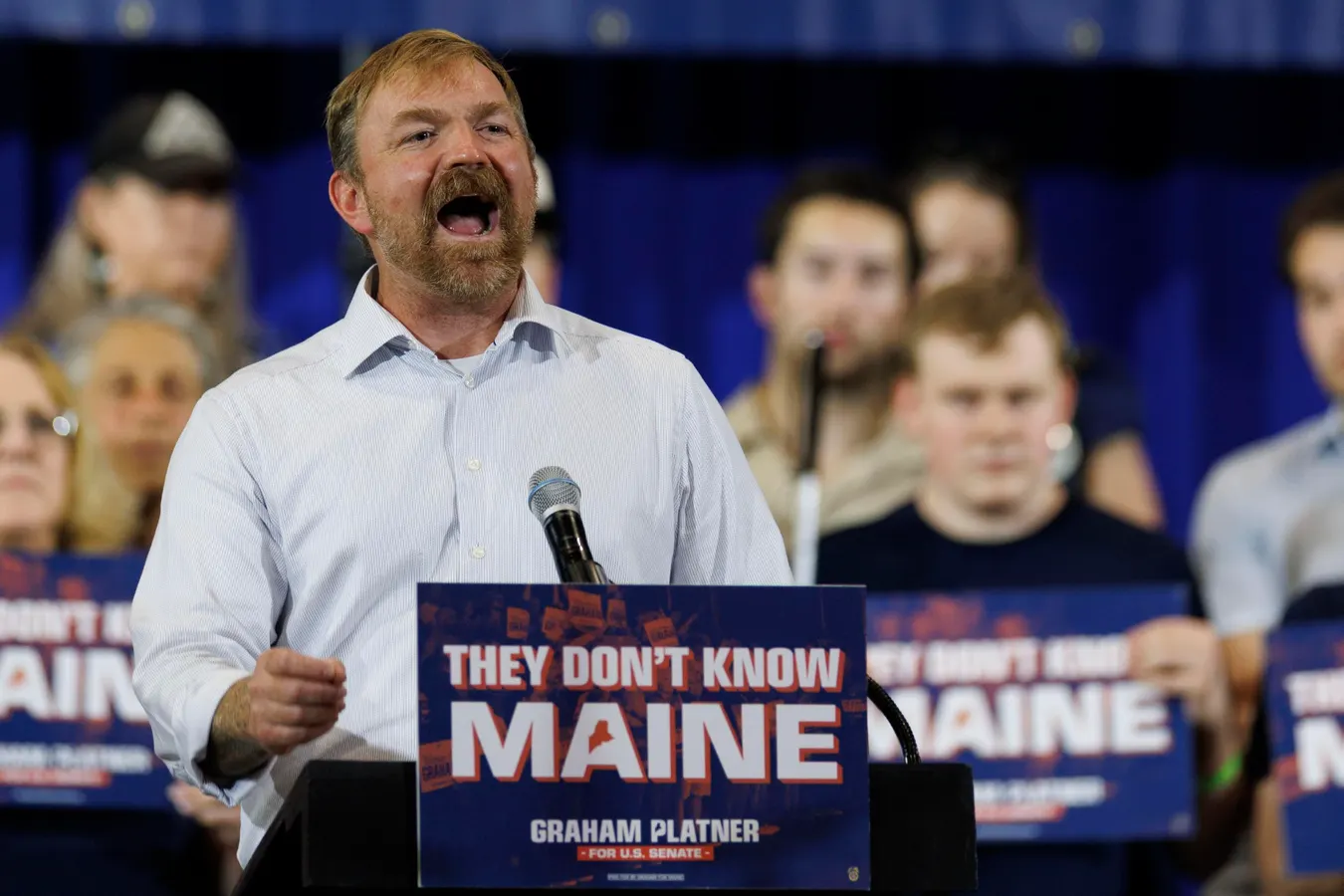
In a deeply earnest video broadcasted to the social media platform X in April, Democratic Senate candidate Graham Platner extended a heartfelt message of gratitude to his grassroots supporters, specifically highlighting the small-dollar donors who helped him outraise his opponents in the critical first quarter of 2026. The populist Marine Corps veteran spoke directly to the everyday trials of ordinary working Americans, noting with somber empathy that many of the individuals contributing to his campaign would genuinely miss the money they had so generously sent to his organization. For people who spend their days tirelessly laboring just to make ends meet, Platner observed, every spare dollar is a significant sacrifice that could have gone toward basic necessities like groceries, utilities, or rent. This message struck a powerful chord, casting Platner as a down-to-earth champion of the working class whose primary crusade is to dismantle the corrupting influence of astronomical wealth in the halls of Congress, a mission summarized in his bold, frequent promises to completely ban billionaires from buying American elections. However, beneath this compelling narrative of grassroots resistance lies a fascinating irony that defines the modern political landscape. While Platner’s public relations team proudly trumpets the fact that his average contribution is a modest twenty-six dollars compiled from nearly every zip code across the state of Maine, official campaign finance reports paint a vastly more complicated picture of his financial foundation. These federal filings reveal that despite his fiery rhetoric against the ultra-wealthy, at least five of the nation’s most prominent billionaires have quietly stepped forward to financially back his campaign. Though these wealthy patrons may not feel the pinch of their contributions in the way Platner’s struggling working-class supporters do, their presence in his donor ledger highlights a persistent truth of modern American politics: even the most vocal anti-establishment populists often find themselves relying on the very financial elite they vow to defeat.
To understand how these ultra-wealthy benefactors are engaging with Platner’s populist campaign, one must examine the strict regulatory architecture of American campaign finance. Unlike his major opponent, the long-serving incumbent Republican Senator Susan Collins, Platner does not have a dedicated, unlimited-spending super political action committee (PAC) working in parallel with his official campaign team. Consequently, his financial strategy is tied directly to his primary candidate committee, forcing his billionaire backers to navigate the rigid constraints set by the Federal Election Commission (FEC), which caps direct individual campaign donations at seven thousand dollars per election cycle. While this legal limit forces these extraordinarily wealthy individuals to contribute what are, for them, mere pocket-change sums, billionaire backing remains a potent political signal and a substantial source of early capital, even when government regulations force that money to “travel coach” rather than through the luxury of dark-money avenues. These high-net-worth endorsements began to coalesce around Platner in earnest after April 30, when his formidable primary rival, Maine Governor Janet Mills, abruptly withdrew from the race, clearing a smooth path for the veteran to secure the Democratic nomination. Prior to this consolidation, the race was a fractured, highly competitive affair, but Mills’ exit instantly transformed Platner into the consensus candidate for the national Democratic establishment. This consolidated support has allowed Platner’s direct campaign committee to remarkably outraise Senator Collins’s primary committee by more than one million dollars since fundraising efforts commenced last year. Yet, this direct fundraising advantage must be weighed against the massive shadow cast by Collins’s dedicated, billionaire-backed super PAC, Pine Tree Results. Supported by multi-million-dollar injections from financial titans like Blackstone founder Stephen Schwarzman and Citadel CEO Ken Griffin, Collins’s external network represents an incredibly well-funded counterweight, demonstrating why Platner’s campaign, despite its populist ethos, eagerly accepts every drop of financial support it can legally extract from friendly billionaires.
Beyond the complex financial chess match, Graham Platner’s candidacy presents a fascinating study in human contradiction, marked by a compelling personal history that is as controversial as it is magnetic. As a battle-tested Marine Corps veteran, Platner possesses a rugged, authentic appeal that resonates deeply with Maine’s independent-minded electorate, who often favor leaders with real-world service over career politicians. However, his rise to prominence has not been an easy, unblemished march; rather, it has been heavily shadowed by several deeply personal controversies that have threatened to derail his political aspirations. Investigative reports from multiple media outlets have unearthed past indiscretions, revealing that during the fragile, formative early years of his marriage, Platner engaged in exchanging sexually explicit messages with other women outside his relationship. These revelations forced him to address private marital shortcomings on a highly public stage, testing his resilience and forcing voters to weigh his personal ethics against his policy goals. Adding to his public relations challenges is a highly visible, provocative skull-and-crossbones tattoo emblazoned on his body, which critics note bears a striking, highly uncomfortable resemblance to the infamous German Totenkopf, a symbol deeply associated with Nazi military units. Platner has vehemently defended himself against accusations of extremist sympathies, arguing with frustration that he was entirely ignorant of the history and dark connotations of the emblem when he originally chose to get the ink, viewing it merely as a traditional military or maritime symbol of mortality. These vulnerabilities have humanized Platner in an unexpected way, transforming him from a polished political caricature into a flawed, fallible individual who is openly reckoning with his past mistakes. As the general election approaches, his ability to survive these continuous cultural and moral scrutinies will depend heavily on whether voters view him as a fundamentally decent man who has learned from his youth, or as a compromised figure unfit for the high office he seeks.
Among the financial giants backing Platner’s campaign, few names trigger as much intense political debate as George Soros, the iconic, Hungarian-born hedge fund tycoon whose vast fortune of seven and a half billion dollars was famously cemented when he yielded billions in windfall profits by shorting the British pound in 1992. Soros has spent decades using his immense wealth to shape global and domestic politics, donating hundreds of millions of dollars to progressive causes and committing a staggering eighteen billion dollars to his global philanthropy network, the Open Society Foundations, in 2017 alone. For Platner’s campaign, the elder Soros maxed out his physical contribution cap by donating seven thousand dollars, a gesture mirrored by his son and the current chairman of the Open Society Foundations, Alexander Soros, who also contributed seven thousand dollars, signaling the family’s unified support for Platner’s progressive Senate bid. Joining the Soros family in backing the populist veteran is another fascinating figure from the upper echelons of American wealth: Jennifer Pritzker, a retired Army lieutenant colonel and the founder of the Chicago-based investment firm Tawani Enterprises. Pritzker, who possesses a personal net worth of nearly three billion dollars, belongs to the legendary Pritzker dynasty, a family of thirteen billionaires that includes Illinois’s prominent Democratic Governor, J.B. Pritzker. A lifelong conservative who initially donated hundreds of thousands of dollars to Donald Trump’s historic 2016 presidential campaign, Jennifer Pritzker experienced a profound political realignment in 2017, breaking sharply with the Republican president over his controversial ban on transgender individuals serving in the United States military, a decision deeply personal to Pritzker, who is herself transgender. Her transition toward supporting progressive platforms led her to invest heavily in VoteVets, a prominent hybrid PAC dedicated to electing Democratic military veterans, and ultimately to her personally cutting two separate thirty-five hundred dollar checks to Platner’s campaign committee on May 28, solidifying her commitment to placing a fellow veteran in the Senate.
The diverse coalition of billionaire donors supporting Platner also includes Christy Walton, whose massive twenty-two point seven billion dollar fortune was inherited following the tragic death of her husband, Walmart heir John Walton, in an airplane crash in 2005. In the years since that personal tragedy, Christy Walton has emerged as an incredibly influential, independent-minded political donor, actively opposing the populist rise of Donald Trump by becoming one of the most generous and consistent financial champions of the Lincoln Project, an anti-Trump organization run by former Republican strategists. Her support for Platner manifested early on March 23, when she committed seven thousand dollars to his campaign well before Janet Mills withdrew from the race, demonstrating her early faith in his competitive viability. Parallel to Walton’s contributions are those from the prominent Stryker sibling duo, heirs to the multi-billion-dollar medical equipment manufacturing empire, Stryker Corporation, which was originally established by their grandfather. Pat Stryker, who boasts a net worth of over three billion dollars, contributed seven thousand dollars to Platner, alongside her immense historical giving of over two hundred and twenty-five million dollars to philanthropic causes through her civic-minded Bohemian Foundation. Her brother, Jon Stryker, who holds a net worth exceeding five billion dollars, donated five thousand dollars to the Platner campaign, adding to his lifetime philanthropic portfolio of over seven hundred million dollars, much of which has gone to his Arcus Foundation to champion LGBTQ rights and great ape conservation. Finally, the list of elite supporters is rounded out by Marsha Laufer, who is married to Henry Laufer, the brilliant former chief scientist of the legendary quantitative trading hedge fund, Renaissance Technologies. The Laufer family, who hold a net worth of over three billion dollars, were among the most prominent financial architects of Kamala Harris’s 2024 presidential campaign, and Marsha Laufer’s thousand-dollar donation to Platner further underscores his credibility among elite Democratic political donors across the country.
As the intense heat of the November general election approaches, the financial strategies of both campaigns highlight the deeply entrenched paradoxes of modern American democracy. Graham Platner’s political identity rests squarely on his image as an authentic, self-made Marine veteran fighting for the disenfranchised citizens of Maine, a message that is explicitly designed to contrast with the corporate-backed, establishment reputation of Senator Susan Collins. Yet, as the fundraising documents clearly show, the sheer scale of modern campaign costs makes it nearly impossible for any major-party candidate to survive solely on twenty-six-dollar donations, no matter how passionate or widespread those grassroots contributors might be. To build a campaign infrastructure capable of resisting the onslaught of Collins’s elite-backed super PAC, Pine Tree Results, Platner’s team has had to quietly welcome the maximum legal contributions from some of the nation’s wealthiest individuals, creating an uncomfortable ideological tension for a candidate who publicly advocates for banning billionaires from political influence. This pragmatic compromise underscores the ruthless realism required to win high-stakes Senate seats in an era where elections cost hundreds of millions of dollars. Ultimately, the voters of Maine will have to decide whether this apparent contradiction undermines Platner’s anti-establishment credibility, or if it simply represents a necessary, tactical alignment to fight fire with fire on an uneven playing field. As the race enters its final, frantic stretch, the steady stream of elite capital blending with grassroots small-dollar sacrifices will continue to define this crucial battleground, serving as a vivid case study of a candidate trying to dismantle the current political system by utilizing the very financial tools and elites that have come to dominate it.