



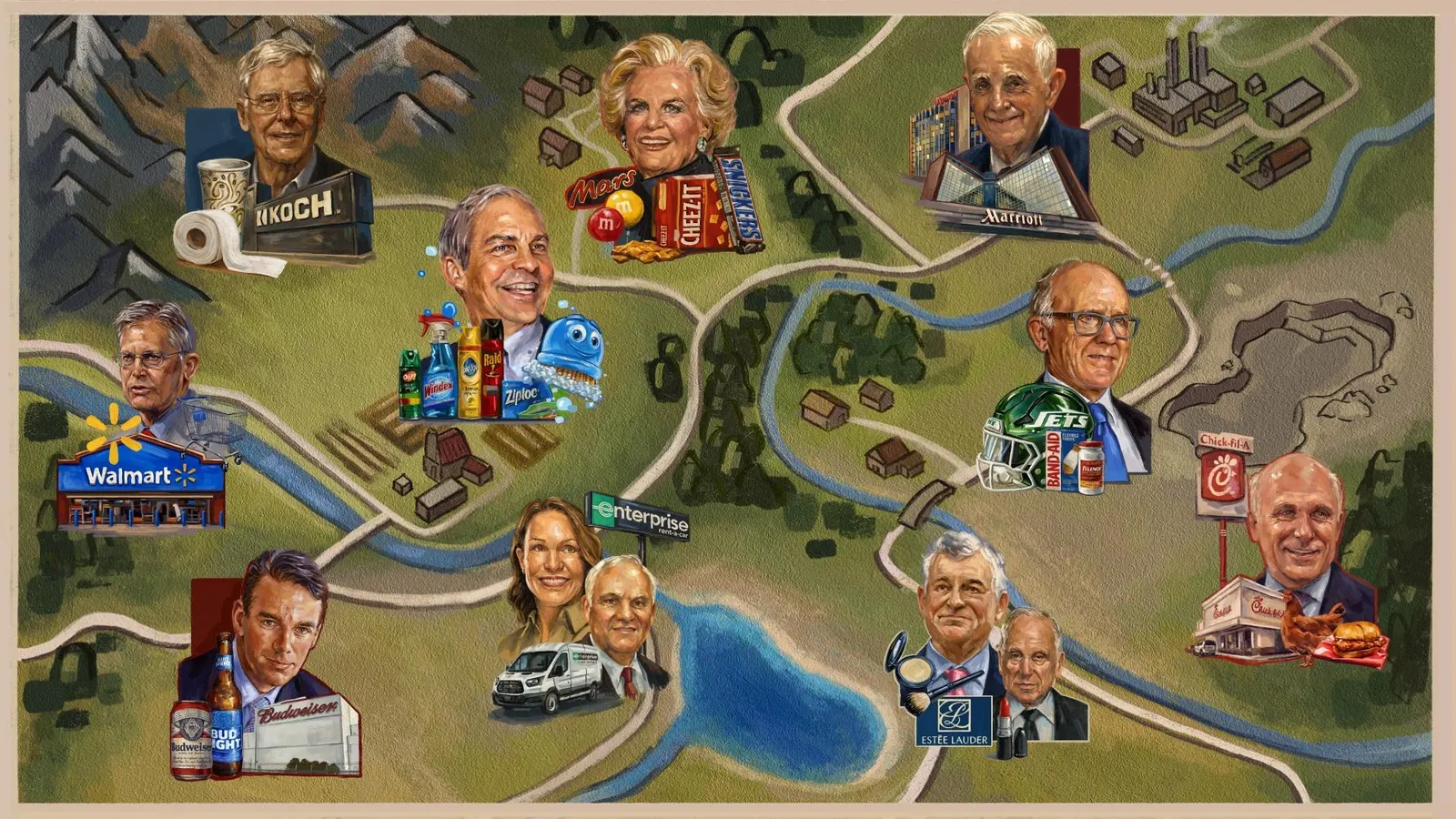
As the United States approaches its historic semiquincentennial—marking two and a half centuries of independence, evolution, and relentless ambition—there is a unique opportunity to look beyond the political architects of the nation and celebrate a different kind of pioneering spirit. Alongside the traditional founding fathers, America has been profoundly shaped by its commercial creators: the visionary entrepreneurs whose early, often risky start-up ventures laid the groundwork for the most massive family fortunes in history. These business dynasties reflect the shifting sands of American industry across generations. On one end of the spectrum is the Du Pont family, the oldest dynasty on the list, whose chemistry powerhouse began back in 1802 as a humble gunpowder mill on the banks of the Brandywine River. Today, spanning an incredible nine generations and boasting a joint fortune of $22 billion, their name is synonymous with corporate endurance. On the other end are modern titans like the Hughes family of Public Storage, who are currently navigating their third generation of leadership with a $14.7 billion real estate empire. What makes these families unique is not simply the sheer volume of their bank accounts, but the complex, often fragile human art of keeping a business alive and aligned through decades of cultural, technological, and familial transitions, transforming a simple commercial idea into a multi-generational legacy.
The evolution of how we track and perceive individual and family prosperity tells a fascinating story about the changing scale of the American economy. Back in 1918, when Forbes first began systematically observing public and private fortunes, oil tycoon and future major philanthropist John D. Rockefeller was crowned as the world’s first and only billionaire, establishing a mythic gold standard for financial success. Over the years, tracking these fortunes evolved from documenting solo captains of industry to observing the deep-rooted family networks that inherited, managed, and expanded these massive legacies. When Forbes initiated its first official ranking of the nation’s wealthiest clans in 2014, an aggregate family net worth of just $1 billion was enough to secure a spot. However, the last decade has seen an unprecedented, meteoric explosion in global wealth, driven by high-octane market forces and digital-scale opportunities. As a result, the cutoff for this prestigious multi-generational list has risen to a breathtaking $10 billion, officially ushering in the era of the “decabillionaire.” This massive financial threshold shift means that even storied dynasties like the Rockefellers—now in their seventh generation and tied for 45th place with a massive $12.5 billion fortune—find themselves navigating a list dominated by ballooning corporate empires.
At the absolute peak of this towering mountain of wealth sits the Walton family, whose retail dominion continues to defy expectations and break global records. As America’s richest family since tracking began, the descendants of Walmart founders Sam and Bud Walton have watched their collective fortune skyrocket to an unimaginable $520 billion—marking a mind-boggling increase of $253 billion in just two years, fueled by a spectacular 117% surge in the retail giant’s stock price. To put this in perspective, if the famously modest, pickup-truck-driving Sam Walton were alive today, his personal net worth would easily make him the second-richest person on earth, trailing only Elon Musk. Behind the Waltons, the landscape of twelve-figure dynasties remains incredibly exclusive, with only two other families claiming membership. The industrial Koch family, led by 90-year-old chairman Charles Koch, secured the second spot with a fortune climbing to $157 billion, swapping ranks with the Mars candy, snack, and pet food dynasty, who landed at number three with a still-staggering $129 billion net worth. These three colossal empires serve as a testament to the persistent power of fundamental American industries: feeding daily cravings, supplying household essentials, and fueling the physical infrastructure of the nation.
While the peak of the list remains stable, the lower ranks are characterized by a lively, sometimes brutal cycle of newcomers and departures that reflects the volatility of the modern marketplace. The ranking welcomed ten remarkable new families into the decabillionaire club, showcasing the diverse avenues of modern wealth creation. Leading the new charge is the Mills family, the masterminds behind medical supply giant Medline, who debuted with a massive $29.6 billion following 2025’s largest and most successful IPO. They are joined by the heirs of the late computer pioneer and political iconoclast Ross Perot Sr., whose family ranks at $12.8 billion, the Richards family of Georgia-based cable manufacturer Southwire at $13.1 billion, and the Lockton family of Kansas City, who built a $10 billion insurance powerhouse. But the market gives and the market takes away; the Chao family of Westlake Corporation dropped off the list entirely as their public holdings dipped to $9.3 billion. Meanwhile, the Brown family, makers of Jack Daniel’s, saw their fortune shrink by $5.8 billion, landing at $10.7 billion. Even sports royalty felt the sting of financial reality: despite the Dolan family’s beloved New York Knicks finally ending a devastating 53-year basketball championship drought on the court, their family fortune ultimately missed the strict new $10 billion cutoff.
It is easy to get lost in the dizzying array of billions and trillions, but the true impact of these decabillionaire clans is felt in the familiar rhythm of everyday American life. Geographically dispersed across 25 states, these families have built businesses that are deeply woven into the physical and cultural landscape of the country, stretching from Boise to Portland. While New York City remains the premier playground for the ultra-wealthy—serving as the home base for seven of these elite families, including the $21.8 billion Hearst media dynasty—cities like Atlanta and Chicago are close behind with four each. Far from being isolated icons of high finance, these families are responsible for the products we touch, eat, and use daily. Whether it is enjoying a bag of M&M’s, eating a Chick-fil-A sandwich on a road trip, cleaning a window with Windex, calling Orkin to handle a household pest, or spending a Sunday afternoon cheering on the Kansas City Chiefs or the Tampa Bay Buccaneers, ordinary citizens are constantly participating in the legacy of these extraordinary families, proving that these private fortunes are built on the foundations of shared public habits.
Ultimately, capturing the true magnitude of these deep-rooted fortunes requires a meticulous analytical approach that balances hard market realities with family genealogy. In drafting this definitive ranking, Forbes purposefully excluded individual self-made billionaires who hold their wealth entirely alone, choosing instead to focus on the complex, collaborative web of multi-generational kinship. By tracking lineage down to the youngest descendants, including minors, and valuing public assets based on modern market closing prices, the data reveals a collective net worth of $1.9 trillion among these 54 families—an astonishing increase of nearly $600 billion in just two short years. This figure is more than a simple metric of economic success; it is a reflection of how legacy is preserved, managed, and passed down through generations. As these dynasties look toward the future, their ongoing challenge will not just be the preservation of their capital, but the heavy responsibility of navigating their social, philanthropic, and economic influence in a rapidly changing world, ensuring that the dreams of their ancestors continue to leave a constructive, human mark on the fabric of the nation.