


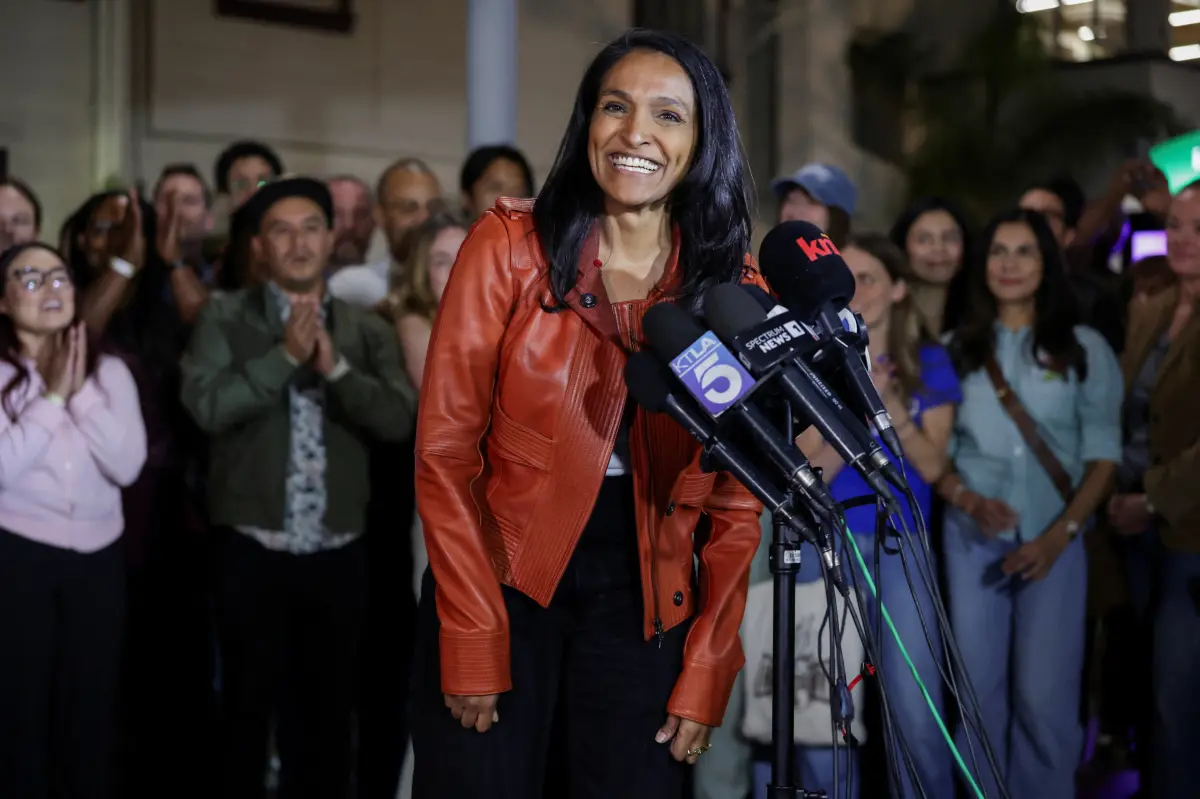
There was something fitting about Nithya Raman’s final address to the Los Angeles City Council on Tuesday. The mayor-elect did not deliver a polished victory lap or a sanitized farewell. Instead, she stood at the same council floor where she had spent six years pushing, arguing, sometimes losing, and occasionally winning, and she promised her colleagues that she would keep being difficult when it mattered. “Just because I’m down the hall doesn’t mean I’m gonna forget how to do that work,” Raman said, her voice carrying a mix of warmth, defiance, and humor. “And so I’m here to be spicy with you and to get through it and to find the outcome that works for all of us.” The 45-year-old former urban planner reflected on a tenure that transformed her from an outsider candidate into the city’s next mayor. She will assume office on December 14, and she will technically remain on the council until midnight on December 13, when her District 4 seat becomes vacant. But her emotional goodbye was less about procedure and more about repairing relationships in a room where most of the people seated around her had not supported her campaign.
Raman’s speech was notable because it openly acknowledged the tension in the room. She had just pulled off one of the most stunning election upsets in modern Los Angeles history, defeating Karen Bass despite entering the race at the last minute and failing to secure a single endorsement from her fourteen council colleagues. The returns released Monday showed her lead at 104,240 votes, with Raman capturing 603,631 votes, or 54.7 percent, compared with Bass’s 499,391 votes, or 45.3 percent. It was a decisive victory, but also a lonely one; almost every institutional force in City Hall had lined up behind her opponent. Rather than pretending the fight had not happened, Raman extended an olive branch. “We all came to this from different pathways and from different perspectives, but we are all here because we love LA and we wanna make it better,” she told the council. She promised to visit neighborhoods alongside councilmembers, to listen to their constituents’ concerns, and to help them navigate the maze of City Hall bureaucracy. “In me, you will have something that not every mayor has, a partner who understands what it means to be a councilmember,” she said. It was a carefully calibrated plea for collaboration, and it suggested that Raman understands the difference between running against the establishment and governing with it.
Raman will inherit a city that remains in the grip of a homelessness crisis. The latest count recorded 45,194 unhoused residents, including 29,115 living without any shelter. During the campaign, Raman pledged to cut street homelessness in half by the time Los Angeles hosts the 2028 Olympics, an ambition as audacious as it is politically risky. She repeatedly criticized Bass’s signature Inside Safe program, questioning both its spending and its effectiveness. Yet on Tuesday she signaled that some version of the initiative would continue under her administration, albeit reworked, as she focuses on filling vacant shelter beds across the city and developing a plan that can deliver real results. The shift acknowledges a fundamental reality: there is no clean break from existing strategies, only a chance to improve them. At the same time, Raman’s own council record on homelessness and housing is more complicated than her campaign rhetoric suggested. She championed tenant protections and alternatives to traditional policing, while repeatedly opposing expansions of Municipal Code 41.18, the city’s rule restricting encampments in designated public spaces. To her supporters, these positions reflected a commitment to civil liberties and long-term solutions. To her critics, they made her an obstacle to clearing unsafe encampments. A review of council voting records from December 2020 through October 2, 2026 found that she missed 2,982 of 21,562 recorded votes, roughly 13.8 percent. The absences did not necessarily mean she was absent from the work—council members miss votes for many reasons, from illness to constituent emergencies—but the number offered ammunition to opponents who questioned her attention to detail.
Perhaps the most delicate relationship Raman must manage is with Council President Marqueece Harris-Dawson, a Bass ally who removed Raman from her leadership position on the council’s homelessness committee during the campaign. It was a pointed rebuke, and many expected it to leave lasting damage. But Harris-Dawson insisted Tuesday that the campaign was just one season in a longer working relationship. “That campaign was nine months. We’ve worked together for six years,” he said. “I don’t have any doubt, and I don’t think she has any doubt that we’re gonna be able to work together.” He also confirmed that he intends to remain council president, meaning Raman will need his cooperation to move her agenda through the legislative branch. Behind the personal relationship, though, stands a broader ideological divide. Raman enters the mayor’s office with the backing of the Democratic Socialists of America, an organization whose positions on policing, housing, and the Israeli-Palestinian conflict have made her a lightning rod. During the campaign, she sparked a fierce battle by pledging to replace LAPD Chief Jim McDonnell before his term expires in 2030. Police union leaders and even some moderate Democrats condemned the promise. At a press conference the day after her victory, Raman declined to provide a timeline for McDonnell’s removal, a carefully worded retreat that suggested she understands the political cost of picking a fight with law enforcement before she takes office. Still, the question will not go away, and how she handles it will shape her relationship with the city’s powerful police unions and with the progressive base that helped elect her.
Amid the political maneuvering, Raman also showed glimpses of the personal toll and personal joy of this transition. She has not decided whether to move into the Getty House, the official mayor’s residence, and she explained why: her twins are entering middle school, and she wants to preserve a sense of normalcy and peace in their neighborhood. The comment was a reminder that behind the public figure there is a parent trying to balance ambition with family. It also humanized a moment that is often all about power. She is not just inheriting a city and a staff; she is also making choices about where her children will wake up, what their commute will look like, and whether they can keep their friends and routines. Her departure will set off another political battle over who will succeed her in District 4. As her seat becomes vacant on December 13, a replacement will be selected by the council—a process that is never simple in Los Angeles. Harris-Dawson told reporters that nothing would be decided for at least a month, partly because of the council’s upcoming recess. That timing leaves Raman’s former district in a kind of limbo while the city absorbs the shock of a new mayor. Meanwhile, Raman’s council staff are still figuring out who will join her in the mayor’s office. According to reports, staffers said those decisions are still being worked out, meaning the transition is far from complete even as the inauguration approaches.
Raman’s rise has been marked by a series of improbable victories. In 2020, she entered City Hall by unseating incumbent Councilman David Ryu, a win that instantly made her a symbol of the city’s progressive turn. Six years later, she completed an even more dramatic ascent, defeating an incumbent mayor who once seemed untouchable. But the road ahead is steeper than any campaign. Los Angeles is still struggling with homelessness, economic inequality, and a housing crisis that no single mayor can solve. Raman’s promise to cut street homelessness in half by the 2028 Olympics is a deadline that will hang over her entire first term. Every decision she makes—about the police chief, about shelter sites, about tenant protections, about how to spend the city’s enormous budget—will be tested against that pledge. Her farewell speech was not a surrender to the political establishment. It was an invitation, with conditions. She made clear that she will still fight, still push, still be “spicy.” But she also acknowledged that governing requires more than winning elections. It requires building trust with people who did not vote for you, who did not believe in you, and who may still doubt you. In that sense, her address to the council was a preview of the mayor she hopes to become: someone who can hold a grudge and let go of it in the same breath, who can be both an activist and an executive, and who can find common ground without abandoning the principles that got her here. Whether that balancing act is possible in a city as vast and divided as Los Angeles is the central question of her mayoralty. For now, at least, she seems willing to try.