



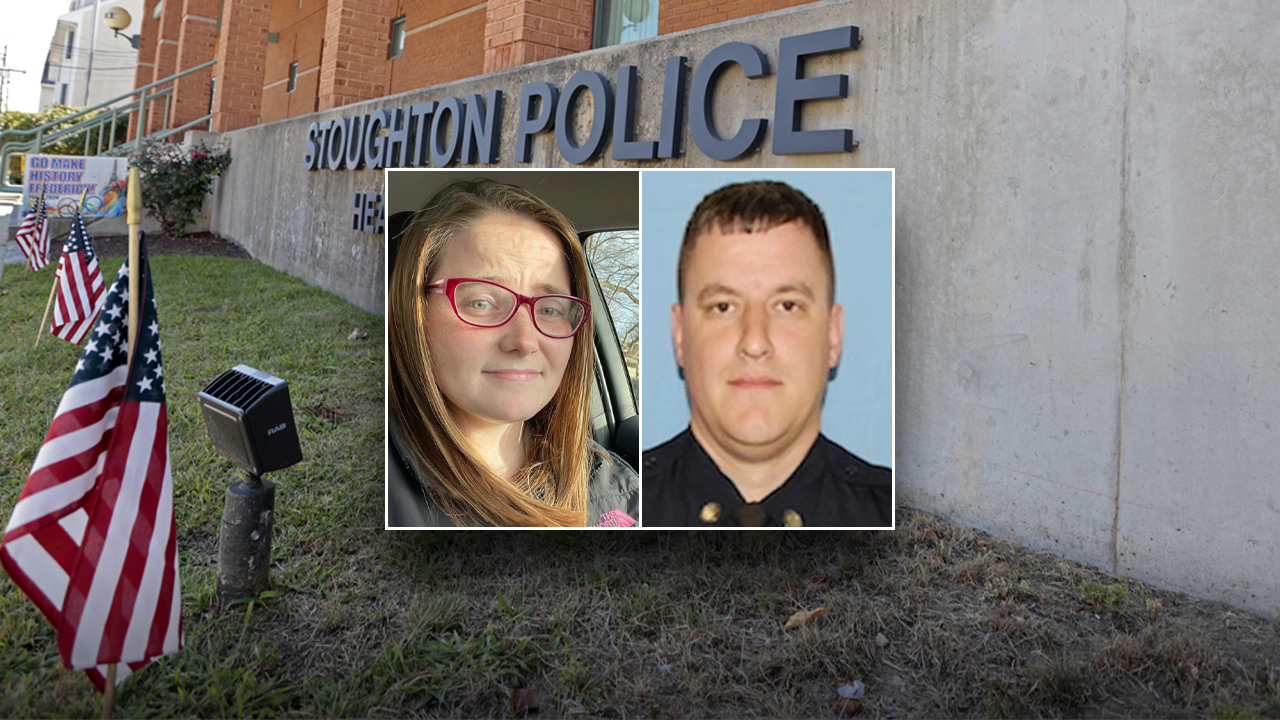
On a gray February morning in 2021, the quiet town of Canton, Massachusetts, was shaken by a loss that would take years to fully understand. Sandra Birchmore, a young woman with her entire life ahead of her, was found dead in her apartment, a strap around her neck, the scene arranged to suggest she had taken her own life. For a time, that is exactly what officials believed. But the truth, as it so often does in cases of hidden cruelty, was far darker and more deliberate. A former police detective, a man sworn to protect the vulnerable, was accused of taking her life — and the life of the unborn child she carried. After weeks of testimony and days of agonizing deliberation, a federal jury finally delivered the answer Sandra’s family had waited so long to hear: Matthew Farwell, once a respected member of the Stoughton Police Department, was guilty of murder. The verdict was not merely a legal conclusion; it was an acknowledgment that a young woman was not broken by her own demons, but destroyed by someone who knew exactly how to manipulate, control, and ultimately silence her.
To truly understand the weight of this verdict, one must understand the relationship at the center of the case. Sandra Birchmore and Matthew Farwell were not two people who happened to meet as adults and embark on a secret affair. Their connection began when Sandra was just fifteen years old — a teenager, still in high school, still forming her sense of self, still trusting the adults around her. Farwell was twenty-seven at the time, a fully grown man and a police officer. He was not merely older; he occupied a position of authority and trust, the very kind of figure a young person might look to for safety and guidance. Instead, prosecutors argued, he used that position to groom her, slowly and methodically building a relationship that would eventually become deeply sexual and profoundly damaging. By the time Sandra was an adult, the damage was already done. The power imbalance had been baked into the foundation of their connection from the very beginning. Farwell was married. Sandra was alone, isolated, and looking for meaning. He gave her attention, affection, and a secret world that belonged only to them. But secrets have a way of becoming cages, and when Sandra became pregnant, the dynamic shifted. She had something that could threaten everything he had built — his career, his marriage, his reputation. And according to prosecutors, that is precisely when the relationship turned deadly.
The evidence that emerged after Sandra’s death painted a disturbing picture of obsession and fear. When federal investigators reopened the case, they uncovered approximately forty thousand text messages exchanged between Sandra and Farwell over the course of their relationship. Forty thousand text messages is not a casual correspondence. It is the digital trail of a relationship that was consuming, constant, and hidden. Those messages became the backbone of the prosecution’s case, revealing the intimacy, the manipulation, and ultimately the desperation that marked their connection. Sandra, prosecutors said, had threatened to expose the relationship after learning she was pregnant. She was no longer willing to live in the shadows. She wanted something more — perhaps a commitment, perhaps simply accountability, perhaps the freedom to live her own life without hiding. Farwell, a man who had built his identity around being a protector, now faced the very real possibility of being exposed as a predator. The prosecution argued that he chose to eliminate the problem rather than face the consequences. On the day Sandra died, investigators believe Farwell went to her apartment, used his training to end her life, and staged the scene to look like suicide. He knew exactly how to make it look convincing. He was a detective. He had seen this kind of thing before. He knew what the early investigators would look for, and he made sure they found it.
The trial itself was a long and emotionally charged journey. For more than three weeks, jurors listened to testimony from medical experts, investigators, family members, and those who had known Sandra at different stages of her short life. They heard about her struggles and her triumphs, her hopes and her heartbreaks. They heard about the mental health challenges she had faced, which the defense would later emphasize, and about the moments when she seemed to be finding her footing. They also heard about Farwell — his career, his choices, his betrayal of the badge he wore. The prosecution painted him as a calculating former officer who feared Sandra more than he loved her, and who used the very skills he had developed as a detective to cover his tracks. The defense, meanwhile, tried to offer a different narrative. They argued that Sandra had died by suicide, pointing to her history of mental health struggles and statements she had made in the past. They acknowledged that she and Farwell had an extramarital relationship, but maintained that he had not been present when she died. They brought in a medical expert who disputed the prosecution’s claim that Sandra had been strangled. The courtroom became a battlefield of competing truths, and the jury was left to decide which version of events they believed. At one point, the deliberation seemed uncertain. On Monday, the jurors sent a note to the judge saying they were deadlocked, unable to reach a unanimous decision. The judge sent them home for the night, instructing them to return on Tuesday and try again. It was a moment of suspended breath, a reminder that justice is not always swift or certain. But when they returned, they found their way to the truth.
The defense’s argument was not without its emotional appeal. It is always painful to consider the possibility that someone took their own life, and the stigma of suicide remains a heavy burden for those left behind. Farwell’s attorneys leaned into that pain, suggesting that Sandra’s mental health struggles were the real culprit, that her past statements about self-harm were evidence of her fragile state. They acknowledged the affair but framed it as a mistake, a lapse in judgment, not the foundation of a murder. They urged the jury to see Farwell as a flawed man who had been unfairly blamed for a tragedy he did not cause. But the prosecution’s evidence was too powerful to ignore. The sheer volume of messages, the timing of events, the physical evidence at the scene, the shift in Sandra’s behavior in her final days — all of it pointed in a single direction. The medical examiner had changed the manner of death from suicide to undetermined, a quiet but monumental shift that opened the door for a deeper investigation. Federal investigators walked through that door and found a web of deceit that had been spun for years. The jury ultimately concluded that Farwell did not merely fail Sandra — he killed her. And because she was pregnant, he also caused the death of her unborn child, a life that had not yet begun and never would. The two charges carried a weight that matched the gravity of the disclosure: killing a witness or victim, and causing the death of an unborn child.
In the end, the verdict was a measure of justice, but no verdict can bring Sandra Birchmore back. She was a daughter, a friend, a young woman with a future that was stolen from her in the cruelest possible way. Her story is a cautionary tale about the danger of trusting those in power, and about how easily authority can be abused behind closed doors. Matthew Farwell will spend the rest of his life in prison. The mandatory sentence of life imprisonment without the possibility of parole is the only fitting outcome for a man who used his badge not to protect, but to prey. And yet, the tragedy of Sandra Birchmore extends beyond this one conviction. It is a reminder that grooming does not always come from strangers in the dark, but sometimes from those who are supposed to keep us safe. It is a reminder that a staged suicide can be the final act of an abuser who will do anything to escape accountability. It is a reminder that thirty-nine thousand messages of manipulation and control can look like love to a frightened teenager, and that the consequences of that confusion can last a lifetime. As Sandra’s family leaves the courtroom, they carry with them a verdict that validates their pain, but they also carry the absence of the young woman who should have been standing beside them, with a child in her arms and a world of possibilities ahead of her. Justice has been served, but the loss remains profound, and the hope is that her story will inspire others to look closer, listen harder, and never mistake the signs of abuse for something they are not.