


Airlines are placing a massive bet on the idea that travelers want more than just a seat from point A to point B—they want an experience. Across the industry, carriers are redesigning their cabins, overhauling menus, and pouring money into airport lounges, all in the hope that passengers will happily pay extra for something that feels special. The shift is already visible: airlines are adding roomier seats, hiring Michelin-starred chefs to create onboard dishes, and investing heavily in premium airport spaces. Some executives even predict that up to 70% of passengers will eventually choose some kind of enhanced travel option, even if they don’t spring for full first or business class. That change has big implications for the flying public. If airlines dedicate more space to premium products, there will likely be fewer standard economy seats on many flights, and the traditional divide between “regular” and “luxury” travel is becoming a spectrum of paid upgrades, from extra legroom to empty middle seats. Even with the recent spike in jet fuel costs tied to the war in Iran, airlines see premium travel as their best long-term path to profitability. The basic economics are simple, even if the flying experience no longer is.
The financial logic behind this premium push is hard to ignore. A business class seat takes up roughly the same floor space as four economy seats, but airlines can price it five or six times higher than a basic ticket. Volodymyr Bilotka, a professor at Purdue University who specializes in aviation economics, told AFP that airlines have traditionally invested heavily in premium offerings because the profit margins are significantly higher. That math has been showing up in airline earnings. American Airlines, for instance, reported that premium revenue climbed 18.5% year over year in its most recent quarter, four percentage points better than the main cabin. Company executives described that growth as a bright spot in a travel market complicated by rising fuel prices. American also revealed that premium products now generate roughly half of the company’s ticket revenue on about 30% of seats. In other words, a minority of passengers are paying for a majority of the revenue. Since 2020, the number of premium seats on U.S. flights has grown by 33%, which is more than double the growth of standard economy seats, according to travel news site Skift. United Airlines says it more than doubled its premium-seat capacity between 2015 and 2026, and the airline has no plans to slow down. Even the traditional distinction between first class, business class, and economy is blurring as airlines invent new tiers and micro-upgrades. Customers can now pay up to $200 for extra legroom, for the right to sit near the front of the plane, or simply to be among the first to step off the aircraft when it lands. These smaller add-ons may not sound glamorous, but they are becoming a crucial part of how airlines make money.
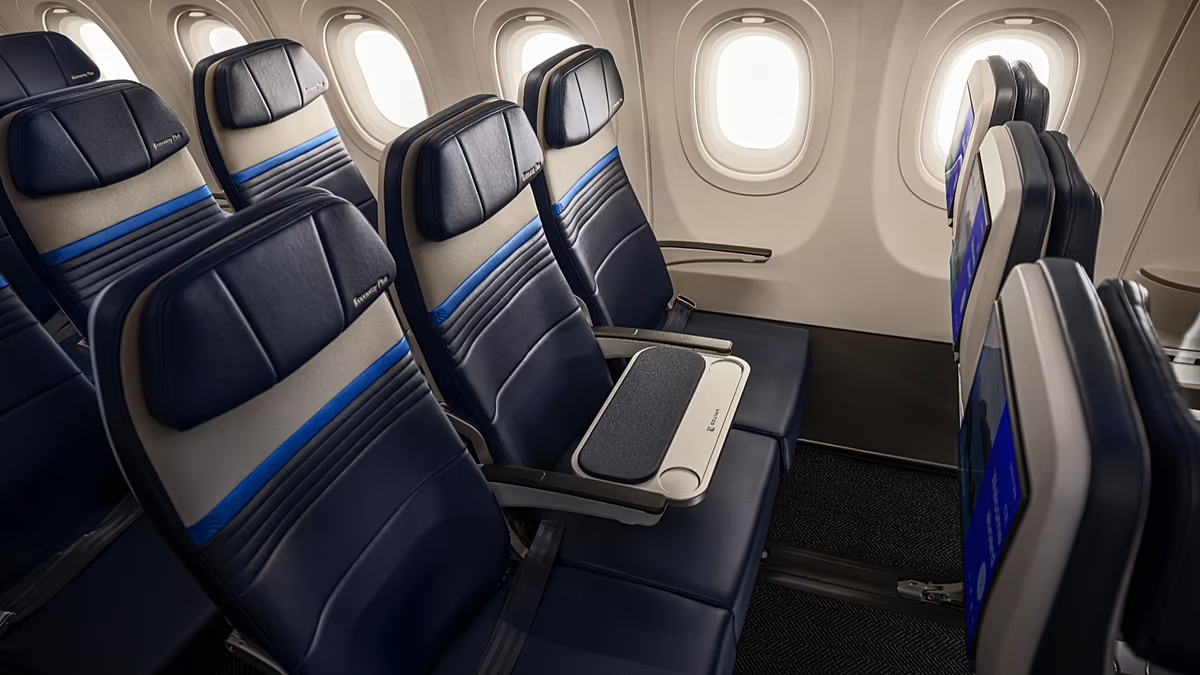
Airlines are also getting creative with specific new products designed to lure passengers into paying more without forcing them into a full business class cabin. United Airlines, for example, has unveiled a new “Relax Row” that will launch in 2027, allowing economy passengers on certain wider Boeing planes to turn a row of three seats into a kind of couch that can be used for sleeping or lounging after takeoff. United has also announced an “Economy Plus” option that guarantees no one sits in the dreaded middle seat, a simple but potentially appealing upgrade for travelers who are tired of being squeezed between strangers. The airline plans to introduce this option on some flights at the end of 2026. JetBlue, meanwhile, has announced the launch of BlueFirst, a new first-class service for domestic flights, with CEO Joanna Geraghty explaining that customers are increasingly looking for more premium experiences. Delta is making its own move with Delta One, a revamped luxury option that comes with premium wines, top-of-the-line food like a Wagyu burger, and larger entertainment screens. To make sure the menu impresses, Delta has partnered with Simon Hulstone, the chef behind the Michelin-starred restaurant The Elephant in Torquay, UK, and Andrea Robinson, an award-winning sommelier. The company plans to offer this upgraded service on new Airbus A350-1000 planes, which will have roughly 150 premium seats and 161 seats in economy. Ekrem Dimbiloglu, Delta’s managing director for onboard strategy and experience, pointed out that twenty years ago, 90% of seats were in the main cabin. Now, on some Delta flights, premium seats could soon account for as much as 70% of the cabin. That kind of transformation is changing the very shape of the airplane and the way airlines think about their customers.
This premium trend is not limited to the United States. International carriers are making equally bold moves. In October, British Airways announced that the top level of its two-tier A380 aircraft would be entirely composed of premium seats, meaning the entire upper deck of the double-decker plane will be dedicated to business class or premium economy passengers. Singapore Airlines has also revealed that it is investing €1.4 billion to upgrade its luxury long-haul cabins, including what it calls the largest double bed in commercial aviation in first class. Some airlines are going even further by eliminating standard economy altogether. All-business-class carriers like BeOnd and La Compagnie already operate without any economy seats, and Jet2 recently announced a new charter service that will use a specially configured Boeing 737-800NG with 76 business class seats. The math is compelling for airlines, but the change also alters the experience for everyday travelers. As more of the aircraft is given over to premium cabins, the remaining economy section becomes denser and less comfortable. At the same time, the definition of “premium” itself is shifting. It no longer simply means lie-flat seats and caviar. It can mean a guaranteed empty seat next to you, a better meal choice made before boarding, or free wifi. Consultancy Cirium estimates that premium seats among the 42 carriers in the three major airline alliances—SkyTeam, Oneworld, and Star Alliance—plus Middle Eastern carriers now represent 19% of total seat volume, compared with 17.1% in 2019. That may not sound like a huge jump, but in an industry where every inch of cabin space is carefully measured, it represents a substantial reallocation of resources.
Beyond the seats themselves, airlines are competing for premium travelers by upgrading the entire journey around the flight. A growing number of carriers are offering passengers the ability to choose their meal options before boarding, and free wifi has become a popular perk for higher-paying customers. There has also been a wave of announcements about new and beautified airport lounges, with even Southwest Airlines—once known mainly as a discount carrier—joining the rush to create more inviting spaces for travelers willing to pay a little more. Lounges are no longer just quiet waiting rooms with free coffee; they are becoming destinations with everything from spa services and showers to restaurants and open bars. For airlines, the lounge is a way to build loyalty and make premium passengers feel that their upgrade is worth the money. But this growing focus on those who can afford premium amenities could also open the door for a true discount carrier. There may be room in the market for an airline that targets cost-conscious travelers who just want a cheap seat and don’t care about premium food, wifi, or lounges. Of course, higher fuel costs have made that harder too. Every airline, no matter how luxurious or bare-bones, is facing the same pressure from rising operating expenses. But the aggressive premium push by major carriers changes the landscape. If the big airlines are all trying to move upmarket, someone new might see an opportunity to serve the millions of travelers who simply want the lowest fare and a safe, dependable flight.
In many ways, this is a story about how airlines have learned to adapt to a world where ticket prices have remained relatively low for decades, and where competition has made it harder to raise fares in a straightforward way. Instead of simply charging more for a standard seat, they have created a hierarchy of experiences, each with its own price point. This allows passengers to choose how much they want to pay, but it also places a heavier burden on travelers who cannot afford the extras. The romantic image of air travel as a glamorous experience for everyone has long since faded, and the current premium boom is carrying that evolution even further. For airlines, the logic is understandable: premium cabins take up valuable space but generate far more revenue per square foot, and the customers who buy those seats are often less sensitive to price. For passengers, the result is a more segmented flying experience, where your seat, your meal, your access to a lounge, and even your ability to board the plane early depend on how much you are willing to spend. It is a model that seems likely to grow, especially as global travel demand remains strong and as airlines see the wealthy and the business traveler as the most reliable source of profit. But it also raises questions about the future of economy travel and whether flying will become even more divided between those who can afford comfort and those who cannot. For now, airlines are betting heavily that the premium experience is the future. Whether that bet pays off will depend on whether passengers continue to see the added value, and whether the wider economy allows enough people to keep paying for it.