

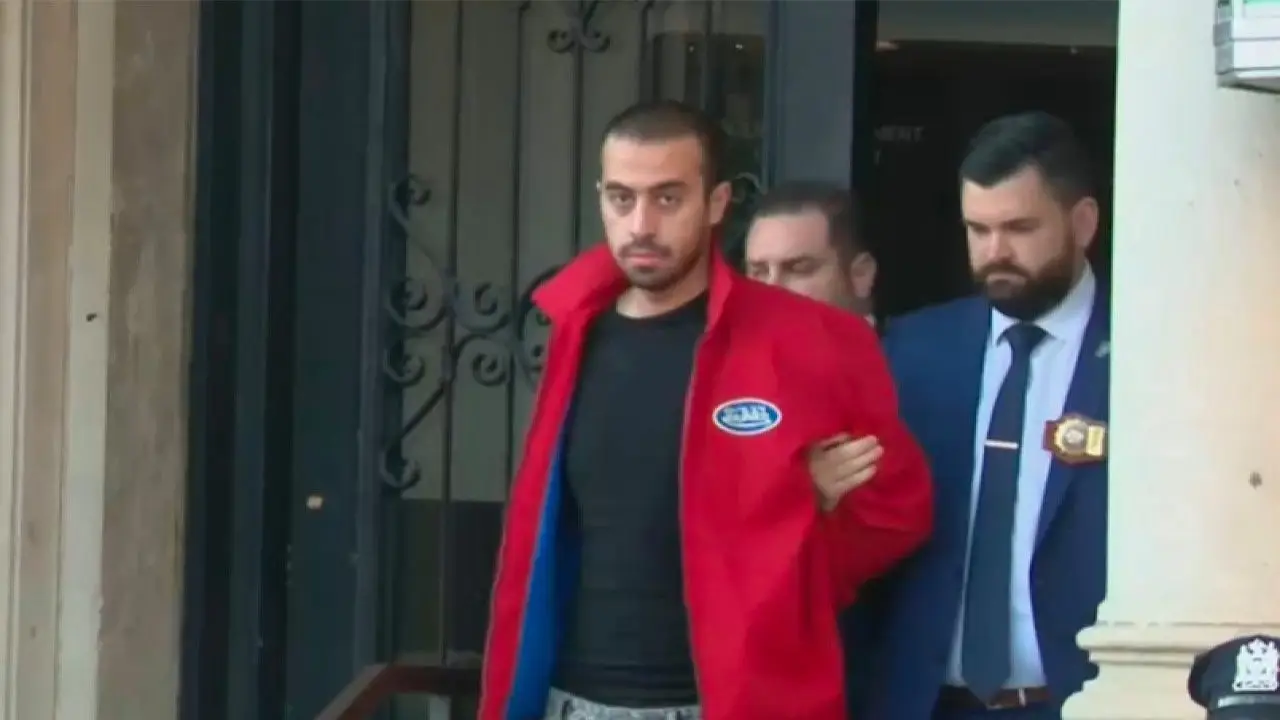
The fluorescent lights of the 62nd Precinct in Brooklyn cast a harsh, unforgiving glare on the sidewalk outside, a stage that had witnessed countless routine arrests but rarely one carrying the heavy, surreal weight of the case that unfolded on that Saturday afternoon. Sayed Mohassib emerged from the brick building flanked by uniformed officers, his hands cuffed tightly behind his back, his face a mask of detached stillness. He was dressed in a red Van Dutch jacket, a brand often associated with youthful self-expression and street style, paired with a simple black top and jeans—an outfit that seemed utterly incongruous with the monstrous accusation now leveled against him. Here stood a man who had once worn the same blue uniform as the officers escorting him, a former member of the New York Police Department, now a defendant facing a potential sentence of 25 years to life for the brutal murder of a young woman. The charge was second-degree murder in the stabbing death of 28-year-old Katie Suarez. The additional charges—criminal possession of a weapon and tampering with physical evidence—painted a chilling picture of a frantic, calculated aftermath, a desperate attempt to erase the traces of a violent act. As he was led into the unmarked police vehicle, Mohassib showed no outward emotion, a blankness that chilled onlookers and reporters alike. This stoicism offered no hint of remorse, no flicker of rage, and no visible sign of the psychological turmoil that might have led him to this precipice, leaving the public to wonder if they were looking at a cold-blooded killer or a deeply fractured man whose memories had abandoned him.
Katie Suarez was more than a number in a crime report; she was a vibrant 28-year-old woman with a life full of promise, a daughter who practiced the simple, endearing ritual of calling her parents during her evening jog to catch up on the day. That night, under the dimming October sky around 8 p.m., she was running along the Shore Parkway Greenway, a serene waterfront path that offered a peaceful reprieve from the city’s relentless clamor, her feet rhythmically hitting the pavement as she talked to the two people who loved her most. The call was abruptly cut short—a sudden, unnerving silence that replaced her voice on the other end of the line. A chill of dread ran through her parents. Something was wrong. Leaving their home, they drove frantically to the path, their minds racing through worst-case scenarios, hoping to find her simply with a dead phone battery. Instead, they found their daughter lying on the cold ground, gasping for air, a gruesome wound on her neck staining the walkway. In a state of utter panic, they called 911, but the paramedics could only rush her to a nearby hospital. Doctors fought valiantly to save her life, but the damage to her carotid artery was catastrophic, and her injuries proved fatal. She died shortly after arrival, leaving her parents to wander the sterile hospital corridors in a daze of disbelief. The greenway, once a sanctuary of exercise and mindfulness, was now a crime scene, marked by yellow tape and police chalk. The ordinary act of a daughter checking in with her folks had become a haunting final memory, and the last words spoken between them were now forever frozen in time, severed by a killer’s blade.
In the days following the arrest, the details of Mohassib’s initial statements to police began to leak, revealing a story that was as bizarre as it was disturbing. He told investigators that he had woken up covered in blood, a scene straight out of a psychological thriller, claiming he had no memory of the attack itself. He admitted, however, to the chillingly practical act of throwing the knife into a garbage can, a decision that implies a moment of clear-eyed panic and survival instinct, even as he professed total amnesia. This profound contradiction is the crux of the case: how can a man possessed of enough motor coordination to discard a bloody weapon have zero recollection of the brutal thrusts that ended a life? The defense of memory loss is a classic, albeit contentious, legal maneuver, often suggesting a chemically induced blackout, a severe dissociative fugue state, or a calculated, cynical attempt to evade the full weight of accountability by hiding behind a convenient void. Compounding the horror, police have released no motive, and they have remained silent on whether Mohassib and Suarez crossed paths prior to that evening. He was a 27-year-old man living in the area, working as a school aide; was this a random act of unprovoked urban violence, or a targeted attack stemming from an unrequited obsession? The uncertainty is maddening. For Suarez’s parents, his confession offers no catharsis. Instead, it deepens the wound, transforming their grief into a frustrating puzzle—why did a man who once pledged to serve and protect choose to extinguish the life of a stranger, and why can he not even offer them the dignity of an explanation for their daughter’s final moments?
Mohassib’s brief and troubling history is a tapestry of broken promises and unfulfilled potential, a stark contrast to the stable civic life he purported to lead. He served briefly with the NYPD, a tenure so short that it left barely a trace on the force’s collective memory, before abruptly leaving the police academy or the department—an exit that raised eyebrows among his few colleagues. He then sought a different kind of service, enlisting in the United States Marine Corps, but that path also ended in rejection when he was deemed unfit for duty. The specifics of this discharge are sealed behind military classifications, but it indicates a pattern of institutional failure to contain or channel whatever impulses drove him. Most recently, he was working as a public school aide, a role inherently designed to nurture, mentor, and safeguard the most vulnerable members of society—children. The irony is stomach-turning. A man entrusted with the safety of students is now accused of butchering a woman on a public jogging path. The New York City Department of Education, upon learning of his arrest, moved swiftly, suspending him immediately and issuing a terse statement that he would be fired upon conviction—a purely procedural action that does little to alleviate the upset parents within the school community who trusted him with their kids. This trajectory from police cadet to marine to classroom aide to murder suspect paints a poignant, disturbing portrait of a man adrift, someone who spent his adult life applying for jobs centered on authority and protection, yet was repeatedly shuffled aside, until his life descended into a cataclysmic, violent outburst.
The fallout from this savage killing has rippled far beyond the yellow police tape and the sterile hallway of the hospital where Katie Suarez died. The Shore Parkway Greenway is a vital artery for thousands of Brooklyn residents—runners pounding out their daily miles, cyclists commuting to work, and families pushing strollers on weekends. The news of a stabbing murder in such a bucolic setting has fundamentally warped the community’s sense of security, a phenomenon that city officials are struggling to contain. Local residents now traverse the path with skittish energy, scanning the bushes and eyeing fellow pedestrians with suspicion. Running clubs have cancelled evening sessions, parents are forbidding their teenagers from going out alone, and local bodegas have sold out of pepper spray. The NYPD has flooded the area with marked and unmarked patrol cars in a visible effort to reclaim the space, but the psychological damage is cannot be undone by a mere police presence. For Katie’s family and friends, the grief is further compounded by an agonizing void where answers should be. Why her? Why that night? Was she simply in the wrong place at the wrong time, or was she targeted? The randomness of the attack, if that is indeed what it was, is the most terrifying aspect, because it strips away the illusion of control we all rely on to navigate city streets. The community mourns a young woman they never met, holding vigils among the flowers and candles that have piled up at the scene, a collective act of sorrow. Beyond the fear, however, simmers a profound rage that a former police officer—a man who swore an oath to protect and serve, who wore the city’s blue uniform—could stand accused of committing this horror. It is a betrayal that shakes public trust in the very institutions designed to guard us, casting a dark cloud over the badge and the classroom alike.
As the wheels of justice begin their slow, grinding turn, Mohassib sits in a holding cell on Rikers Island or a similar facility, facing the full weight of the legal system, a system he once almost belonged to. His upcoming court appearances will draw a parade of anguished family members, meticulous attorneys, and a relentless media circus, all dissecting the minutiae of his life and mental state. The professional integrity of his amnesia claim will be rigorously tested over the coming months by court-appointed psychologists, toxicology reports that map his blood chemistry on that fateful night, and forensic cell tower data that might trace his movements before and after the attack. The second-degree murder charge suggests that while premeditation might not be the central focus, the prosecution will argue that his actions demonstrated a depraved indifference to human life, an intentional, reckless act that resulted in a catastrophic death. The separate charge of tampering with physical evidence serves as an ironic anchor against his defense of transient insanity; by discarding the murder weapon, he demonstrated a clear awareness of its incriminating nature, undermining the notion of a total, instantaneous blackout. For Katie Suarez’s parents, each court hearing will be a brutal replay of their loss, a search for a closure that can never truly arrive, because a verdict, no matter how severe, cannot restore the sound of their daughter’s voice on the phone. Ultimately, this heartbreaking saga is a stark meditation on the fragile intersection of mental health, institutional failure, the ubiquity of violence, and the fundamental vulnerability of just being alive in a bustling city. It serves as a grim reminder that beneath the mundane texture of our daily routines—a jogging path, a phone call home, the glance of a security guard—lurk hidden depths of darkness, and that sometimes, the greatest threat does not come from the shadowy stranger in the alley, but from the very hands we once trusted to keep us safe.