



The San Clemente Border Patrol checkpoint is an unlikely theatre for high drama. Wedged between the sparkling coastline and the dry, chaparral-covered hills of Southern California, it’s a place where the monotony of the I-5 corridor collides with the vigilance of federal law enforcement. Each day, thousands of vehicles roll through the primary inspection lanes, a steady stream of surfboards, commuters, and trucks carrying produce. For the agents on duty, it’s a job that requires honed intuition, the ability to read a hundred faces in a minute, to notice the slight tremor in a hand, the sweat beading on a brow, the eyes that dart away a little too quickly. On the afternoon of October 25th, that intuition screamed loudly. The first vehicle, a sedan that looked utterly unremarkable, suddenly made a move that turned it into a suspect: it attempted to reverse out of the line. In the traffic flow, this is a death knell for any smuggler. The driver’s nerves had betrayed him. Simultaneously, a second vehicle, three minutes behind, appeared to be an accomplice, or perhaps a decoy, but its driver’s rigid posture and the car’s heavy, lowered suspension gave it away. The agents’ pulse quickened as they signaled for both drivers to pull into the secondary inspection area. There, shielded from the hundreds of passing motorists, the officers faced the vehicles, their stomachs tightening with the familiar premonition of a major discovery. The sun beat down on the concrete, and the only sound was the crunch of gravel underfoot as they approached, ready to peel back the layers of metal and lies to reveal what lay hidden within. It was a moment that would transform a routine checkpoint assignment into a headline-grabbing victory against the drug trade, a stark reminder that the battle for American streets is often fought in the quiet, sun-scorched stretches of the nation’s highways.
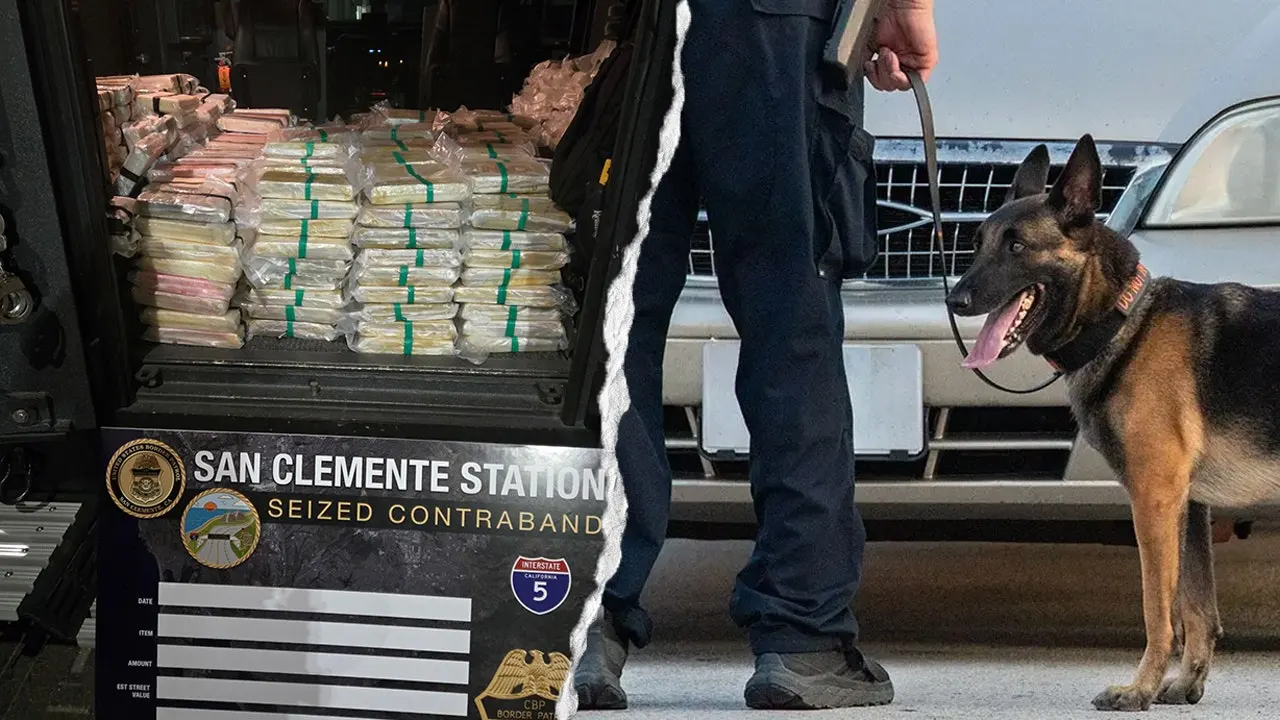
The secondary inspection is a world of its own, filled with the tools of the trade: crowbars, flashlights, and the most important asset of all—a highly trained canine. As the handler walked the German Shepherd around the two vehicles, the dog’s body language shifted from relaxed to focused, its ears pricking forward, nostrils flaring as it caught a scent that no human nose could detect. It wasn’t long before the dog sat, a definitive signal that narcotics were present. With that, the agents moved with purpose, disassembling the vehicles piece by piece. They removed interior panels, popped trunk linings, and unscrewed door wells. In a few tense minutes, they found what they were looking for: 550 vacuum-sealed packages, each one pressed tightly into a stone-like brick, all wrapped in black garbage bags. The quantity was staggering. The packages were heavy, dense, and uniform in size, a testament to the industrial scale of the cartels that produced them. When they were all removed and laid out on the pavement, the pile formed a small mountain of white powder. A field test was quickly administered, producing the faint purple hue that confirmed the presence of cocaine. The agents looked at each other, the gravity of the find settling in. This wasn’t a street-level bust; this was a major logistics operation, a multi-million dollar load that had been intercepted before it could reach the arteries of American cities. The sheer weight of the haul, over 1,435 pounds, was enough to crush the spirit of any law-abiding citizen, but for these agents, it was fuel for the fire—a tangible proof that their vigilance could stem the tide of poison flooding the nation.
To fully comprehend the magnitude of this seizure, one must move beyond the sterile language of pounds and dollar figures. 1,435 pounds of cocaine is not just a collection of bricks; it is a devastating weapon aimed at the heart of American communities. Retail value estimates place the load at $9.8 million wholesale, but on the street, after cutting and dilution, that figure can explode into the hundreds of millions. More importantly, that quantity represents roughly 650,000 individual doses of cocaine, enough to fuel addiction for thousands of people for years. Each dose carries the potential for an overdose, a fatal cardiac event, or a descent into paranoia and violence. The drugs seized at San Clemente would have been distributed to mid-level dealers across the western states, feeding the insatiable demand that keeps cartels in power. For the families who lose a son or daughter to a powder-induced spiral, this bust is a silent reprieve—a tragedy averted. For the emergency room doctors who handle the aftermath of a bad batch, it’s a missed crisis. But the human cost goes even deeper. The money generated by this cocaine funds the violence that plagues Mexico and Central America, financing kidnappings, assassinations, and the corruption of public officials. Standing over that pile of contraband, the agents were not merely counting evidence; they were momentarily, and powerfully, staring into the abyss of a humanitarian catastrophe that would have rippled outward for months, potentially claiming lives far beyond the initial users. It is this weight of responsibility that drives these men and women to keep their eyes sharp, knowing that every interception is a lifeline thrown to someone they will never meet.
The official statement from the San Clemente Station Patrol Agent in Charge, J.D. Scott, offers a glimpse into the changing dynamics of the border war. “With this seizure, we are heading for a record year in narcotics interdictions here at the San Clemente checkpoint,” he noted, his words carrying the pride of a unit finally able to focus its resources on the right enemy. He elaborated on the strategic pivot: “A few years ago, our agents were deployed to the immediate border and processed hundreds of illegal aliens.” That was a different era, one where the Border Patrol’s primary mission was overwhelmed by humanitarian and logistical challenges. But the landscape has shifted dramatically. With illegal border entries in the San Diego sector at all-time lows—a direct result of changing immigration policies and enforcement strategies—the agency has been able to repurpose its personnel. The agents who were once tied down in processing tents, doing the paperwork of detentions and releases, are now free to engage in robust patrol work and interdiction. This has allowed the San Clemente checkpoint to remain open for longer hours, maintaining a constant presence along the I-5 corridor, a critical thoroughfare for the drug trade. The checkpoint is not just a barrier; it is a sensor, a node in a larger intelligence network that tracks the movement of illegal drugs. By keeping the checkpoint operational and staffed, the agency is essentially shutting the door on a major smuggling route. This seizure is a testament to that strategy, demonstrating that the boots on the ground, freed from the burdens of migration processing, are now doing what they were originally intended to do: stopping the flow of dangerous contraband. The shift has breathed new life into the agency, transforming them from custodians of a crisis into warriors on the front lines of the drug war.
In the aftermath of the October 25th discovery, the immediate legal machine swung into action. Both drivers, whose names have been withheld pending formal charges, were taken into custody without incident. The narcotics, meticulously catalogued and weighed, were turned over to the Drug Enforcement Administration (DEA), which will now build a federal prosecution case against the smugglers. These arrests are not isolated incidents but part of a cohesive, high-priority campaign under the Trump administration to dismantle the infrastructure of drug cartels, foreign gangs, and transnational criminal organizations. The executive branch has made clear that human smuggling and drug trafficking are existential national security threats. This particular seizure aligns with that broader initiative, sending a clear message to the cartels that their shipments are being tracked and intercepted with increasing frequency. The case also resonates with other significant busts in the region. Just months earlier, in May, authorities in the Southern District of California announced the discovery of over a ton of cocaine, valued at around $45 million, which was linked to an elaborate cross-border drug tunnel. That tunnel, a stunning feat of underground engineering, represented a sophisticated attempt to bypass surface-level checkpoints altogether. The fact that both a tunnel system and a vehicular checkpoint were breached speaks to the relentless, multi-pronged nature of the drug trade, and the equally relentless response from law enforcement. Each bust, whether it involves a tunnel or a sedan, adds another brick to the wall of intelligence and interdiction, making it increasingly difficult and costly for cartels to operate. The sheer creativity and persistence of the smugglers, countered by the adaptability and training of federal agents, creates an endless game of cat and mouse, but for now, the good guys are winning.
For the agents who made this bust, the moment is more than just a line on a monthly statistic. It is a tangible victory, a morale booster in a never-ending grind. J.D. Scott’s quote about heading for a record year hints at the renewed purpose felt by the unit. For years, their work was defined by the chaotic logistics of mass migration, a job that often felt more like social work than law enforcement. Now, with illegal entries down, they are back to their core function: hunting for contraband. The feeling of pulling 1,435 pounds of poison off the street is deeply satisfying, a reminder of why they signed up in the first place. Yet, there is no time for prolonged celebration. As the DEA agents drive away with the evidence, the checkpoint lights continue to blink, the vehicles continue to line up, and the officers return to their posts, scanning the next horizon for the next threat. The war on drugs is a hydra; for every head severed, two more appear, often in more creative and desperate forms. But on this day, the good guys won unequivocally. The bust represents a significant blow to the cartels’ bottom line, a disruption of their supply chain, and a powerful deterrent to other would-be smugglers who might consider testing the gates at San Clemente. In the silent aftermath, as the sun dips toward the Pacific, the temporary victory solidifies into the enduring commitment of the men and women in green. Their vigilance, born of training and hardened by experience, is the shield between chaos and order, a quiet bulwark protecting the American public from the scourge of narcotics. Every brick of cocaine left in an evidence locker, every driver led away in handcuffs, is a testament to the unsung heroes who stand watch, often unnoticed, at the edges of the nation, ensuring that the next car that passes through might just be a little safer than the last.