


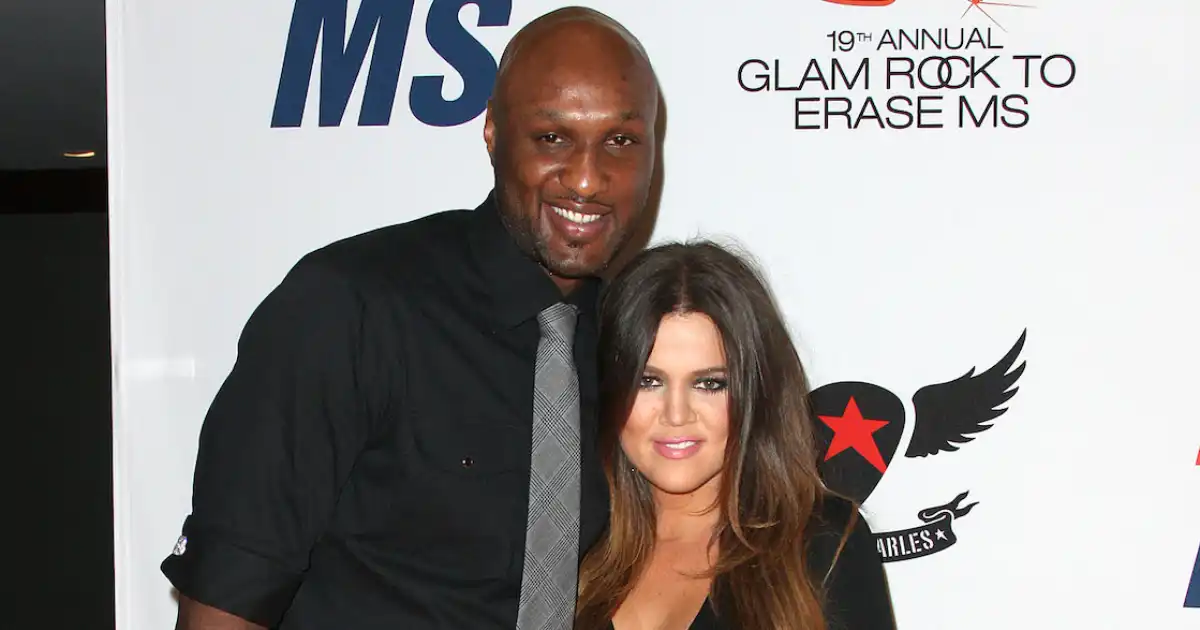
There are moments on reality television that feel so overproduced, so sculpted around dramatic pauses and confession-cam tears, that you forget actual human beings are sitting behind the cameras. Then there are moments like the one that unfolded on Thursday, November 5, during an episode of Hulu’s The Kardashians—a moment so raw, so absurd, and so unexpectedly vulnerable that it cuts through all the surface gloss. Kris Jenner and Khloé Kardashian were sitting together, apparently ready to open up about their past, when Kris, who had taken weed gummies while filming, began to unearth one of the darkest chapters in their family history: the years when Lamar Odom was lost to addiction and no one seemed able to pull him back. Khloé, 42, and Kris, 70, recalled a night years ago when they went searching for Odom, 46, after receiving “intel” about where he was staying. They tracked him down to a certain hotel, convinced they had to intervene. “We’re going to extract him from the situation because he’s being held hostage by these hookers,” Kris remembered, her blunt phrasing revealing both the fear and the fierce maternal instinct that had taken over. It was not the polished story of a family overcoming adversity with grace. It was a chaotic, terrifying, deeply human memory that had been lodged inside them for years, waiting for the right moment—or perhaps no real moment at all—to come pouring out.
To understand why that memory still carries so much weight, you have to remember how high the stakes actually were. Lamar Odom was not just a troubling chapter in Khloé’s romantic history. He was a man struggling with addiction so severe that it nearly killed him. In 2015, he suffered six heart attacks and twelve strokes, slipped into a coma for three days, and then spent months fighting to reclaim his life through rehabilitation. Khloé, who was married to Odom from 2009 to 2016, had begun divorce proceedings, but she paused them to assist with his medical care when his life was on the line. That layered mix of heartbreak, duty, anger, and love is what makes the hotel story so haunting. The night she and Kris found Odom was not a random memory; it was the culmination of a long, exhausting battle to keep someone alive who could not yet keep himself alive. As Kris recalled, Khloé’s security burst into the room. And then came an image that Khloé says has never left her. “All I saw [was] they were literally having a circle jerk. There were 20 people in the room.” The space was full of strangers, drugs, and a man who had completely lost control of his own life. Khloé’s first instinct was to make everyone leave. Kris, meanwhile, began grabbing all the drugs she could find and throwing them into the trash. It was not a strategic rescue. There was no plan, no rehearsal, no time to think about how this moment would be remembered. It was just two women trying to pull someone they loved out of a nightmare that kept swallowing him whole. Khloé later admitted she was surprised her mother brought up the “crack cocaine story” on national television, but there it was, in all its ugly, unfiltered truth.
Perhaps the only way to survive a memory like that is to find some way to laugh at it, even when it still hurts. Khloé has clearly adopted that survival mechanism. After recounting the hotel scene, she turned to the cameras and delivered a line that was both hilarious and heartbreaking: “This is solidifying how I will never date a freak again.” She went on to joke that she needed to add some new entries to her manifest list for a future partner. “Maybe I should add no circle jerks and no orgies. Also maybe no hardcore drugs.” The absurdity of having to say those words out loud is not lost on her. But the longer you sit with that moment, the less funny it becomes. This is a woman who has been through enough chaos in her romantic life to know exactly what she does not want. She has seen addiction up close. She has walked into a hotel room and witnessed her husband in a situation that was degrading, dangerous, and deeply wounding. And instead of letting that experience destroy her ability to hope, she turned it into a list. A list is a form of control. It is a way of saying: I may not be able to rewrite what happened to me, but I can decide what I allow next. The jokes are a shield, but the list is a boundary. And sometimes, in the messy aftermath of trauma, a joke and a boundary are the only things you can hold on to.
This is not the first time Khloé has used the language of manifestation to describe the kind of partner she wants. In an October episode of The Kardashians, the Good American cofounder laid out her requirements in brutally honest detail. She wants a “man of God” and someone who is “successful in his own right.” She made it clear that physical attributes matter too, quipping, “He can’t have a micropenis.” She wants a man who is open to beauty treatments, or at least someone who won’t judge her for the procedures she chooses to have. “He must be OK with plastic surgery,” she said. She wants someone who will be her biggest supporter and cheerleader, just as she promises to be for him. She wants her friends and family to love him. And she was emphatic about honesty: no cheaters, no liars. “I want someone that’s honest and makes me feel safe. First and foremost, I need to know that I can trust you,” she said. She also acknowledged her own intense, high-energy personality. She doesn’t need someone calm, because she isn’t calm. She doesn’t think patience should be on the list, because she isn’t interested in testing anyone. That list is not merely a collection of demands. It is a mirror of everything she has experienced and survived. Every item is a lesson learned, often the hard way. It shows that Khloé has paid attention to her own history and is trying to build a future that does not repeat it.
What makes this entire story so compelling is not the shock value of the hotel room. It is the contradiction Khloé carries with her. She has every right to be bitter, closed off, and unwilling to look back. Yet she was the one who paused her divorce when Odom nearly died. She was the one who showed up during his medical care and rehabilitation. She was the one who, years later, can sit on a reality show and tell this story without pretending she was the hero who saved the day. She and Kris were just two women doing what felt necessary in an impossible moment. Kris swiped drugs into the trash. Khloé told strangers to leave. It was messy, invasive, and far from perfect. There is no neat moral to this story, no clean lesson that makes the pain worth it. But that is exactly what makes it human. Addiction does not respect love. It does not care about your plans or your pain or how hard you are fighting. It takes over, and the people who love someone in the middle of it often end up doing things they never imagined they would do. They search hotel rooms. They throw away drugs. They turn their trauma into manifest lists and make dark jokes about orgies because otherwise the grief might swallow them whole. Khloé’s willingness to share this part of her past is not a cry for sympathy. It is an act of honesty—for herself, and for anyone who has ever loved someone through something they could not fix.
At the end of it all, Khloé’s story is not just a cautionary tale about addiction or another reality TV confessional. It is a reminder that healing is not linear. She can laugh at the absurdity of the situation and still feel the weight of it. She can say she does not want a freak and still believe that love is possible. “I don’t know what tomorrow holds. But then again, I never do,” she said. “I don’t think I’m closed off. When the right person comes, I’m sure I will feel open. At the moment, I’m not even looking. But I imagine that someone great will come into my life one day and I will feel safe, and … we will talk about the next steps.” That is not the voice of someone who has given up. It is the voice of someone who has been burned and still refuses to define herself by the flames. New episodes of The Kardashians premiere every Thursday on Hulu, and if this episode is any indication, the series is still capable of delivering real, unguarded moments beneath all the glamour. Khloé may never fully escape the memory of that hotel room. But she has taken that memory and shaped it into something she can carry—as a warning, as a boundary, and as proof that she is still here, still hopeful, and still willing to believe that someone great will one day make her feel safe enough to talk about the next steps. That is the kind of strength you cannot manufacture. You can only live it.