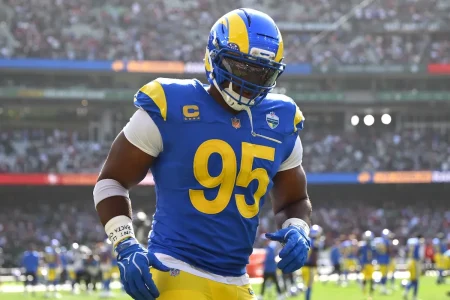




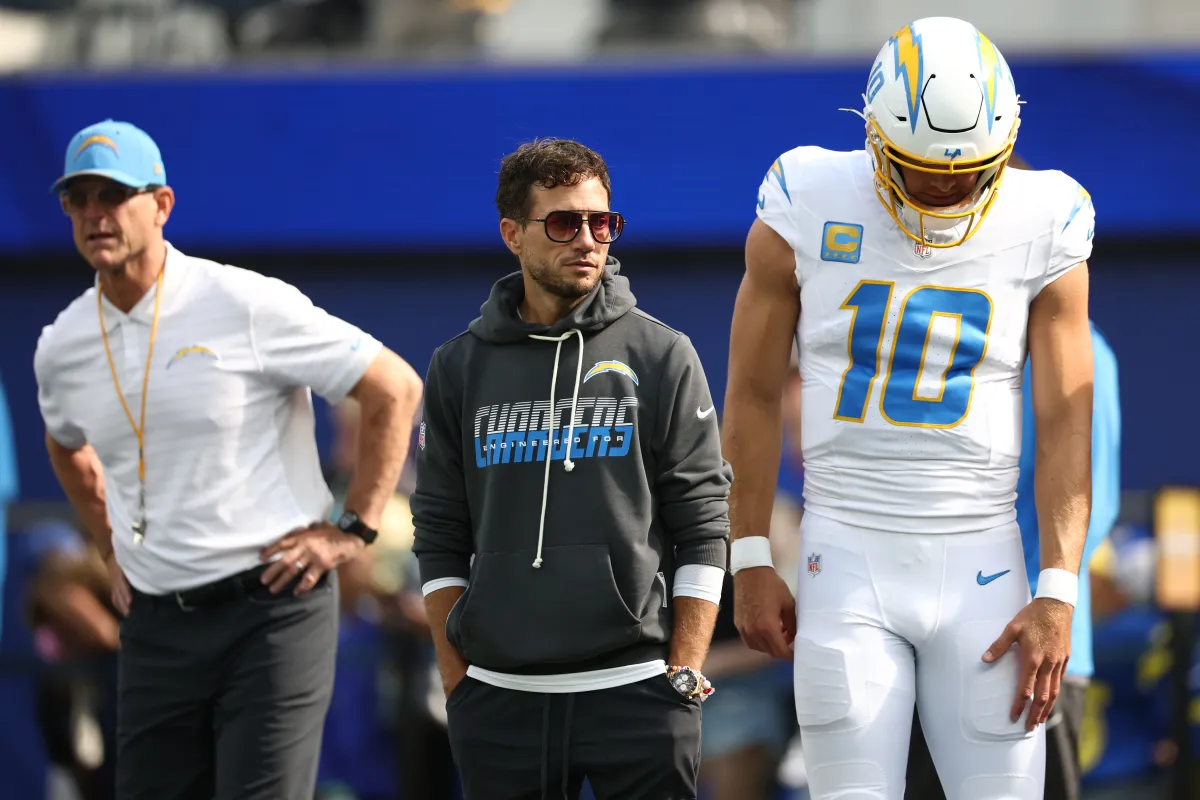
In the quiet, fluorescent hum of a locker room that has heard too many losing speeches, Justin Herbert did what he has spent weeks learning to do: he made the conversation go small. The Los Angeles Chargers quarterback was asked Wednesday about Rams safety Quentin Lake’s comments on the “St. Brown Podcast,” where Lake said Herbert was “seeing ghosts” during the Rams’ 24-9 victory. It was a harsh phrase, chosen carefully, meant to suggest that Herbert is rattled, that the pressure of the pass rush has gotten inside his head, that he is playing scared. Herbert declined to take the bait. He said he hadn’t heard the comment, hadn’t reviewed the clip, and couldn’t form a response to something he hadn’t seen. There was no defensiveness, no wounded pride in his voice. Just the steady, low-key monotone of a quarterback who understands that the outside world is now full of people waiting for him to break. The silence, in some ways, was more powerful than any verbal counterpunch. It told the Rams, the media and the fans that Herbert is not interested in a war of words. He is fighting something much bigger — the weight of an 0-7 season, the sting of repeated turnovers, and the creeping doubt that maybe, just maybe, the ghost narrative has a small piece of truth in it. But admitting that, even to himself, is not something he’s ready to do. So he does the only thing he can control: he shuts out the noise and goes back to work.
Jim Harbaugh, the Chargers’ head coach, answered Lake’s comment with the ferocious protectiveness for which he is known. When reporters brought the “seeing ghosts” line to him, Harbaugh dismissed it with a shrug and a sentence that sounded like a coach drawing a line in the sand. “As far as anybody’s opinion I don’t see that,” he said. “Everybody’s entitled to their opinion. Not what I see.” Losing, especially losing this often, has a way of turning every coach into a lawyer for his own players, and Harbaugh is a gifted defender. He insisted that Herbert has done his job exceptionally well, a claim that might seem out of step with the statistics but is part of Harbaugh’s larger message: don’t blame one man for the failures of many. At the same time, the coach was honest enough to acknowledge that Herbert threw two passes he would want back — two interceptions that changed the shape of the Rams game. The first came when the Chargers were still in control, the second helped set up a Rams touchdown in the second half. In a tight game, those are the moments that turn leads into deficits and hope into resignation. Harbaugh’s defense made it clear that he sees Herbert as a victim of circumstance as much as a contributor to it. The offensive line, the play-calling, the lack of a consistent running game, the untimely drops — all of it shares blame. But because Herbert is the quarterback, because he wears the most important number and holds the ball on every play, he absorbs the criticism. Harbaugh knows this. And his refusal to let Lake’s words hang in the air was a way of saying that Herbert may be struggling, but he is not broken.
The game itself followed a pattern that has become dangerously familiar to Chargers fans. For much of the first half, there was reason to believe this might be the day it all turned around. Los Angeles held a 9-3 lead late in the second quarter, built on field goals and a defense that was making life difficult for the Rams. The offense was not electric, but it was effective enough to create a belief that, for once, a single touchdown might be enough. Then the game slipped. The Rams scored before halftime, and the emotional weight of that drive seemed to land on the Chargers like a physical blow. When the third quarter began, Los Angeles surrendered another touchdown drive, and suddenly the 9-3 lead had become a 17-9 deficit. The Chargers never recovered. Herbert’s second interception led directly to another Rams score, and the offense, which had been unable to reach the end zone all day, went quiet in the second half when it needed to be bold. The final score, 24-9, was a painful reflection of the team’s larger problem: this is an offense that can move the ball but cannot finish, a group that starts strong but fades when the margins tighten. The defense, though imperfect, had given the team a chance. The early lead had given the fans something to cheer about. But the offense could not answer, and the same old questions followed the team off the field: Why can’t they score? Why do the turnovers keep coming? Why does every winnable game end in the same ache? There are no easy answers, only the miserable arithmetic of a season that has produced seven defeats in seven attempts.
For Herbert, the path forward lies not in responding to critics but in narrowing his world. When he spoke Wednesday, he didn’t talk about Lake, the Rams, or the need to prove anyone wrong. He talked about the work, the preparation, the daily grind of trying to find something to salvage from a season that seems to be slipping away. “We’re really just focused on what’s going on in the building, playing football and doing what we can and doing our best to, you know, go put our best effort out on Sunday,” Herbert said. “And that’s all that really matters. Anything outside of that is out of our control.” There is something almost monastic about the way he has chosen to deal with the outside world. In an age of athlete-led media channels and 24-hour debate cycles, Herbert has retreated into the quiet rituals of the game. He knows that “seeing ghosts” is not the kind of narrative that gets erased by a single press conference. The only way to change the story is on the field, one incomplete pass at a time, one touchdown drive at a time. But the clock is ticking. At 0-7, there is no magical fix waiting in the locker room. The losses have a way of testing not just a player’s skill, but his sense of self. The hardest part for Herbert may not be the interceptions or the poor rating; it may be the slow erosion of confidence that comes with so much failure. He says the right things, and his calm suggests a quarterback still trying to lead, but there is no way to know what happens in the dark hours after another defeat. That is the lonely part of the position, and no amount of coach’s praise or media training can shield a quarterback from it.
The numbers paint a harsh portrait. Herbert has completed 131 of 212 passes for 1,398 yards, five touchdowns and 10 interceptions, with a passer rating of 69.3. For a player who was once among the league’s most promising young passers, the regression has been startling. But statistics can flatten a story. They don’t show the receivers who couldn’t quite get open, the protections that collapsed at the worst possible moment, the catches dropped at the exact time a spark was needed. They only show the bottom line, and the bottom line says Herbert has thrown twice as many interceptions as touchdowns, and his team has not won a single game. The Chargers finished Sunday’s defeat without a touchdown, their nine points all coming before halftime. That kind of offensive futility has nothing to do with one player. It is a collective failure, a system that has not functioned: the offensive line inconsistent, the run game nonexistent, the play-calling at times too conservative and at times too hopeful. Herbert, meanwhile, has appeared to press at moments, trying to force throws that a patient quarterback might let go. It is a classic spiral: when a team can’t score, the quarterback tries to make something out of nothing, and the resulting turnovers only make things worse. Herbert is not excused from that dynamic. He owns his mistakes, and his ten interceptions are a real part of his season. But to lay all of it at his feet would ignore the fuller picture of a team that has found new and inventive ways to lose. Great quarterbacks are supposed to lift everyone else, and Herbert has not done that this year. But the truth is, not even the great ones can do it alone.
There is no relief in the schedule. On Sunday, the Chargers host the Houston Texans at SoFi Stadium, and while Houston is also struggling at 2-5, the Chargers are in no position to take anything for granted. Every remaining game is now less about playoff hopes — already shattered — and more about identity, pride, and the kind of small redemption that can only be found in a season’s wreckage. Herbert’s challenge is both simple and impossibly hard: he has to keep believing that the story is not already written. He has to walk into a building that has heard boos, answer questions about losing, and still find a way to throw the ball with trust and confidence. The “seeing ghosts” comment will not fully disappear from the conversation until Herbert produces a clean, productive performance. No podcast clip, no head coach’s defense, no careful words can change that. What can change it is a Sunday afternoon where the ball leaves his hand with conviction, where the decisions come quickly and the throws find their targets. Whether that happens is unknowable. But there is something deeply human, even moving, about the way Herbert has responded so far — not with excuses, not with anger, but with the quiet commitment to keep working in the face of so much disappointment. Sports are filled with quarterbacks who folded when things got hard. Herbert has not folded, at least not visibly. He is still standing in the pocket, still taking the blame, still talking about the process as if winning might be right around the corner. Maybe it is. Maybe it isn’t. But watching a man refuse to surrender to a brutal year might be the most compelling story left in this Chargers season.