


It was the kind of election night that rewrites political maps and leaves even the most confident forecasters scrambling for new language. Democrats didn’t just win on Tuesday—they swept. The House, the Senate, and a string of governor’s races all fell their way, including in Texas, a state that hasn’t elected a Democrat to the governor’s mansion in decades. The reaction from the country’s wealthiest and most influential tech figures was immediate, unfiltered, and deeply divided. Elon Musk, the world’s richest man and the largest individual donor of the 2026 midterm cycle, took to X early Wednesday with a joke that seemed to acknowledge both his own massive spending and the magnitude of the Democratic wave. “Guess my election-interfering space lasers didn’t work this time,” he wrote, a sardonic nod to the wild conspiracy theories that have swirled around him in recent years. But his next post was less playful and more pointed: “Data centers in space looking pretty appealing right now.” That second comment wasn’t just a random musing. It was a direct response to the political earthquake happening in his home state, where governor-elect Gina Hinojosa had campaigned on a moratorium on new data-center construction—a policy that strikes at the heart of the AI boom that has made Musk and his peers even richer. For a man who has built his fortune on terrestrial infrastructure, the idea of moving the whole operation off-planet suddenly didn’t seem so absurd.
The contrast between Musk’s flippant online persona and the reactions of other billionaires could not have been starker. Reid Hoffman, the LinkedIn cofounder and one of the Democratic Party’s most reliable megadonors, used the same platform to declare the results an “overwhelming wave against Trump and his cronies.” Hoffman didn’t stop there. He took direct aim at Musk, accusing him of spending “outrageous amounts to keep authoritarian clowns in power.” It was a sharp, personal rebuke from a man who has often tried to stay above the fray, but the stakes felt too high for restraint. Hoffman also acknowledged his own role in the money-soaked system, admitting that he had donated heavily during the midterm cycle and arguing that, ideally, money should be taken out of politics entirely. But in the same breath, he said he “proudly” supported candidates who “ALL believe in the rule of law” and who understand that the American economy has a responsibility to deliver prosperity for everyone, not just the already powerful. His message was clear: yes, the system is flawed, but this election was about something bigger than campaign finance reform. It was about defending democratic norms against a movement that seemed willing to discard them. And he wasn’t alone. Mike Bloomberg, the former New York City mayor and a billionaire in his own right, had spent more than $115 million in the final two months of the campaign to support Democratic candidates. In a statement to the New York Times, he expressed satisfaction with the party’s House victory and congratulated Hakeem Jeffries, who is set to make history as the next Speaker of the House. Bloomberg’s words were measured, but the message was unmistakable: the money he poured into the election had been worth it.
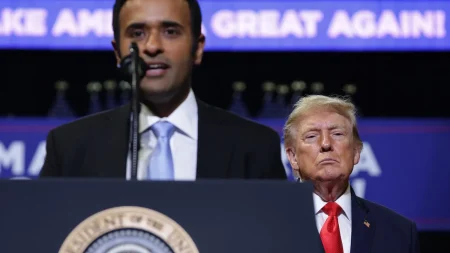
Of course, not every billionaire on the losing side took the defeat with grace. Vivek Ramaswamy, the tech entrepreneur and former presidential hopeful, had poured his own fortune into a bid for Ohio’s governorship, only to lose to Democrat Amy Acton by nearly eight points. At his election-night watch party, Ramaswamy tried to strike a somber, statesmanlike tone, telling supporters, “I have to tell you, I have some serious concerns about the future direction of our country. There’s no avoiding that.” But the context made his words feel less like a concession and more like a warning. Acton’s victory was especially stinging because Ramaswamy’s campaign had run a controversial attack ad featuring her estranged mother, a move that many voters saw as a new low even for modern politics. The ad backfired spectacularly, and Ohio’s governorship flipped to the Democrats in a state that had increasingly leaned Republican. Another billionaire Republican candidate, healthcare entrepreneur Rick Jackson, faced a similar fate in Georgia. Jackson spent more than $200 million of his own money—an astronomical sum for a gubernatorial race—but still lost to Democrat Keisha Lance Bottoms. His concession speech was brief and gracious: “Tonight the voters spoke. And I respect their decision.” It was a stark contrast to Ramaswamy’s darkly prophetic tone, and perhaps a sign that even the most self-funded candidates understand that money alone cannot buy the affection of voters who are angry, tired, and looking for change.
The reaction from the broader tech and venture capital world was less about the candidates themselves and more about what the Democratic sweep might mean for the industries that have made these people fabulously wealthy. Jason Calacanis, the angel investor and co-host of the popular “All-In” podcast, took to X to vent his frustration. He blamed President Trump’s policies for leading the GOP off a cliff, citing inflation, the war, tariffs, and the general sense of chaos that had defined the past year. But his real anguish came through in a single sentence: “Ugh, I moved here to get away from the left lunacy!” That “here” was Texas, and the realization that the state had just turned blue clearly shook him. Mike Solana, the chief marketing officer for Peter Thiel’s Founders Fund, was even more apocalyptic. “texas + california politics would (will?) be a much, much, much worse place to live than california,” he tweeted, suggesting that the Democratic wave in Texas would combine the worst of both states’ progressive governance into a kind of dystopian super-state. Sequoia Capital partner Shaun Maguire, never one to shy away from controversy, offered a cryptic and inflammatory take: “Charlie Kirk was assassinated by the left. Yet people still voted for it. Says a lot.” The post was widely condemned, but it captured the sense of disbelief and resentment that many in the tech right were feeling. For a group of people who have spent years positioning themselves as outside the political establishment, the establishment had just come roaring back with a vengeance.
Perhaps the most telling reaction came from Chamath Palihapitiya, another “All-In” co-host, who during the election-night livestream zeroed in on what he saw as the real existential threat lurking beneath the Democratic victory. Watching the returns come in for Texas governor, Palihapitiya warned that if Gina Hinojosa’s lead held, the consequences would be catastrophic for the American economy. “There’s only one thing that sinks the U.S. economy, it’s the AI trade,” he said, “and the only way to sink the AI trade is to sink the data centers.” Hinojosa had campaigned on exactly that: a moratorium on new data-center construction in Texas, a state that has become the beating heart of the AI infrastructure boom. For Palihapitiya and many others in the tech elite, this was the nightmare scenario. They had spent years building a narrative that AI was the future of American prosperity, and now a newly empowered Democratic government was threatening to pull the plug on the very physical infrastructure that made that future possible. The warning was blunt, almost paranoid, but it reflected a genuine anxiety that the political winds had shifted in a way that could not be undone by a few well-placed donations. And then there was Sam Altman, the OpenAI CEO, who chose the middle of election night to post a philosophical meditation on the future of artificial intelligence. “People should always be in control of the future,” he wrote. “OpenAI is against the notion that it would be acceptable for people to be relegated to a role of doing things that ‘AI systems think makes sense to reward in humans.’ People should not cede control of the future to superintelligence, and that requirement should ultimately constrain AI progress.” The post made no explicit mention of the election, but the timing felt deliberate. Several X users reshared it with jokes about whether Altman was trying to reassure nervous Democratic lawmakers that he was on their side, or whether he was quietly preparing for a future in which AI regulation became the central political battleground.
In the end, the numbers tell the story of just how much money was thrown at this election. According to Forbes’ analysis of FEC filings and other reporting, Elon Musk spent a staggering $458 million supporting Republican candidates and groups in the 2026 midterms, making him by far the largest individual donor of the cycle. That is more than the GDP of some small nations, more than the combined campaign budgets of dozens of Senate races, and yet it was not enough to stop the Democratic wave. The irony was not lost on observers: the world’s richest man had tried to buy an election, and the voters had simply shrugged. The reactions from the losing side ranged from bitter to bewildered, from conspiracy-laden jokes to genuine soul-searching. But the broader message of the night was perhaps best summed up by Reid Hoffman’s thread: money is loud, but it is not always decisive. The tech billionaires who had spent years believing they could shape the political landscape with their checkbooks were confronted with the uncomfortable reality that the American electorate is not for sale. For the winners, the task now is to govern in a way that justifies the trust placed in them. For the losers, the task is to figure out what went wrong—and whether the answer lies in more money, better messaging, or something far deeper. The election may be over, but the battle over the future of the country, and the role that billionaires and artificial intelligence will play in it, is only just beginning.