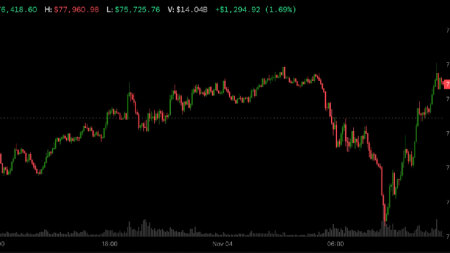





Wintermute Flags $80,000 as Bitcoin’s Critical Test — Analysts Say Recovery Needs Real Buying to Last
A Market at a Crossroads
Bitcoin’s latest recovery attempt has put traders on high alert. After a turbulent period in the digital asset market, the cryptocurrency has managed to claw its way back toward important price levels, but the mood among institutional observers remains measured. At this point, analysts are warning that the recovery could stall unless there is sustained and aggressive buying in the spot market. That is not just a call for more volume. It is a call for the right kind of volume. In this delicate phase, the actions of spot buyers and those moving capital through regulated exchange-traded funds will matter more than futures-fueled optimism. Among the voices weighing in on the current state of play is Wintermute, one of the leading market makers in the cryptocurrency industry. The firm’s latest report offers a clear technical map for Bitcoin’s next move, and at the center of that map is an unmistakable number: $80,000. Wintermute’s analysts believe how BTC behaves around that price will shape the broader market outlook for some time. But they are just as focused on what happens below it, pointing to a support level that could determine whether the recovery turns into a breakout or fades into another disappointment.
Wintermute’s role as a market maker gives its assessment practical weight. The company does not simply observe trading activity from a distance; it stands in the middle of the flow, providing liquidity, absorbing risk, and seeing how buyers and sellers actually behave under pressure. That kind of visibility matters in a market where headlines often move faster than fundamentals. When Wintermute speaks about a critical price level, institutional traders listen because they know the firm’s view is grounded in real order flow and balance sheet activity. The report arrives at a moment when Bitcoin is trying to rebuild trust, and it sets a clear challenge: get back above $80,000, hold the line, and prove that this recovery has genuine traction behind it.
Why $80,000 Matters More Than a Round Number
In crypto, price levels often become self-fulfilling prophecies. Trading desks, algorithms, and retail investors watch the same charts, and when a level is flagged as important, it begins to influence positioning. Wintermute’s report says $80,000 is the most critical level for Bitcoin right now. It is not merely a psychological milestone. According to the report, Bitcoin’s return above this level, and more importantly its ability to hold it, is crucial for improving the market outlook. If BTC can reclaim $80,000 and close above it with conviction, it will give cautious participants a reason to adjust their positions. If it fails, the same participants may see it as technical confirmation that the recovery has no legs.
The report also stresses the need to defend the level through genuine demand, not short-lived bursts. A spike above $80,000 on low volume, or on a move driven entirely by derivatives, is far less meaningful than a sustained push supported by spot buyers. That distinction matters because spot purchases represent a real transfer of capital and a real expression of conviction. When people buy actual Bitcoin, they are not just placing a bet on price; they are taking ownership of the asset and absorbing risk. That is exactly the kind of behavior that can shift the structure of a market. Traders often talk about reclaiming a level with “authority.” In practice, that means volume, follow-through, and a genuine sense that the market wants to be at this price. Wintermute’s reference to retention makes the point clear: a quick visit to $80,000 is not enough. The market needs to live there again.
The $76,800 Support: Where the 50-Week Average Comes Into Play
As important as it is for Bitcoin to break upward, the path is just as dependent on the floor below. Wintermute’s report identifies roughly $76,800 as the next major support level. This number is not pulled out of thin air. It corresponds to Bitcoin’s 50-week moving average, a widely followed technical indicator used by traders and institutional analysts to measure medium-term trend strength. The 50-week average smooths out the volatility of daily trading, giving a clearer view of whether the asset is still in an uptrend. As long as Bitcoin trades above that line, the underlying market structure remains intact. Losing it would be a warning sign that the trend is under pressure.
Wintermute notes that the next thing Bitcoin needs to do, from a technical standpoint, is hold on to the $76,800 area. With $80,000 acting as the upper threshold and $76,800 as the lower boundary, a narrow but significant trading range has formed. It is a range that could go either way. If buyers can defend $76,800 and eventually push back above $80,000, the story stays bullish. But if support breaks, the same technical line that anchored the market becomes a burden overhead, and the risk profile changes quickly. Technical analysts frequently use moving averages to separate trends from noise. The 50-week average is not as sensitive as shorter-term indicators, and that is exactly why it matters here. It takes time to break it. When Bitcoin does trade below it, the shift is statistically meaningful and should not be ignored.
What Would Change the Cautious Mood?
One of the most important parts of Wintermute’s report is what it says about changing market sentiment. The current stance, in the firm’s view, is cautious. That caution is rational. Bitcoin has been through a storm, and traders want evidence before they commit fresh capital. The report argues that the cautious posture could change if the $80,000 level is regained through the right kind of activity. Specifically, Wintermute points to spot dollar purchases and ETF inflows as the two signals that would make a rally credible. Both are forms of demand that cannot be dismissed as speculative noise. When Bitcoin is bought directly on spot markets, it puts real dollars behind the price and creates immediate buying pressure. When Bitcoin ETFs see net inflows, they indicate that mainstream and institutional investors are choosing to participate through regulated vehicles.
Together, these flows create a foundation for recovery. They are also difficult to unwind quickly. A wave of buying generated by futures contracts can vanish as fast as it appears, but spot and ETF flows are generally tied to longer-term allocation decisions. Wintermute’s report suggests that these are the conditions required for a meaningful shift from “cautious” to “constructive.” Some market participants may wonder why ETF inflows matter if spot buying is already strong. The answer is that ETFs create a bridge between traditional finance and digital assets. A steady flow of capital into a regulated product signals confidence to a wider group of investors who might not want to touch crypto exchanges directly. When both engines are running, the market begins to look less like a casino and more like a maturing asset class.
The Risk If Bitcoin Loses $76,800
The counterpart to this scenario is straightforward. If Bitcoin fails to hold the $76,800 support, the downside risks increase. That is the point in Wintermute’s report that should not be overlooked. While the market has been focused on whether Bitcoin can climb back to $80,000, the more urgent question may be whether it can keep the ground beneath it. A move below the 50-week moving average has historically been a red flag for Bitcoin’s medium-term outlook. It tends to attract sellers and repel buyers. Liquidity thins, positions get reduced, and the next dip can happen faster than expected.
The current macro backdrop does not make things any easier. With global economic uncertainty and shifting appetite for risk assets, the cryptocurrency remains vulnerable to sharp sentiment changes. Wintermute’s warning that aggressive buying is needed in the spot market should be read in that context. The longer Bitcoin stays below a critical level, the harder it becomes to recover. If $76,800 gives way, the expected bounce may be replaced by a deeper correction. Traders who have been long from lower levels may decide to take profit, while short sellers may begin to target the next liquidity pool below the average. In the world of digital assets, technical breakdowns can feed on themselves, and a failure to hold one important level can trigger a cascade of further risk-off behavior across the market. That is why Wintermute’s message sounds urgent. Defense needs to come before decline, not after it.
A Waiting Game at the Highest Level
Wintermute’s latest assessment is not a prediction of doom. It is not a guarantee of a rally. It is a map of the levels that matter most in the current market. For Bitcoin to make a real recovery, the company argues, it needs more than a temporary flicker of upward momentum. It needs demand that is genuine, sustained, and visible in both spot markets and ETF flows. The level to watch is $80,000. The line to defend is $76,800. Between those two markers, the next chapter of Bitcoin’s market cycle will be written. If the cryptocurrency can push above $80,000 and hold that position, sentiment should improve, and the cautious stance may begin to fade. If not, market participants will have to prepare for the possibility of a more difficult road.
The coming days will likely provide answers. The longer the price remains trapped in the space between support and the critical threshold, the harder it becomes for traders to build a clear strategy. Wintermute’s report is essentially an early warning system. If spot demand and ETF inflows show up, the path is clear. If not, risk management should be the priority. As always, this information should not be treated as investment advice. The digital asset market remains volatile, and no technical analysis can guarantee outcomes. But when one of the most sophisticated market makers in the industry draws a line at $80,000 and points to support at $76,800, it is worth reading carefully. In a market as fast and as unforgiving as cryptocurrency, knowing the levels that matter is not just useful — it is essential.
This is not investment advice.