


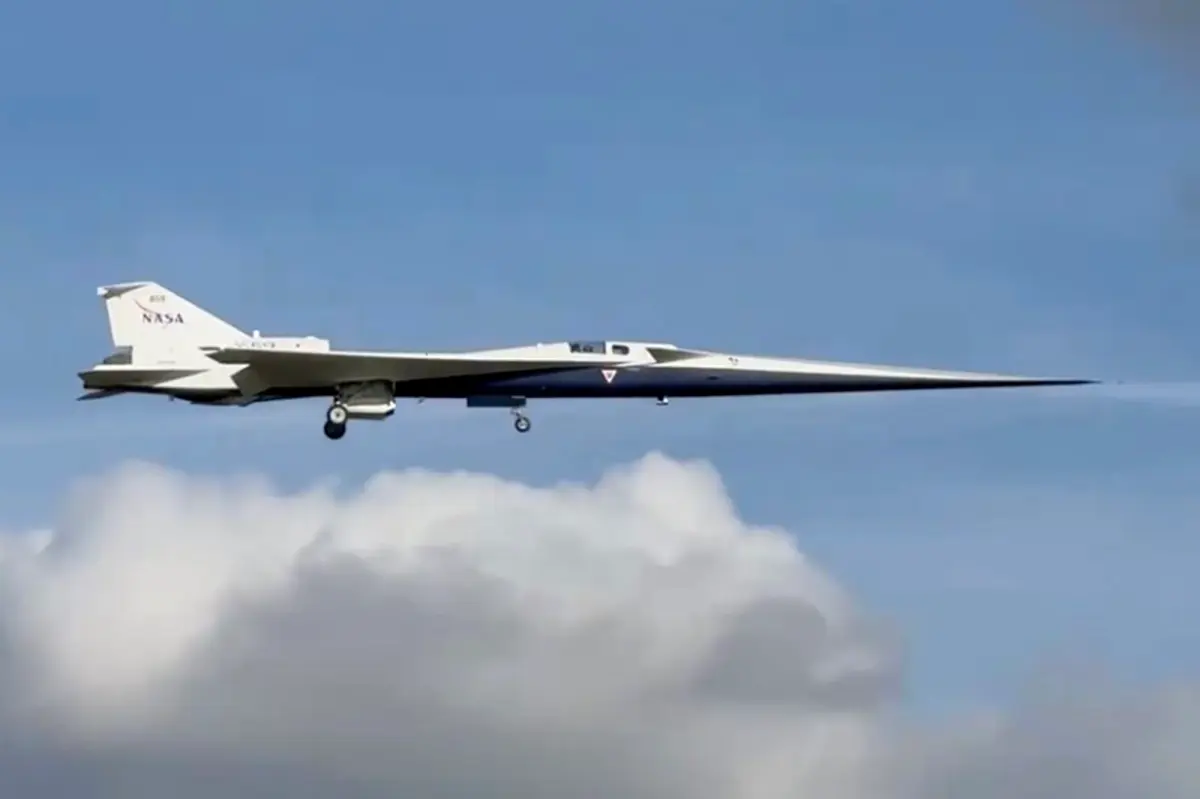
There is something deeply poetic about the image of a needle-nosed jet crossing the country on its first birthday, not hidden in a hangar but out in the open, flying toward the very place where humanity first learned to reach for the stars. The X-59 QueSST, NASA’s experimental aircraft with a nose so sharp it seems to split the air before it arrives, recently marked one year in flight with a cross-country journey from California to the Kennedy Space Center in Florida. Along the way, it dropped into Fort Worth, Texas, where aviation enthusiasts looked up and caught a glimpse of the future. That moment was more than a milestone; it was a reminder that NASA’s X-59 is no longer just a drawing or a mockup. It is a real, flying machine, one that has already logged 41 flights and hit speeds that would make a frequent flyer weep with joy. The aircraft can reach 925 mph, or Mach 1.4, and cruises at 55,000 feet—more than twice as high as a conventional airliner and nearly twice as fast. But the numbers, impressive as they are, don’t fully explain why this airplane matters. The X-59 has been nicknamed the “Son of Concorde,” and like any child, it carries the legacy of its parent. It remembers the glory of supersonic travel and also the mistakes that grounded it. The X-59 is built to do something the Concorde never could: break the sound barrier without shattering the peace below.
To truly appreciate the X-59, imagine what it means for a normal human being to cross the world in the time it takes to watch a movie and eat a meal. Right now, a flight from New York to London takes about seven or eight hours, enough time to read a book, suffer through jet lag, and feel every mile of the Atlantic Ocean. The X-59, if its design ever grows into a passenger plane, would finish that journey in just three and a half hours. New York to Los Angeles, a trip that usually eats up most of a day with security, boarding, and a five-hour flight, would be compressed into a mere two and a half hours. The last time such times were possible, you needed a Concorde ticket, a champagne budget, and a willingness to accept that you were part of a very small club. The X-59 is not a passenger plane yet, and it may never be one. But it is a demonstration that the dream of supersonic travel is not dead. It is being re-engineered, reborn, and made kinder. The point of the X-59 is not to impress the few people who get to fly it. The point is to tease the rest of us with the possibility of a world where time zones feel smaller, where a business meeting in London doesn’t mean a ruined weekend, where a family on opposite coasts could see each other for dinner without needing to clear their calendar for two days. That is the human promise hidden inside all that titanium and composite material: the gift of hours, the luxury of proximity.
The most revolutionary thing about the X-59, however, is not its speed but its sound. For decades, supersonic flight has been banned over populated land for a simple reason: the sonic boom. When an aircraft breaks the sound barrier, it pushes air aside so violently that the pressure waves merge and crash to the ground as a deafening explosion, capable of startling entire neighborhoods, rattling windows, and even damaging buildings. The Concorde could only fly over water, which meant its passengers got the speed but the route was also the plane’s cage. The X-59, whose name stands for Quiet SuperSonic Technology, is designed to turn that deafening boom into something far more gentle. Engineers at Lockheed Martin’s Skunk Works, the legendary facility in Palmdale, California, gave the jet a long, elongated nose and a smooth underbody that reshape the shockwaves before they ever reach the ground. Instead of a violent crack, the X-59 is expected to produce something like a distant drumbeat, a soft “glide thump” that might barely register as a car door closing down the street. That difference matters more than it sounds. If the X-59 can prove that supersonic flight does not have to be an explosive nuisance, the legal barriers that have kept fast planes out of the continental United States could begin to fall. The revolution is not that we can fly faster. It is that we can fly faster without becoming a jerk about it. The X-59 is politeness at 55,000 feet, a machine that is learning to whisper while still soaring farther and faster than almost anything else in the sky.
For anyone old enough to remember the Concorde, there is a bittersweet ache in this story. The Concorde was the most glamorous way to cross the Atlantic, a dart-like marvel with a price tag to match, and for a while it seemed like the future had actually arrived. Then time caught up with it. The plane was expensive to maintain and offered limited seating, so ticket prices were astronomical. A fatal crash in 2000 shattered public confidence, and by 2003 the last Concorde was grounded, never to fly again. The United States, in particular, has not had commercial supersonic flights since then. For over two decades, the phrase “supersonic travel” has felt like a relic, a future that was tried and abandoned. The X-59 is the quiet answer to that quiet loss. It is not trying to be the Concorde. It is not aimed at the luxury set. It is an experimental aircraft, a research tool, a flying laboratory designed to collect data and prove that quiet supersonic technology is real. If that research succeeds, the next generation of passenger planes, whether built by NASA partners or private companies, will not have to reinvent the wheel. They will simply have to scale up what the X-59 has already shown can be done. In that sense, this small, strange-looking jet is a bridge between a beautiful, failed past and a far quieter, more accessible future.
The public flyover at Fort Worth was a perfect way to celebrate the X-59’s first anniversary. The plane was recorded leaving its base in California last week, then spotted landing in Texas on October 28, exactly one year after it first took to the skies at Lockheed Martin’s Skunk Works. A video shared by aviation photographer Victoria Fontana captured the X-59 flying over Fort Worth, its unmistakable silhouette cutting through the sky alongside a NASA F-15 chase plane. For those who caught it, the sight was almost surreal, an X-plane looking exactly the way an X-plane should look: strange, elegant, and slightly ahead of its time. NASA chief Jared Isaacman confirmed on X that the jet was en route to the Kennedy Space Center in Florida, turning a routine repositioning flight into a journey of celebration. The X-59 is no stranger to causing excitement; earlier sightings had already made the rounds online, with people marveling at the design’s bizarre beauty. But this particular trip felt like a birthday party with a purpose. It also served as a reminder of the cost of such ambition. The X-59 program is estimated to be a $630 million investment, a sum that sounds enormous until you remember that the mission is not to build one jet but to unlock an entire era of flight. The X-59 is not a product; it is a question. And after 41 flights, NASA is still listening for the answer.
At its heart, the X-59 is not really about speed at all. It is about connection. Every human being has someone they miss, somewhere they wish they could be, some horizon they have wanted to reach since childhood. Airplanes have always been the machines we use to chase those dreams, but they have also remained stubbornly bound by time and distance. The X-59 is a promise that we do not have to settle for that. It is a promise that the future of travel is not just faster but gentler, that we can shrink the world without annoying the neighbors, that the skies can be opened again without turning the ground below into a war zone of shockwaves. As the jet crossed Texas, escorted by a fighter plane and followed by cameras, it carried more than scientific instruments. It carried a little bit of every child who ever watched a plane in the sky and wondered why it couldn’t go faster. It carried the restless spirit of all the passengers who have ever stared at an airplane window, doing the math on how many hours were left before they could finally land. It carried the memory of the Concorde and the hope of a new generation. The X-59 is a machine, yes, but it is also a stubborn human dream made physical, a way of saying that the future is not something we wait for. It is something we build, piece by piece, year by year, flight by flight, until the sound barrier is no longer a barrier at all but just another faint and friendly thump on the way to everything we have ever wanted to reach.