


Paragraph 1: The Announcement and the Shockwave
The news landed like a frost on a ripe field—unexpected, devastating, and final. SoCal Berry Growers, a name synonymous with the verdant, strawberry-scented valleys of Ventura County, has issued a formal notice to the Oxnard City Council on Halloween, announcing the complete shutdown of six of its farms and the mass layoff of approximately 572 employees, nearly all of whom are the seasoned, skilled hands that bring the region’s signature crop to life. The closures, slated to take effect in phases between January 11 and January 25, 2027, are not a quiet reorganization or a mere scaling back; they represent a complete exit from the local farming landscape for this major grower. The affected properties—Casper Ranch, Johansing Ranch, McConica Ranch, Parks Harbor Ranch, McGrath Conservancy Org. Ranch, and Teitelbaum Ranch—are all dedicated exclusively to growing strawberries for Driscoll’s, the global agricultural titan that essentially dictates the market terms for berries across the continent. While California law mandates a mere 60-day warning for large employers, this notice felt colder and more clinical than a simple legal requirement; it was a death sentence for a way of life. For the 572 workers and their families—many of whom have lived and breathed strawberry cultivation for decades, returning to the same fields year after year—the announcement shattered the illusion of permanence in an inherently transient industry. The Oxnard plains, often called the “Strawberry Capital of the World,” have long provided a semblance of stability, where seasonal work transitions into lifelong careers for those who prove their worth. Now, with this one massive filing, that stability has evaporated, leaving a community in shock and forcing everyone from the local grocer to the town council to confront the terrifying possibility that the strawberry economy they’ve built their lives around is crumbling beneath their feet.
Paragraph 2: The Economics of Despair
While the human toll is immediate, the underlying cause of this collapse is rooted in a financial reality that has been tightening like a noose around the necks of local growers for years. Ventura County’s agricultural sector has long been a pillar of the Southern California economy, and strawberries are its crown jewel, generating an impressive $808 million in wholesale revenue in 2025. Yet, that staggering figure hides a dark secret: the industry as a whole collectively lost roughly 1% of that revenue, meaning that despite record-breaking sales numbers, the bottom line for farmers is increasingly red. This is the paradox of modern agriculture—higher prices at the grocery store do not translate into higher profits in the field. Louise Lampara, the CEO of the Farm Bureau of Ventura County, painted a grim picture for the Ventura County Star, describing the current state of ag economics as “horrifying.” She warned that no industry can survive indefinitely if it experiences year after year of decreasing returns, and the statistics back her up. Looking at the broader picture, Ventura County’s total agricultural revenue hit a record $2.4 billion in 2025, but when adjusted for inflation, that figure represents a staggering 19% decline over the past decade. The money coming in simply isn’t what it used to be, while the costs of doing business—water rights, labor compliance, pesticides, land leases, and fuel—have skyrocketed. Growers are caught in a brutal squeeze: Driscoll’s, the massive buyer, holds the leverage to set wholesale prices that barely cover production costs, while the growers themselves absorb the risk of bad weather, pest outbreaks, and shifting consumer habits. For SoCal Berry Growers, the math reportedly stopped working long ago, and as Lampara noted, “You can only operate at a loss for so long.” The decision to shutter these six farms, likely costing hundreds of thousands of dollars in severance and legal fees, is a calculated move to cut losses before the bleeding becomes fatal to the parent company. It is a stark reminder that in the world of corporate agriculture, loyalty to the land and its workers rarely outweighs the exigencies of the balance sheet.
Paragraph 3: The Human Cost Behind the Headlines
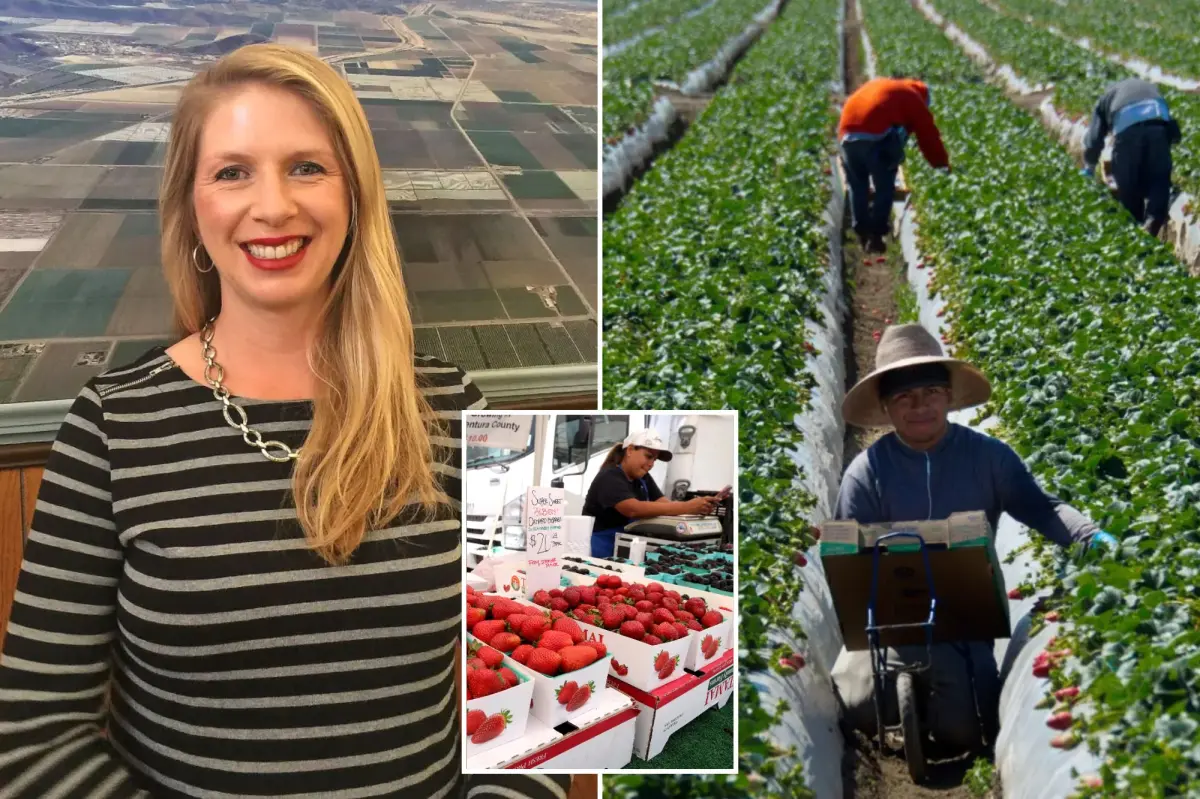
To truly grasp the magnitude of this layoff notice, one must step onto the damp, sun-drenched rows of the strawberry fields themselves. The pickers are not mere interchangeable cogs; they are artists of the earth, possessing an almost intuitive knowledge of which berry is perfectly ripe, how to snap the stem without bruising the fruit, and how to fill their wooden crates with precision that borders on obsession. For many of the 572 workers facing termination, this is not just a job—it is their identity, their culture, and their sole means of survival. The typical strawberry picker in Ventura County is a seasoned migrant worker, often a mother or father who has spent decades bent over the low plants, enduring chronic back pain and scorching heat, all while maintaining the stamina to move quickly through thousands of plants each day. They earn a premium wage for this grueling work, often exceeding the minimum wage due to piece-rate incentives, but that income is entirely dependent on the harvest season. The notice of closure, arriving just after Halloween, means these workers will see their final paychecks in January, right when the cold winter months make alternative agricultural work scarce. There is no safety net for many of these families, who often live in cramped, expensive housing in Oxnard or nearby towns, paying rents that consume most of their modest savings. The psychological impact is equally brutal. For workers who have toiled for a decade or more on the same ranch, who have watched children grow up while working alongside them, the closure represents a profound betrayal. They are being told that their years of tireless service count for nothing against the impersonal whims of a corporate ledger. As they file for unemployment and scramble to find work in other counties, they face the stark reality of a dwindling agricultural industry. The search for new jobs will likely lead them to different crops or to the service sector, where wages are lower and the physical demands are different. The fabric of their community, woven tightly through shared hardship and shared triumphs on the same soil, is now being torn apart, leaving behind a deep, aching void that no severance check can fill.
Paragraph 4: The Union Battle and Accusations of Retaliation
Adding a layer of venomous controversy to the economic tragedy is the accusation of bad faith and retaliation leveled by the United Farm Workers (UFW). Just a few months prior to the closure announcement, in July, the 572 workers at these six SoCal Berry Growers farms made history by voting to unionize with the UFW—a rare and hard-fought victory in a county where organized labor has struggled to gain a foothold. The company immediately contested the election, alleging misconduct by the union during the organizing drive, but a state board thoroughly reviewed the case and denied the company’s request, firmly reaffirming the workers’ right to unionize. The UFW sees the subsequent shutdown announcement as a blatant act of union-busting. Roman Pinal, the UFW’s Vice President, issued a scathing public statement, accusing SoCal management of using the closure as a weapon to punish workers for exercising their legal rights. “Instead of giving the workers a chance to negotiate a fair contract,” Pinal said, “SoCal management is now saying it will shut down, in what we believe is a clear violation of the law to avoid their legal and moral obligations to the workers who pick the strawberries.” He vowed that the UFW is intimately familiar with such tactics and would utilize every legal avenue available to defend the members’ rights, promising a fierce legal battle that could drag on for years. The timing is undeniably suspicious to union supporters; the closure comes only months after the successful vote and shortly before contract negotiations were set to begin. If the UFW can prove that the closure is a retaliatory measure designed to evade collective bargaining, the company could face severe penalties, including back pay and reinstatement orders under the National Labor Relations Act. The case now pivots on whether the company’s financial claims are genuine or a cynical cover for their disdain for organized labor. For the workers, the fear is that they have inadvertently signed their own termination papers by standing up for better wages and safer conditions, a chilling thought that could discourage other farmworkers across the state from pursuing unionization in the future.
Paragraph 5: The Industry’s Defense and the Changing Labor Landscape
However, the growers and their industry representatives are robustly rejecting the narrative of union retaliation, instead pointing to a cold, hard business calculus that makes no mention of labor politics. Rob Roy, the president and general counsel of the Ventura County Agricultural Association, argues that the unionization effort has had virtually no impact on the local industry over the past 25 years, and he dismisses the idea that these closures are a punitive move. Roy points to a fundamental shift in agricultural labor dynamics: over the last quarter-century, businesses have increasingly moved away from organized labor not because of fear, but because they have found better ways to manage their workforce through improved legal compliance, higher wages, and stronger in-house problem-solving structures. The association contends that SoCal Berry Growers is simply responding to the ruthless reality of the market. The company operates on razor-thin margins, and the promise of higher labor costs that comes with a union contract—even before negotiations—could have been the final straw that broke the camel’s back. From the industry’s perspective, the layoffs are a defensive measure to protect the solvency of the company as a whole, saving the remaining farms that might still be profitable. They also highlight the broader economic climate: the 19% inflation-adjusted decline in agricultural revenue over the past decade has already forced dozens of smaller farms into bankruptcy. The strawberry industry is particularly vulnerable because it is so labor-intensive; labor comprises up to 50% of the total production cost. While the UFW frames the shutdown as a violation of labor law, Roy and his colleagues argue that forcing a company to keep a money-losing operation open would be a violation of basic economic sense. They suggest that the union is looking for a scapegoat, when the real culprits are domestic competition, high land values, and the immense pricing power of corporations like Driscoll’s. In this view, the workers are collateral damage in a broader fight for survival within an industry that is rapidly consolidating, leaving less room for local family-run operations to thrive.
Paragraph 6: The Uncertain Fate of the Strawberry Fields
As the January closure deadline looms on the horizon, the future of Ventura County’s strawberry industry hangs in a precarious balance. The shuttering of these six farms is not an isolated incident; it is a bellwether for the potential exodus of one of California’s most iconic agricultural products. Land that has been cultivated for over a century may now be sold to developers or converted to less labor-intensive crops like avocado or citrus, which require significantly fewer hands but also yield different economic results. The ripple effect will be felt far beyond the laid-off pickers; it will hit the local trucking companies, the packaging suppliers, the fertilizer vendors, and the small-town diners that rely on the workforce’s patronage. The 572 workers, armed with information about their rights and the UFW’s promise to fight, now face a winter of uncertainty. They will likely scatter across the state, following the harvest seasons of different crops, breaking the stable communities they have built. The legal battle between SoCal Berry Growers and the UFW could set a precedent for how agricultural companies handle unionization in the future. If the company successfully emerges from this closure without major penalties, it may embolden other growers to use similar threats of closure to quell organizing efforts. Conversely, if the UFW wins a hefty judgment, it could force companies to think twice before using economic hardship as a shield. But beyond the legalities and the profits, there is a deeper, more haunting question: what does it say about our food system when the very people who feed us are treated as disposable? Louise Lampara’s warning echoes in the silence of the empty fields—”We are at a precipice.” The decision to close these farms is a stark illustration of the fragility of our agricultural infrastructure and a plea for consumers, policymakers, and corporations to look beyond the price tag of a pint of berries. For the residents of Ventura County, the strawberry is no longer just a sweet summertime treat; it is a symbol of a vanishing way of life, and its loss will leave a permanent scar on the community.