

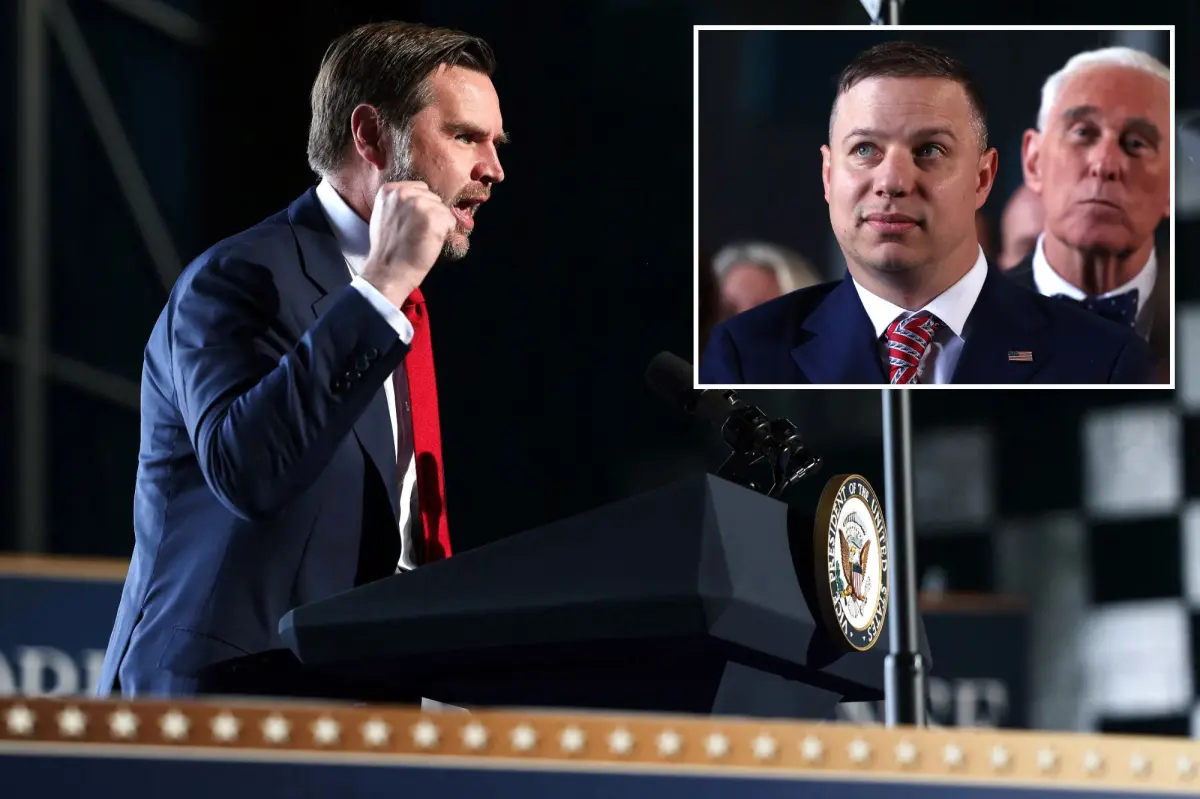
The winter light was already fading over the gray expanse of the former Griffiss Air Force Base when the engines of Air Force Two sent loose snow skittering across the tarmac. Vice President JD Vance stepped out into the cold Rome, New York air—a man on a mission, face set, coat collar up—and within the hour he was standing before a hangar full of Republicans, their breath visible in the chill, their cheers echoing off the corrugated steel. It was the evening before Election Day, and the vice president had come to save a seat that should not have needed saving. New York’s 21st Congressional District—a sprawling North Country expanse that stretches from the Adirondacks to the Canadian border, past mill towns and dairy farms and rusting factories—had been reliably red for generations. Elise Stefanik had carried it by 24 points just a year earlier. Donald Trump had carried it by 21. Republican control here was not a hope; it was an assumption, something locals had come to treat like the weather. And yet here was the vice president of the United States, landing at a decommissioned air base to stump for a man named Anthony Constantino, a self-made sticker tycoon who, according to a recent poll, was trailing a little-known Democrat. The energy in the room was not the easy confidence of a party expecting victory; it was the nervous bravado of an organization that knows it is in a fight. Vance seemed to feel it too. He reminded the crowd of their duty. He told them to get out and vote. And in a campaign that had already grown strange—with a bitter primary, a wounded Conservative Party, a furious candidate, and an unprecedented infusion of Democratic cash—he added another layer of urgency, because every sign pointed to this race being closer than anyone in that hangar could have imagined twelve months earlier.
Standing at the podium, Vance reached for something more than the usual pre-election applause lines. He summoned the story of his own upbringing in Middletown, Ohio—a steel town that had seen its plants close and its people scatter, and yet refused to call itself broken. He said Rome was not so different. He pointed to places like Massena, a manufacturing hub along the St. Lawrence River, and to the hard-luck factory towns that dot the North Country, and he told these Republicans something they had not expected to hear: this is not a story of what America has lost, but of what America still has the power to build. It was the language of a man selling revival, not rescue. Vance framed the election as part of what he called President Trump’s “America First revolution”—a sweeping agenda built on the pillar of “sovereignty.” He meant it broadly, and he let the crowd fill in the contours: cracking down on illegal immigration, interdicting cross-border drug trafficking, and pursuing a combative trade policy that demanded fairness from other nations. In a district that shares a long, porous border with Canada, these are not abstract talking points; they are the stuff of daily headlines, of rural anxiety about fentanyl and the flow of goods and the feeling that Washington has long treated the borderlands as an afterthought. Vance told the crowd they had done so much already, that the country had turned a corner, but he insisted there was much more to do to rebuild the good lives of working people in the 21st Congressional District. He did not just ask for votes; he asked them to believe their problems had been heard, that the government had finally sent someone who understood. He praised Constantino in the same breath—a man, he said, who had actually lived putting American workers first, who had built a business in New York despite its punishing regulatory climate, who had risked his own fortune rather than ask for favors. It was a quintessential Vance pitch: working-class nostalgia fused with Trumpian industrial optimism, delivered with the sense that knowing the country’s pain is as important as fixing it.
The circumstances that brought the vice president to this hangar were as unlikely as they were revealing. For years, the 21st had been considered a safe Republican fortress, the kind of seat ambitious party members used as a launching pad. It had been held by Stefanik since 2015, and when she stepped down to take a position in the Trump administration, the presumption was that her successor would coast into office with a similarly lopsided margin. But a chain of events turned that assumption on its head. Constantino, a brash, combative businessman who had made a fortune founding Sticker Mule, an online custom sticker company headquartered in Amsterdam, New York, locked horns with the local GOP establishment during a bruising primary battle. He won the nomination—with the backing of Donald Trump himself—but he did so by alienating many of the conservative committees, county chairs, and grassroots activists whose buy-in usually ensures a unified party. The wounds never healed. In a bitter twist, the Conservative Party, which in House races almost always aligns with the Republican, left its ballot line blank, a public rebuke that signaled deep internal fractures. Then came the national environment. Democrats, riding a wave of frustration with the early days of the Trump administration, sensed an opening. A Siena College poll released in early November—viewed skeptically by Constantino’s campaign, which called it a “scam” and complained that it included questions about a write-in candidate—showed Constantino’s Democratic opponent, Blake Gendebien, up by four points. Four points. In a district that a year earlier had gone Republican by two dozen. The poll was greeted in Democratic circles with something close to shock; strategists rushed into the district, pouring $1.4 million into television advertising in a single week. The race had suddenly become the most surprising battleground in the country, a seat long taken for granted now defining the anxieties of both parties. Republicans saw the same numbers and the same danger, which is precisely why Vance’s plane had touched down on that cold strip of tarmac twenty-four hours before the polls opened.
The candidate at the center of it all seemed almost to feed on the chaos. Anthony Constantino stormed the stage after Vance with a mix of gratitude and rage, his voice raspy, his energy uncontainable. He thanked the vice president for coming, and then made a promise that came out like a threat: if the district turned out for him, he would pay them back in Washington by creating jobs, keeping the border secure, cutting taxes, restoring the Second Amendment in New York, and supporting law enforcement. But he spent several minutes not on policy but on the press—the reporters penned in at the back of the hangar, whom he urged the crowd to berate, calling them “evil” for suggesting he was anything but overwhelmingly ahead. “We’re not running against Blake, we’re running against these people,” he shouted, jabbing a finger in their direction. It was vintage Constantino: truculent, theatrical, thin-skinned, and wildly energizing to the section of the crowd that mistrusted the media as much as he did. He had, after all, pumped seven million dollars of his own money into the race, and he was not about to accept the idea that it might not be enough. Vance had called him a man who put American workers first, and Constantino carried that endorsement like a banner. For all his bluster, he represented something the GOP had hoped to franchise: a successful businessman who claimed he had been fighting for workers long before he ever ran for office, who had chosen to build in New York despite the state’s well-known distaste for corporate growth, who picked public fights not with his opponent but with the institutions—political committees, the Conservative Party, the press—that he insisted were secretly aligned against him. He painted himself as the ultimate outsider in an establishment game, even if he was the one with Trump’s blessing and seven million dollars of his own.
Around Constantino stood proof of how far the party was willing to go to keep this seat. Donald Trump Jr. had flown in as well, as had Energy Secretary Chris Wright, both lending their presence to a rally that had the feel of a last-ditch campaign swing more than a victory lap. Notably absent was the woman whose seat they were fighting to fill: Elise Stefanik, the popular congresswoman who had spent a decade representing the district, was nowhere to be seen—a silence that spoke volumes about the fissures beneath the surface of the rally. Vance, for his part, widened his target beyond the congressional race. He encouraged the crowd to “ditch the witch,” his unflattering nickname for Democratic Governor Kathy Hochul, though he declined to mention Republican gubernatorial candidate Bruce Blakeman by name—a small but telling detail in a state where the GOP’s statewide hopes remain a long shot at best. The message was simple: the party needed this district not only to maintain the House majority but to send a signal that the America First movement still owned the working-class heart of the North Country. Every speaker, every applause line, every reference to borders and trade and factories was carefully calibrated to remind voters that the national Republican brand still spoke their language. But there was an unmistakable edge of worry in the proceedings. When you fly the vice president, the president’s son, and a cabinet secretary into a small-city hangar the night before Election Day, you are not doing it because you expect a rout. You are doing it because you are afraid. The crowd, mostly gray-haired, mostly rural, mostly certain in their conviction, applauded everything and waved signs, but even they seemed aware that something was different this time—that the district they had always owned had become a question mark, that the cold air outside might not be the only thing making the evening uncomfortable.
Gendebien, watching from afar, could not resist the jab. In a statement released within hours of the rally, the Democrat framed the vice-presidential visit not as a show of strength but as evidence of panic—pointing out that a party that had won the seat by 24 points less than a year ago should not need to fly in the country’s highest-ranking backup singers to keep it. He cited the soaring cost of diesel, the Medicaid cuts that had closed rural hospitals, and the feeling among working families that the GOP had turned its back on them. It was a graceful, disciplined response from a candidate who had been vastly outspent, vastly outgunned in celebrity firepower, and yet might just win. And it spoke to the deeper meaning of this strange little race. For all the talk of sovereignty and America First, the contest in the 21st District had become something else: a test of whether national politics could rescue a local campaign, whether familiar brand names could outweigh local grievances, whether Trump’s aura could paper over a party’s internal bleeding. The people filing out of that hangar into the dark New York night were not thinking about national trends; they were thinking about their homes, their jobs, their kids, the high price of heating oil, the long drive to the nearest hospital. They had been told by a vice president that their story was not lost, that it was still being written. Whether they believed him would be determined at the ballot box the next morning. Win or lose, the night itself had already told a story—of a seat once so safe it was invisible, now held aloft by the entire machinery of the national GOP, while a lone businessman and the swirling currents of a volatile electorate decided its fate. In a country watching closely, the outcome would offer an early glimpse of what the next two years might look like, and whether the path Vance had described was one the people would choose to walk.