

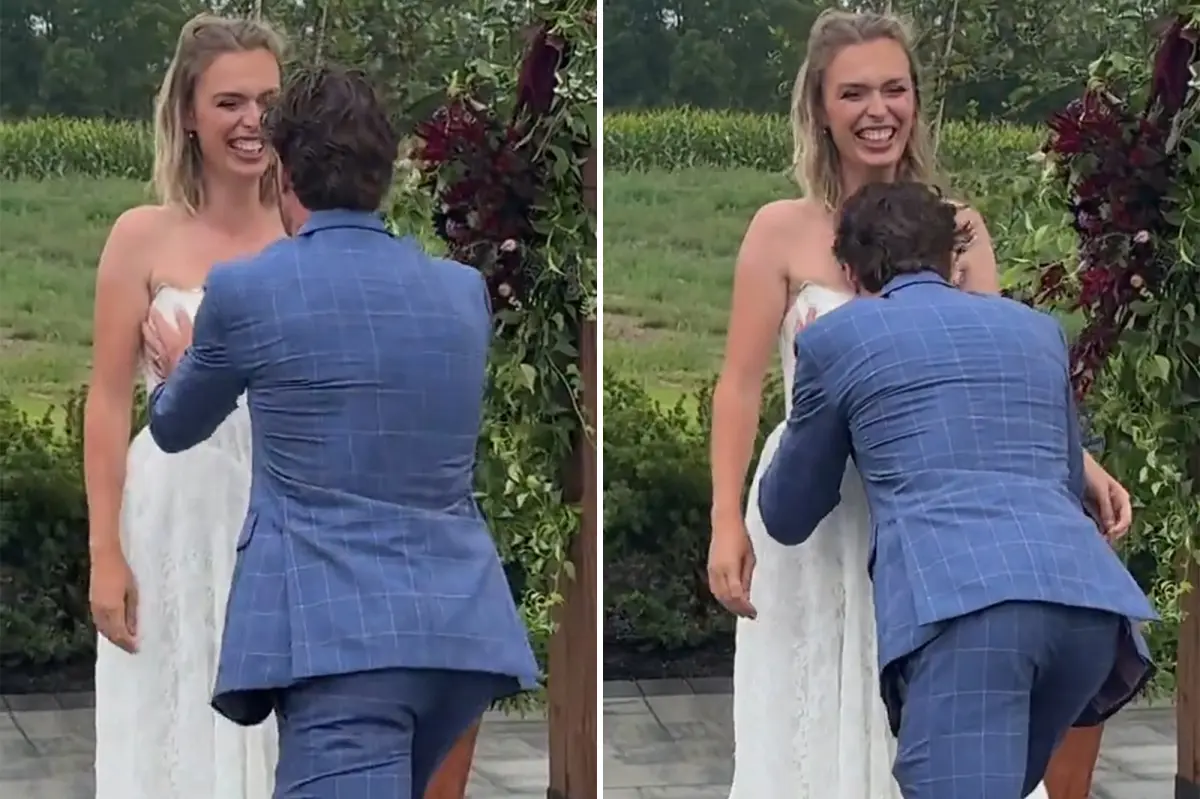
In a moment that has now been witnessed by hundreds of thousands of people across the internet, a Canadian groom chose to celebrate his wedding vows in a way that was anything but traditional. The video, shared by the wedding officiant, captures the newly married couple, Adelina and Riley, standing at the altar after exchanging rings and weathering an unexpected downpour that had briefly interrupted their outdoor ceremony. As the officiant pronounced them husband and wife, the crowd leaned in, expecting the tender, romantic first kiss that typically seals such a moment. Instead, Riley, in a burst of exuberant and decidedly unconventional enthusiasm, buried his face into Adelina’s chest, shook his head vigorously in the classic “motorboat” gesture, and then pumped his fists triumphantly to the guests. Adelina erupted in genuine laughter, her joy undeniable, but the scene left more than a few audience members—and later, millions online—wrestling with a mix of disbelief, amusement, and outright disapproval.
The officiant, Nathan Grieve, who captured the footage, admitted that he had never seen anything quite like it in all his years performing ceremonies. He playfully captioned the video as “perfect chaos,” noting that the moment would certainly be remembered at family gatherings for years to come. What made the scene even more surreal was the impromptu soundtrack: as the couple began their walk back up the aisle, the planned exit music mysteriously failed to play, and instead, a blaring car alarm from the nearby parking lot filled the air. For the couple, it seemed to be a fitting, if chaotic, capstone to a day that already had its share of surprises—the rain, the unconventional celebration, and now the unexpected alarm. Their laughter and easygoing demeanor suggested a couple who thrive on unpredictability, but the public’s reaction was far less forgiving. The video quickly amassed over 270,000 views on TikTok, sparking a heated debate about boundaries, respect, and what constitutes appropriate behavior at a sacred ceremony.
While the bride’s joyful reaction might have seemed to indicate that this was a private joke between two people deeply in love, etiquette expert Jo Hayes was quick to offer a firm rebuke. In an interview with news.com.au, Hayes acknowledged that the act appeared consensual—Adelina was not shocked or trying to stop him—but she argued that the setting itself made the gesture deeply inappropriate. “Such sexually suggestive or innuendo-type behavior isn’t appropriate,” she said, pointing out that wedding ceremonies are rarely adults-only affairs. Children are often present, and witnessing such a physical display can be confusing or uncomfortable for them. Even for adults, she noted, the act can create an awkward atmosphere, detracting from the solemnity and emotional weight of the vows just exchanged. Hayes speculated that the groom might have been inspired by the famous “motorboat” scene from the movie Wedding Crashers, but she offered a blunt piece of advice: “Darling, it’s really not funny.” Her final counsel was simple and direct: “Save it for the honeymoon.”
The etiquette expert’s criticism struck a chord with many who watched the video, and social media was soon flooded with a mix of outrage, humor, and disbelief. Some commenters were quick to declare that the act would “immediately instigate a divorce,” while others took a more measured but still critical stance. One user thoughtfully pointed out that while they and their husband enjoy crude jokes in private, they would never dream of making such a display in front of family members. “It shows a lack of respect for her and their families,” they wrote. Another commenter expressed sheer embarrassment, noting the presence of the bride’s parents at the altar, while others simply wrote that they were “speechless” or that the gesture was “distasteful.” The overwhelming sentiment was that, regardless of the couple’s happiness, the act crossed an invisible line—one that many felt should be reserved for the privacy of their bedroom or at least for less formal, less sacred occasions.
But as the online backlash grew, a quieter counter-narrative also emerged, with some viewers defending the couple’s right to celebrate their union in their own way. Adelina’s laughter, they argued, was not forced or performative; it was the genuine, unguarded reaction of a woman who clearly knows and loves her husband’s playful, spontaneous nature. The ceremony, after all, is supposed to reflect the personalities of the two people getting married, not just conform to rigid societal expectations. For a couple who had already survived an unexpected rainstorm and a missing musical cue, a motorboat might have felt like just another inside joke in a day full of joyful unpredictability. This perspective invites us to consider whether we are too quick to judge moments that are not our own, and whether the true measure of a wedding’s success is the happiness of the couple rather than the applause of the audience. It also asks us to recognize that humor and affection manifest in countless forms, and that what might make one person uncomfortable can be deeply meaningful to another.
At the heart of this viral moment lies a larger, more introspective question about the nature of public affection, the boundaries of propriety, and the shifting norms of wedding culture. Weddings are curious events, blending ancient ritual with deeply personal expression, and they often become a stage for the couple’s most authentic selves. For some, that authenticity means a sweet, chaste kiss; for others, it might mean a playful, raunchy gesture that shocks the room. The question is not whether Riley’s behavior was “right” or “wrong”—after all, the bride’s consent and happiness are evident—but rather why such an act provokes such strong reactions. It challenges our assumptions about what belongs in a sacred space, about respect for elders and children, and about the fine line between playful affection and crude display. As the video continues to circulate, it serves as a mirror, reflecting not only the couple’s unique bond but also the diverse and often contradictory expectations we place on one of life’s most significant ceremonies. And perhaps, in the end, the most human thing of all is not to judge quickly, but to wonder, with a mix of curiosity and empathy, what we would have done in that moment—and to recognize that love, in all its strange and wonderful forms, has a way of writing its own rules.