


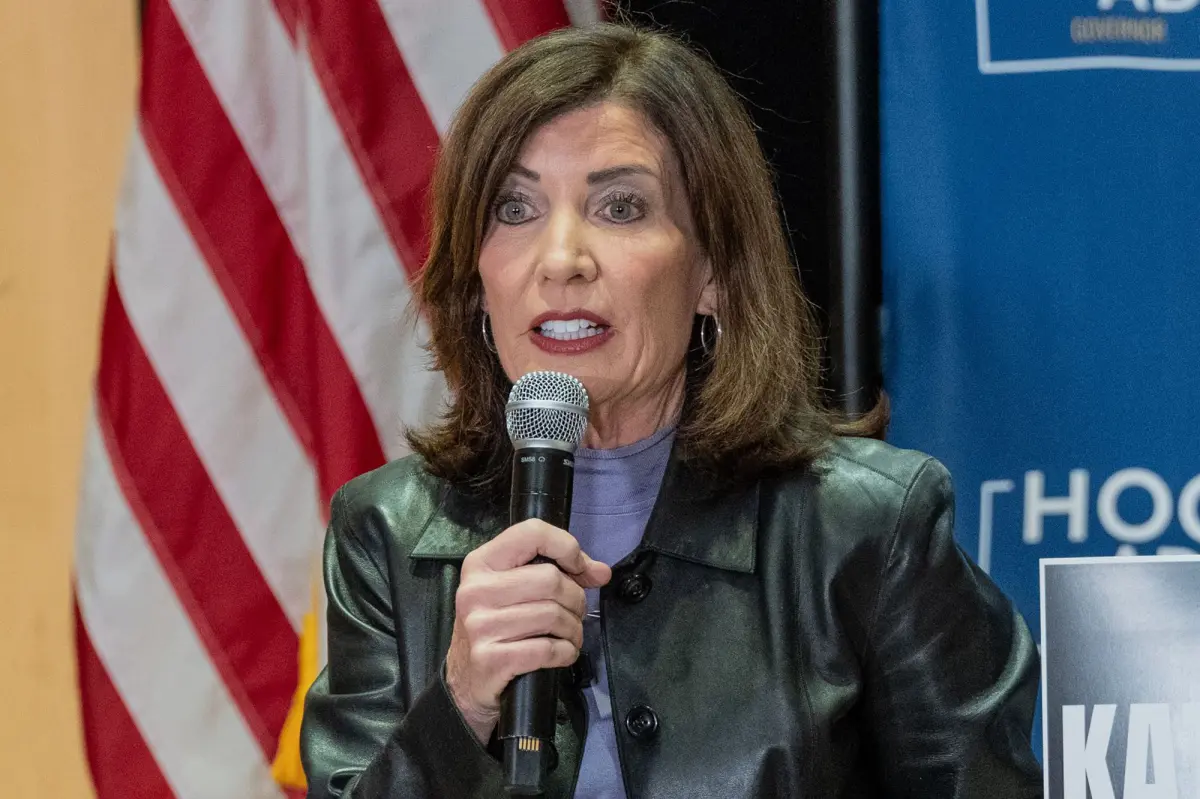
It’s a strange feeling to be asked for four more years and yet hear so little about what those years would actually look like. That’s where Kathy Hochul finds herself as she campaigns for another term as governor of New York. She has a record to run on, and she’s proud of it, but when it comes to the future, her campaign website is oddly quiet. It lists her accomplishments from her first full term in office—things like standing up to Trump, expanding childcare, bringing back subway patrols, and giving rebate checks to struggling families—but if you go looking for a policy agenda, a vision statement, a set of promises for 2026 and beyond, you’ll be scrolling for a while. There are no specific proposals on taxes or spending, no detailed plan for economic development, public safety, education, or welfare. There is no blueprint. There’s just the record, and a hope that it will be enough. It’s a bit like a job interview where you talk about everything you’ve done at your old job but never answer the question that’s actually being asked: what will you do if we hire you? For many voters, that’s not just a political flaw—it’s a human one. People want to feel that they’re voting for something, not just against something or for someone who already has the title. And in a state as big, complicated, and expensive as New York, the absence of a clear forward-looking agenda can feel less like humility and more like avoidance.
That avoidance has never been more obvious than when the conversation turns to taxes. Hochul has spent months walking a very delicate tightrope, trying to keep one foot with the moderate suburbanites and the other with the fiery progressive wing of her party. During her only debate with Republican challenger Bruce Blakeman, she gave a short, direct “no” when asked whether she would raise income taxes. But since then, she has been far less clear, dancing around the subject and refusing to pin herself down. And that’s not an accident. Hochul has been cozying up to Zohran Mamdani, the democratic socialist New York City lawmaker who has become a favorite among younger, left-leaning voters. Mamdani’s message is simple and energizing: tax the rich, redistribute wealth, and build a more just society. He’s popular. His supporters are young, loud, and enthusiastic. And Hochul seems to want their energy without fully embracing their ideology. She’s even given him tangible things—like a new tax on luxury second homes in New York City, a move aimed at the wealthy that delighted the left. But even that hasn’t cooled the demand for more. The socialists still want more tax money, more programs, more structural change. Critics see Hochul’s dance as something darker than political caution. They see an empty vessel waiting to be filled by someone else’s agenda. Blakeman puts it bluntly: Hochul doesn’t have an agenda because Mamdani is writing one for her. According to Blakeman, if she gets another term, Mamdani will call the shots. Hochul will just hold the pen. And that means higher property taxes, higher income taxes, new inheritance taxes, more businesses fleeing the state, and more prisons closing down. Whether you believe that or not, it’s a compelling story—and in a political moment where people are desperate for specifics, it fills the void that Hochul herself has left open.
Bruce Blakeman, for his part, isn’t shy about telling voters what he would do. The 71-year-old Nassau County executive has offered a sweeping tax-cut plan that, if approved, would eliminate income taxes entirely on the first $50,000 of earnings for single people and on the first $100,000 for married couples. It’s a big, bold, easy-to-understand promise, the kind that makes you wonder why every candidate doesn’t do it. It may not be fully fleshed out, and opponents might question whether it’s realistic, but at least it’s something. That contrast is what makes Hochul’s vagueness so frustrating to her critics. GOP strategist Bill O’Reilly says she knows exactly what the agenda is—she just isn’t telling you because she’s waiting for instructions from Mamdani and the Democratic Socialists of America. State Conservative Party chairman Gerard Kassar puts it even more harshly, saying Hochul has kicked the can down the road on the two issues that matter most to New York families: taxes and the green energy mandates that could drive up costs. He calls her agenda a status quo agenda, and to him, that’s the worst kind of agenda. It’s an agenda that doesn’t move anything forward, doesn’t take a stand, doesn’t risk anything. It just exists, like a placeholder until someone else tells her what to think. That’s a serious charge, and it resonates because she won’t do the one thing that would disprove it: stand up and say, here are my plans, here are my numbers, here is what I’m going to fight for.
But if you step back and look at how Hochul came to power, her reluctance starts to make a certain kind of human sense. She wasn’t elected governor in a normal way. She was lieutenant governor when Andrew Cuomo resigned in August 2021, following a barrage of sexual misconduct allegations that he has denied. She took over the state during a crisis, then had to run for a full term in 2022, when she won. So she’s spent her entire time as governor in a kind of extended stress test, trying to stabilize a ship that was already rocking. That might explain why she’s cautious about making promises she might not be able to keep. It might also explain why she’s following a playbook that feels familiar: Cuomo himself, when he ran for reelection in 2014, published a detailed, 200-plus-page policy book called “Moving New York Forward.” But four years later, when he ran for a third term, his campaign website was mostly about his accomplishments—his plans for the future were largely blank. It was a winning strategy for him, and maybe Hochul is hoping it works for her too. The logic is understandable. If you’ve done something, you can defend it. If you promise something, you can fail. But voters are not always logical, and what they want in a candidate is often less about safety and more about hope. When a candidate refuses to paint a picture of the future, it starts to feel like they don’t trust us to hear it. And for a lot of New Yorkers, especially young ones who are struggling with rent, student debt, and the cost of childcare, that’s not just a political failing. It feels personal.
When Hochul does talk about the future, though, you can hear the excitement in her voice. Her campaign points to a recent press gaggle where she got a little loose and a little emotional about what she still wants to do. She talks about the Interborough Express, an ambitious infrastructure project that would connect Queens and Brooklyn, a train line that’s been talked about for decades and, she believes, would be transformational. She talks about reinvesting in the subway system, making it faster, safer, and more efficient than it is today. She talks about Micron, which she calls the largest private sector investment in American history, promising fifty thousand jobs in upstate New York. She wants to build an entire semiconductor ecosystem, a Silicon Valley for chip manufacturing, right in the state. She wants to update New York’s energy plan with an “all-of-the-above” approach that even includes reviving nuclear power. And she says she’ll go back to the Trump administration after the election—because, as she put it, the politics will be over—and ask for the authorization to move forward on nuclear. She also wants to continue expanding universal childcare, building out the infrastructure, finding locations, hiring staff, and making sure there’s enough money to make it work. And she wants to build housing, all over the state. When she says all this, you get the sense that she isn’t just reciting bullet points. She’s describing a longer game, one that can’t be finished in a single term. That’s a fair argument. Big things do take time. But it also feels, at times, like she’s describing projects that are already underway, not a new vision for the next four years. She’s saying she’ll keep going, not that she’ll take us anywhere new. There’s a difference between maintenance and momentum, and voters can feel the difference in their bones.
The truth is that Hochul has plenty of real accomplishments to point to, and her website makes sure you see them. She fought back against Trump by holding ICE agents accountable and suing over tariffs. She passed laws to curb auto insurance costs. She sent inflation and utility rebate checks to people who needed them. She banned cell phones in schools, which some parents love and others think is overreach. She expanded universal pre-K and universal childcare. She funded more patrols in the subway. These are real things, tangible things, and they’ve made a difference in people’s daily lives. But none of them answer the question that all campaigns must eventually face: what comes next? Her opponents are happy to fill in the blank with a nightmare version of the future, and her supporters are left hoping that she’ll find her voice before it’s too late. It’s a human problem, really. We all like to be appreciated for what we’ve done. We all resist being forced to promise what we might not be able to deliver. But asking someone to give you four more years is an act of trust, and trust usually requires some vulnerability. Hochul has spent a career being careful, being competent, being steady. What she hasn’t done is given New Yorkers a clear, detailed answer to the question of what those four years will actually be for. So voters are left with a choice: a governor who says she’ll keep working hard, or an opponent who says he’ll change the math. In a world that feels uncertain and scary, certainty is a powerful thing. And right now, the only thing certain about Hochul’s agenda is that there isn’t one—not in writing, not in sight, and not in the speeches that are supposed to give people something to believe in. Four more years of something something may be enough for some. But for a state as restless and demanding as New York, it might not be enough at all.