


It’s the kind of milestone that makes you feel both ancient and wonderfully young at the same time. A quarter of a century has somehow slipped by since Harry Potter and the Philosopher’s Stone arrived in cinemas, and yet the image of a bespectacled boy trundling his trunk through a brick wall at King’s Cross still feels as fresh as yesterday. The first film didn’t just introduce us to a boy wizard; it gave us a world we wanted to climb into, a world of hidden platforms, talking portraits and friendships forged in the unlikeliest of places. Alongside Harry, Ron and Hermione, the films created another unlikely star: the Hogwarts Express itself, portrayed by the GWR 4900 Class No. 5972 Olton Hall, a graceful steam locomotive that seemed to have as much personality as any of the actors. It became shorthand for adventure, freedom and the delicious thrill of leaving the ordinary world behind. Every time it pulled out of Platform 9¾, puffing smoke and carrying young witches and wizards toward an unknown future, it somehow made us believe that the train was the real magic. The truth, of course, is that while the spells were fictional, the landscapes and stations that framed those scenes were wonderfully real. The journey the Hogwarts students made, and so many of the places where they stopped, studied and stumbled into danger, were all rooted in actual British locations. Rail Europe, clearly in tune with our nostalgia, has rounded up a handful of the best real-world places where you can step directly into the Harry Potter universe this spooky season. From the gleaming platforms of London to the misty Highland valleys, these are spots where the boundary between film and reality blurs. You don’t need an invisibility cloak to feel the enchantment; you just need a rail ticket, a sense of wonder and maybe a good scarf. Whether you’re a longtime fan who can quote every film or someone who simply loves beautiful British scenery, these destinations offer a way to experience the story not as a spectator, but as a traveller. The magic may have been made in a studio, but the settings were always waiting for us in the real world, and now, twenty-five years on, they’re easier to reach than ever.
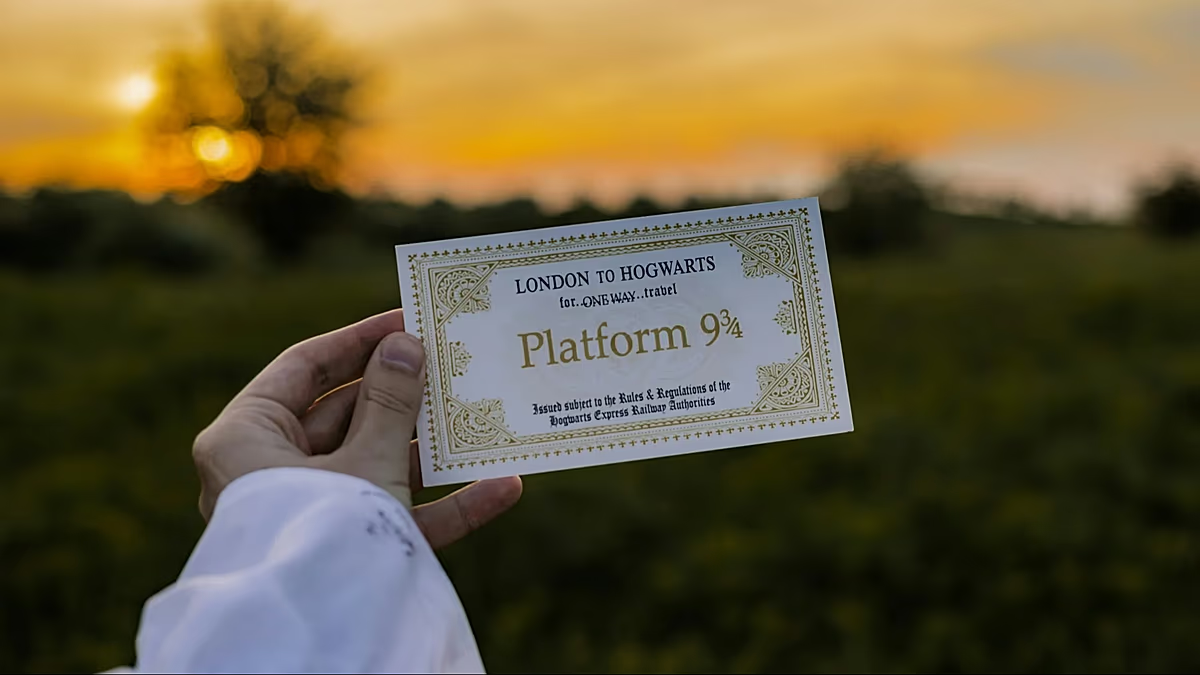
Start where the story starts. No Harry Potter-inspired trip would be complete without a stop at Platform 9¾ at London King’s Cross station, and yes, you will feel a little self-conscious queuing for a photo with a luggage trolley that appears to be vanishing into a brick wall. But then you see it, that wonderful half-trolley with its worn labels and the little owl cage, and something inside you shifts. You remember being eight years old, or twelve, or however old you were when you first believed that magic could be found if you only knew where to look. It’s a fitting place to kick off a magical rail adventure, not least because the trains departing from King’s Cross head north towards destinations that will feel uncannily familiar, including Durham and Yorkshire. But if you want to go deeper into the physical world of the films, make your way to the Warner Bros. Studio Tour just outside London. Between 14 November 2026 and 17 January 2027, the attraction transforms into “Hogwarts in the Snow,” a seasonal version of the original sets where snow settles on cobblestones, the Great Hall tables groan with festive feasts and twinkling lights make everything feel cosier than a common room fire. It’s the perfect antidote to a cold British winter, and it offers a rare chance to walk through the actual doors and corridors that served as the backdrop for some of the most beloved scenes in cinema history. Getting there is easy: take a train from London Euston to Watford Junction, then hop on the Studio Tour shuttle bus. Just be sure to book your entry separately, because the magic, unlike the shuttle, is not walk-up. This is one of those rare experiences that manages to feel both like a behind-the-scenes documentary and a dream come true, and it’s an especially lovely way to spend a November afternoon when the light fades early and you want to hold onto the warmth of the films a little longer. You’ll leave with snow in your hair, a lump in your throat and a renewed belief in the power of a good story.
Of all the images in the Harry Potter films, none is more instantly recognisable than the Hogwarts Express curving over a sweeping stone viaduct, its steam trailing into a sky full of Highland clouds. It’s one of those shots that makes you want to live inside the film, and here’s the wonderful secret: you can. The Glenfinnan Viaduct is real, standing proudly in the Scottish Highlands near the village of Glenfinnan. You don’t need a time-turner or a Portkey to see it. The most magical part? You don’t even need to book a special heritage train to cross it. Regular ScotRail services between Fort William and Mallaig rumble over the same arches, following the exact route the students took on their way to Hogwarts. As the train clatters across the viaduct, you can look out of the window at the mountains, the loch and the endless sky, and it doesn’t take much to imagine that you’re on your way to school. If you prefer to watch the train from the ground, there are viewing points where you can wait for the crossing, camera in hand, and feel the ground tremble as the locomotive approaches. The area itself is steeped in history too, with the Glenfinnan Monument nearby and the atmospheric landscape that inspired countless legends. Whether you’re on the train or beside the track, this is the moment where the film’s most breathtaking scene becomes your own memory. It’s not just a photo opportunity; it’s a chance to experience the same sense of wonder that Harry, Ron and Hermione must have felt, looking out at a world that was bigger, wilder and more beautiful than anything they had ever known. And if you time your visit right, you might even catch the famous Jacobite steam train crossing the viaduct, all whistles and billowing smoke, and for a few seconds you’ll be certain that magic is real.
If you’ve ever walked through Oxford on a foggy autumn afternoon, you already know that the city seems to have been designed by someone who loved the same books you loved as a child. Its winding lanes, ancient colleges and grand halls wouldn’t look out of place at Hogwarts, and in fact many of them stood in for the school in the film series. The Bodleian Library’s Divinity School, with its exquisite vaulted ceiling, doubled as the hospital wing where Harry and his friends recovered from their many adventures. Duke Humfrey’s Library, all dark wood and hush, appears as the restricted section of the Hogwarts library, and the sweeping staircase at Christ Church also makes a memorable appearance. What makes Oxford so special for Harry Potter fans is that you don’t have to queue for a ride or a soundstage; you can simply wander through the same stone corridors and courtyards that the actors walked, feeling the weight of centuries and the ghost of every story told there. The air smells of old paper, damp stone and woodsmoke, and every corner seems to invite you to stop and stare. When you’ve had your fill of filming locations, the city offers a delightful tangle of bookshops, cafés and hidden corners to explore. You can spend a morning retracing the steps of a film, then spend an afternoon discovering a beautiful old library or a quiet garden you never knew existed. And because fast trains from London take only around 45 minutes, Oxford is an easy day trip. It’s the kind of place where history and fantasy sit side by side, and where the boundary between the real world and the wizarding world feels thinner than almost anywhere else. Bring a camera, bring a jumper, and bring your inner child, because Oxford will remind you why you fell in love with this story in the first place.
Durham is the kind of place that makes you want to lower your voice and look around in awe. Its cathedral, perched dramatically on a hill above the River Wear, is one of the most recognisable real-life locations in the Harry Potter films, and for good reason. The Norman architecture, with its massive columns and ancient stone cloisters, practically breathes history. It’s easy to see why the filmmakers chose it to stand in for Hogwarts: every corridor feels like it has secrets, every shadow seems to hold a ghost. The cloisters feature prominently in Harry Potter and the Philosopher’s Stone, including the memorable moment when Harry releases Hedwig into the wintry sky, and the cathedral’s Chapter House served as Professor McGonagall’s classroom. Standing there, you can almost hear the clip of McGonagall’s heels and the rustle of student robes. But Durham is not just a film set. The city itself is a treasure, with its dramatic hilltop setting, riverside walks, narrow streets and charming shops. You can wander along the river, look up at the cathedral towers, and feel as though you’ve stepped into a medieval story. Direct trains from London King’s Cross take around three hours, making it entirely possible to swap the capital for cathedral views and a little Hogwarts nostalgia in a single day. It’s the kind of place that rewards both the dedicated Potterhead and the casual traveller, because the magic of Durham is not only in the scenes it helped create, but in the timeless, slightly mysterious atmosphere that clings to its stones. If you’re lucky enough to visit on a grey, drizzly day, so much the better: the wet cobbles and low clouds only add to the feeling that you’ve stumbled into a film set.
Finally, there is a place that feels as though it has been frozen in time, waiting for a scarlet steam train to pull in. Goathland station in North Yorkshire will be instantly familiar to anyone who has watched Harry Potter and the Philosopher’s Stone, because this is where the young heroes arrived at Hogsmeade station, bundled in winter cloaks and surrounded by steam and snow. The old-fashioned platforms, wooden signal boxes and rolling moorland make it one of the most atmospheric stops on any Harry Potter pilgrimage. The station is part of the North Yorkshire Moors Railway, a lovingly preserved heritage line that winds through some of England’s most beautiful and untamed countryside. As you stand on the platform, the sound of a distant whistle and the smell of coal smoke are enough to send a shiver down your spine. Whitby and Grosmont are useful gateways for exploring the area, though the final leg to Goathland needs to be planned separately; check the heritage railway’s timetable before you set off, because trains run seasonally. But when you do make it, you’ll be rewarded with something rare: a place that looks exactly as it did in the film, unspoiled and full of quiet magic. The nearby village of Goathland, with its duck pond and stone cottages, only adds to the charm. It’s the perfect final stop on a journey that began at a hidden platform in London and has carried you through mountains, cathedrals, libraries and moorland, always with the same thread: the Hogwarts Express, and the enduring magic of a story that refuses to grow old. Twenty-five years on, the train still waits. All you have to do is buy a ticket, find your seat, and let the world outside the window turn into something wonderful.