



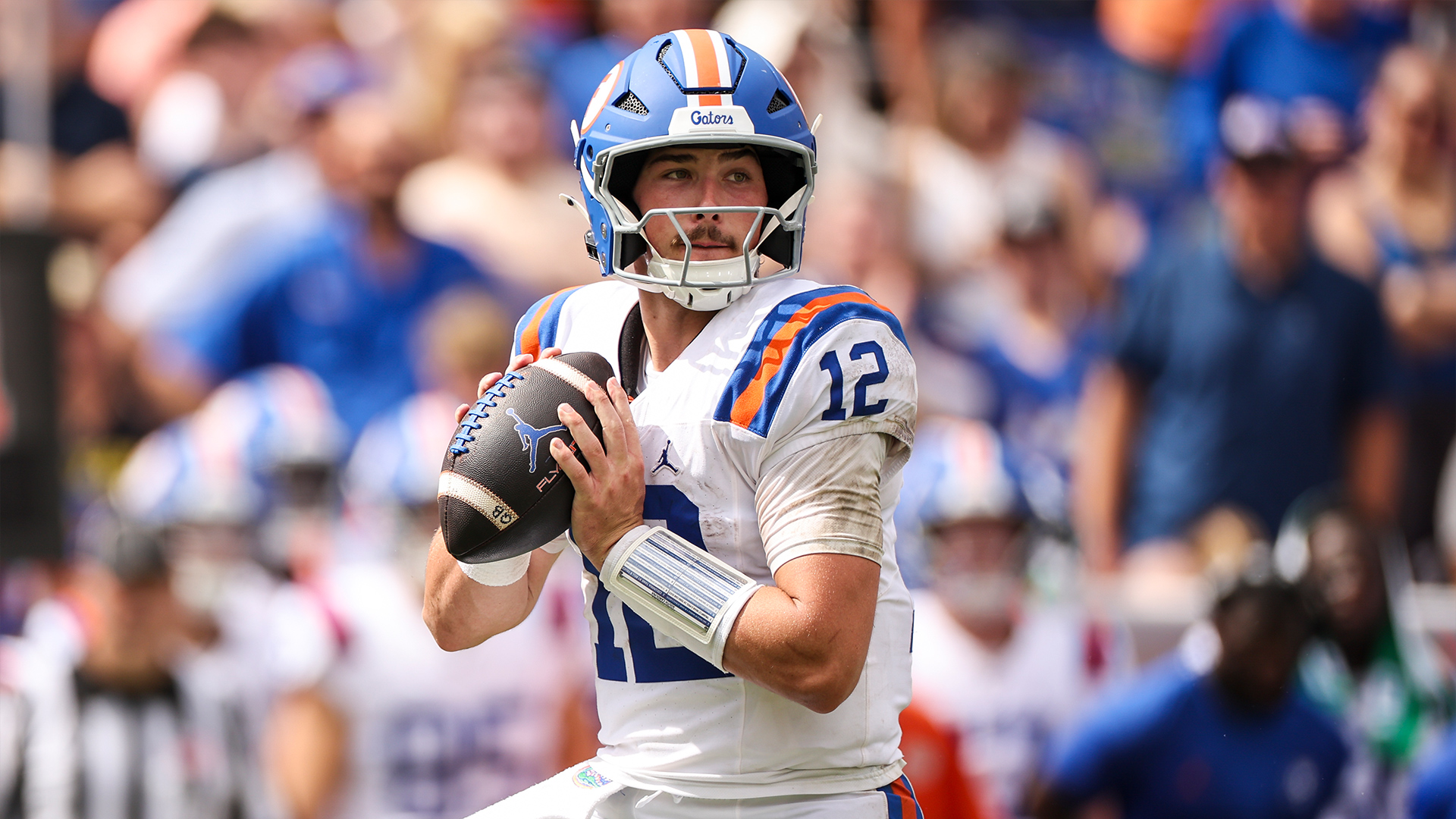
There’s something about Florida-Georgia week that feels bigger than football. It’s a rivalry soaked in tailgate smoke, orange-and-blue and red-and-black, and memories that stretch back generations, a game so full of noise and history that it earned the nickname “The World’s Largest Outdoor Cocktail Party.” This Saturday, however, the party is being held in Atlanta, a neutral site that will host two teams carrying very different burdens. No. 17 Florida will walk into that spotlight with a new face behind center, as the Gators are expected to start quarterback Aaron Philo against third-ranked Georgia, according to a person familiar with the decision who spoke to The Associated Press on Friday. The source spoke on condition of anonymity because Gators coach Jon Sumrall had not yet made the choice public. It’s the kind of decision that can define a season, a coaching staff, and a young quarterback’s future, and it’s one that Sumrall and his staff weighed carefully all week. Philo and backup Tramell Jones Jr. had both been listed as questionable on Wednesday and Thursday, and the two split repetitions throughout practice, with Sumrall repeatedly saying that the final call would come down to “health and availability.” In other words, this was never about who deserved the job or who had earned it in some tidy, narrative-friendly way. It was about which young man could step onto a big stage, against a defensive front loaded with future NFL talent, and give Florida the best chance to shock the world.
For Philo, this moment has been a long time coming and also a long time delayed. He was injured in a home loss to South Carolina the previous week, when he was tackled late and landed hard on his right shoulder, the same throwing shoulder that has carried him through a relatively short but eventful journey in Gainesville. The pain was enough to sideline him for Florida’s final upset victory at then-No. 7 Texas on Oct. 17, a game that became a launching pad for backup Tramell Jones Jr. Philo still made the trip to Austin, Texas, and dressed for the game, but he served only as the team’s emergency quarterback, standing behind Jones and Aidan Warner on the sideline and watching as his teammate rewrote a small piece of Florida history. It could not have been easy. Any competitor wants to be out there, especially in a game that can flip a season’s narrative from disappointment to hope. But Philo handled it the way coaches dream of their leaders handling it, staying engaged, staying supportive, and using the time to heal rather than to sulk. Now, with the shoulder feeling stronger and the swelling gone, he is being handed the keys to a matchup against Georgia, a program that has become the measuring stick for the entire SEC East. There is no easing into it, no tune-up against an overmatched opponent. This is trial by fire, and Philo will have to be ready not just physically but emotionally, because the Bulldogs are going to come after him early and often, and the entire college football world will be watching how he responds.
The reason the decision was so difficult is that Jones did not just survive in his first career start against Texas, he thrived. Jones became the first Florida quarterback since Jesse Palmer in 1997 to win his first career start on the road against a top-10 team. He completed 22 of 35 passes for 155 yards, with two touchdowns and no interceptions, and he added 41 yards on 10 carries, showing a calm, slippery athleticism that kept drives alive and gave his defense time to breathe. But the play that will live in Gators lore came on a critical third-and-7 late in the game. Instead of forcing a pass into traffic or taking a sack, Jones pulled the ball down and ran, picking up just enough yardage to move the chains and allow the Gators to kneel out the clock. It was the kind of play that doesn’t show up in the box score as heroics, but it was everything. It showed poise, awareness, and a refusal to lose. Sumrall acknowledged as much when he said, “I’ve said the whole time I think we can win with either guy.” That is the kind of statement that sounds like coach-speak, but here it was backed by evidence. Jones had proven he could handle the moment, and Philo had proven earlier in the season that he could move the offense and make the throws that matter. The problem, of course, is that Jones has been dealing with what Sumrall vaguely called “a couple of bumps and bruises” since beating the Longhorns. The coach declined to offer specifics, which only fueled speculation, but it seems clear that Jones’ condition was not where it needed to be for him to get the nod on Saturday. It’s a cruel twist for Jones, who did everything right when his number was called, but it’s also a reminder that health and availability are the most unforgiving parts of football.
For Sumrall, this week has been a master class in managing a quarterback controversy without letting it become a circus. He spent the week deflecting questions with the patience of a man who understands that nothing good comes from overexplaining. He said repeatedly that the decision would be based on health and availability, and he let that principle guide the process. The fact that Philo and Jones split reps all week suggests that Sumrall genuinely believed both were capable, and that he was waiting for final medical evaluations before making a call. That kind of approach protects the locker room, because it treats the quarterback position as a collective room rather than a hierarchy of egos. It also sends a message to the entire roster: winning is the only thing that matters, and personal pride is secondary. The players seem to have bought in, too. There’s no public drama, no cryptic social media posts, no whispered complaints from unnamed sources. Instead, there is a sense of focus, a recognition that Georgia presents a challenge that dwarfs any individual story line. The Bulldogs are the team everyone is chasing, and beating them requires a level of togetherness that cannot afford the distraction of a messy quarterback debate. Sumrall’s steady hand has been exactly what this team needs, a stabilizing presence in a week that could easily spiral into chaos. He has also been careful to praise both young men without giving away too much, saying he trusted both and that the team would be fine either way. It’s the kind of leadership that turns a potential crisis into a quiet confidence, and it bodes well for the culture he is building in Gainesville.
Philo will not have to do it all alone, and that might be the most encouraging news of the week. The Gators are expected to have speedy receiver Vernell Brown III back for the first time in more than a month, and his return could not come at a better moment. Brown has been sidelined for the last three games while recovering from a sprained right knee, an injury he suffered in a home win against then-No. 4 Mississippi on Sept. 26. He has been listed as probable, and all signs point to him being on the field Saturday, giving Philo the kind of explosive playmaker who can turn a simple slant into a 75-yard touchdown. Brown’s speed forces defenses to respect the deep ball, which in turn opens up running lanes and shorter passing windows underneath. Against a Georgia defense that thrives on pressuring the quarterback and locking down outside receivers, having Brown available is a significant boost. It changes the math, at least a little, and it gives Philo a familiar target who can help him settle into the game. Of course, not all the news is good. The Gators are expected to be without receiver Bailey Stockton and linebacker Jaden Robinson, both of whom were listed as doubtful. Stockton’s absence will thin the receiving rotation, and Robinson’s loss is a meaningful blow to a defense that will need every available body to try to slow down Georgia’s attack. Injuries are a part of football, but their timing can feel particularly cruel, and losing a couple of key players in a game this big is never ideal. Still, the return of Brown feels like a turning point, a bit of good fortune at exactly the right time.
In the end, this game is about more than who starts at quarterback or who is healthy enough to suit up. It’s about a rivalry that has shaped the SEC for decades, a clash of cultures that has produced legendary moments and heartbreak for both sides. For Florida, this is a chance to announce that the rebuild is real, that the Gators are not just competitive but dangerous, that they can beat anyone on any given Saturday. For Georgia, it’s about maintaining the standard, proving that they are still the team to beat, and avoiding the kind of upset that can derail a championship run. And for Philo, it’s a chance to write his own story, to step out of the shadow of an amazing backup performance and show that he belongs. There will be nerves, there always are. There will be difficult moments, moments when the Georgia pass rush collapses the pocket and the noise of the crowd becomes a physical presence. But there will also be opportunities, chances to make a throw or a play that changes the game, and the kind of memories that last forever. The World’s Largest Outdoor Cocktail Party has a new home this year, but the emotions are just as strong. On Saturday, two teams will meet in Atlanta with everything on the line, and a young quarterback named Aaron Philo will lead the Gators onto the field, carrying both the weight of history and the hope of a program that believes its best days are still ahead. It’s the kind of moment that makes college football so special, and no matter how it ends, it will not be forgotten.