


Take it from me: if you have an upcoming stopover in Doha, you’re not looking at an inconvenient layover, you’re looking at a bonus holiday. As the first Arab nation to host a FIFA World Cup, Qatar used all that global attention as a launchpad, transforming its capital with new hotels, gleaming infrastructure, and a metro system that makes getting around almost too easy. Most travellers arrive through Hamad International Airport, which is itself a destination in its own right. It has plenty of places to eat, enough public art to fill a gallery crawl, and the beloved Urs Fischer Lamp Bear, whose fluffy yellow presence has become something of a mascot for travellers passing through. There are even free 20-minute guided wellness sessions in the enormous 6,000-square-metre ORCHARD space, so you can stretch, breathe, and reset before your next flight. But the real magic begins when you step beyond the arrivals hall. Doha is the hub for Qatar Airways, which flies to more than 170 destinations worldwide, including many direct routes to Europe, meaning a stopover here is not just a pause in a journey, but a chance to turn one holiday into two. Even if you only have a few days, you can wander through centuries-old souqs, drive into golden desert landscapes, eat world-class food, and sleep in hotels that feel like havens. I say this as a travel journalist who has spent a fair amount of time wandering this city: Doha will surprise you. It’s not just a place to pass through; it’s a place to arrive.
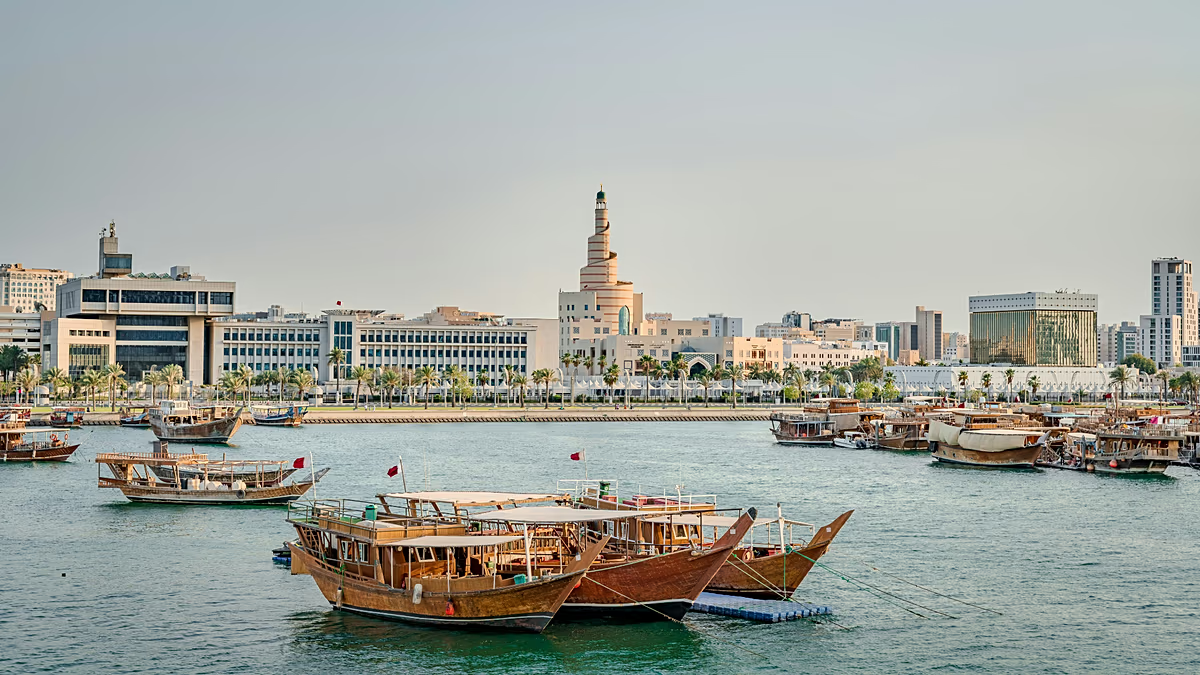
Once you step outside the airport, Doha reveals itself gradually, starting with its landmarks and public spaces. If you need to stretch your legs after a long-haul flight, the Mina District and old port area are a dream. With quaint cobble-stoned streets, pastel-coloured buildings, and the gentle breeze of the water nearby, it’s one of those corners where you can forget you’re in a rapidly growing global city. Not far away, the popular Box Park takes repurposed shipping containers, gives them a coat of technicolour paint, and turns them into a playground of shops and food outlets that are practically designed for Instagram. In the winter months, you might even spot cruise ships docked at the Grand Terminal, adding to the sense that this is a city in motion. For waterfront views, the Doha Corniche is hard to beat. This seven-kilometre promenade is where the skyline really shows off, and where traditional wooden dhow boats drift across the water. You can simply watch them from a bench, or better yet, set sail on one yourself; with every turn of the boat, a new panorama of the city unfolds. Shopaholics are equally spoiled. At Place Vendôme Mall in Lusail, inspired by classical French architecture, you can wander through four floors and as many as 580 high-end and mid-range stores, so bring comfortable shoes. Then there’s the Pearl Island, often described as the “Arabian Riviera,” with its Mediterranean-style buildings and yacht-lined marina, a scenic spot for a late-night stroll where a café or restaurant is always just a stone’s throw away. On neighbouring Gewan Island, the shopping and dining spaces house around 100 outlets, and the Crystal Walk is a genuinely enchanting experience: about 180 illuminated panels are embedded into the ground, studded with crystal artworks depicting everything from desert caravans to forest landscapes and even a colony of penguins. And here’s a clever twist for warm weather: Doha has outdoor spaces with air conditioning. Gewan Island’s open-air promenade holds Guinness World Records for the longest outdoor air-conditioned mall and the largest outdoor interactive light canopy. Even parks like Rawdat Al Hamama, Umm al Seneem, Al Gharrafa, and Oxygen Park have cooled walkways, so you can enjoy greenery without melting. Doha has figured out how to make the outdoors comfortable year-round, and it makes all the difference.
No trip to Doha is complete without spending time in its cultural heart, and that means starting at Souq Waqif. Nestled in the capital’s old town, this open-air market has winding alleyways that carry centuries of history, and while it is charming by day, it truly comes alive as evening falls. The sounds of shoppers haggling with vendors mix with the smell of saffron, zaatar, dried flowers, and coffee known locally as gahwa, creating an atmosphere that feels both ancient and wonderfully alive. You can also meet some of Qatar’s most beloved animals here at the Falcon Souq, where shopkeepers are happy to let tourists pose with these majestic birds perched on their arms. Just a short journey away, the Katara Cultural Village offers a different kind of magic. This waterfront destination is full of galleries, performance spaces, and architectural landmarks, including an amphitheatre that blends classic Greek style with arched entrances inspired by Islamic architecture, seating up to 5,000 spectators with sweeping sea views. Scattered around Katara are striking public art installations, none more memorable than Lorenzo Quinn’s “Force of Nature II,” where a giant swirling figure seems to bend the wind itself. Doha also has an impressive line-up of museums. The National Museum of Qatar is an architectural marvel in its own right, its exterior inspired by the desert rose, while inside, an immersive journey takes you through Qatar’s history, identity, and modern achievements. Other museums worth your time include the 3-2-1 Qatar Olympic and Sports Museum, Lawh wa Qalam: M. F. Husain Museum, and Msheireb Museums, and there are even more planned for the future, including the Art Mill Museum, Lusail Museum, and Qatar Auto Museum. If you want to sit quietly and soak things in, the Qatar National Library is a treasure trove filled with books and periodicals in various European languages, alongside Arabic manuscripts, maps, globes, and printed materials dating back to the 15th century, when printing was first introduced in Europe. It is a reminder that this is a country that has always valued knowledge, and that the past and present live very comfortably side by side.
Choosing where to eat in Doha can feel like an impossible task, largely because you’re spoiled for choice. The city is home to more than 3,000 restaurants, serving everything from traditional Qatari and Gulf cuisine to Latin American, African, Asian, and European flavours. After a stroll through Katara Cultural Village, I highly recommend Kamachi for traditional bites. Their balaleet is a must-try: a popular local dish made with saffron and cardamom-spiced vermicelli noodles, slightly sweetened and topped with a fried egg. It’s comforting, fragrant, and unlike anything you’ll find at home. Souq Waqif is another no-brainer dining destination. If you have a craving for local street food, try karak, a sweet and spicy tea, alongside any of the varieties of khobz regag, a very thin and crispy flatbread, at the rustic Shay al Shamoos. That place has a lovely story behind it too: it was established by Shams Al-Qassabi, the Souq’s first businesswoman, which makes the food taste even better. For something more formal, Doha’s food scene has attracted the attention of the Michelin Guide, which debuted in the country in 2024. As many as 41 restaurants are listed in the Michelin Guide Doha, including three that earned a Michelin star and eight with a Bib Gourmand. One of the shining stars is IDAM by Alain Ducasse, located inside the Museum of Islamic Art, overlooking the Doha Corniche. It serves contemporary French cuisine paired beautifully with Qatari ingredients, and the setting is absolutely unforgettable. The other one-Michelin-starred establishments are Alba, which serves Italian cuisine, and Jamavar, which serves Indian cuisine. Whether you want a tiny corner café, a lively market stall, or a white-tablecloth fine dining room, Doha has a seat for you. And honestly, half the joy is in the choosing: you can eat your way across the world without ever leaving the city.
After all that exploring, you need a good place to rest, and Doha’s hotels are among the best I’ve encountered. Mandarin Oriental, Doha, located in the Msheireb district, is about a 20-minute drive from the airport. It offers 117 rooms, 41 suites, and 91 apartments and villas, along with two rooftop pools and a spa that seems designed to melt away every bit of travel fatigue. I cannot recommend the buffet breakfast at Mosaic enough, and the hotel’s other dining concepts, like IZU and Liang, are absolutely worth booking a table for. Then there’s the Sheraton Grand Doha Resort & Convention Hotel, right on Corniche Street. Its distinctive pyramid shape has been part of the Doha skyline since the early 1980s, and today it offers 371 rooms and suites where you can choose between sea or city views. Inside, you’ll find nine dining options, a 24-hour fitness centre, and a spa; outside, there’s a pool and a 400-metre stretch of private beach. But Doha isn’t just about city comforts. If you have a little more time, day trips open up a whole different side of Qatar. About an hour and a half from the capital by road lies the Inland Sea, Khor Al Adaid, a landlocked lagoon surrounded by sand dunes up to 40 metres high, currently on the tentative list for UNESCO World Heritage status. The water is calm, warm, and perfect for swimming, and the best time to visit is between November and April, when the weather is just right. Closer to the city, Al Khor is one of Qatar’s oldest towns, about 45 minutes away, with early 20th-century watchtowers that once guarded the harbour. My own favourite escape, however, is kayaking through the mangroves at Purple Island, near Al Khor, about an hour from Doha. On my days off, you can always find me gliding through the lush greenery, spotting flamingos and herons, and feeling a world away from the city. On the west coast, at the Brouq Nature Reserve near Zekreet, Richard Serra’s permanent installation East-West/West-East stretches more than a kilometre across the desert, surrounded by white cliffs and strange mushroom-shaped rock formations. Just remember to bring a cap, sunscreen, and plenty of water. And if you really want to trade the skyline for the open desert, book a stay at Regency Sealine Camp, an hour’s drive from the capital, where tents, rooms, and suites put the desert and sea right at your doorstep, with quad biking, dune bashing, camel riding, falconry shows, and communal dining under the stars.
Before you go, a few practical details can make your stopover even smoother. Many travellers can enter Qatar without a visa: all EU member-state passport holders and non-EU European nationals, including travellers from the UK, Bosnia and Herzegovina, Iceland, Azerbaijan, and Switzerland, can benefit from visa-free travel as long as they have a confirmed hotel booking. Getting around is easy too. Visitors can rent a car, book a taxi or Uber, or use public transport such as the Doha Metro, the Karwa bus network, and the country’s three tram lines in Lusail, Msheireb, and Education City. The metro, in particular, is clean, air-conditioned, and fast, and it connects many of the main attractions, so you don’t need to worry about being a confident driver to explore. What I love most about Doha is that it doesn’t ask you to choose between modern luxury and old-world charm; it simply gives you both. In one day, you can watch dhows sail across the Corniche, bargain for spices in Souq Waqif, stand in awe of desert sculptures, kayak through mangroves, and dine like royalty. A stopover here is more than a layover; it’s a chance to slow down, open your eyes, and let a city you barely knew teach you something about hospitality, beauty, and the art of living well. So next time you see Doha on your itinerary, don’t dread the connection. Embrace it. Step out of the airport, breathe in the warm air, and let this remarkable country write its own little chapter in your journey. You’ll leave with more than memories; you’ll leave with a feeling you’ll want to come back to.