


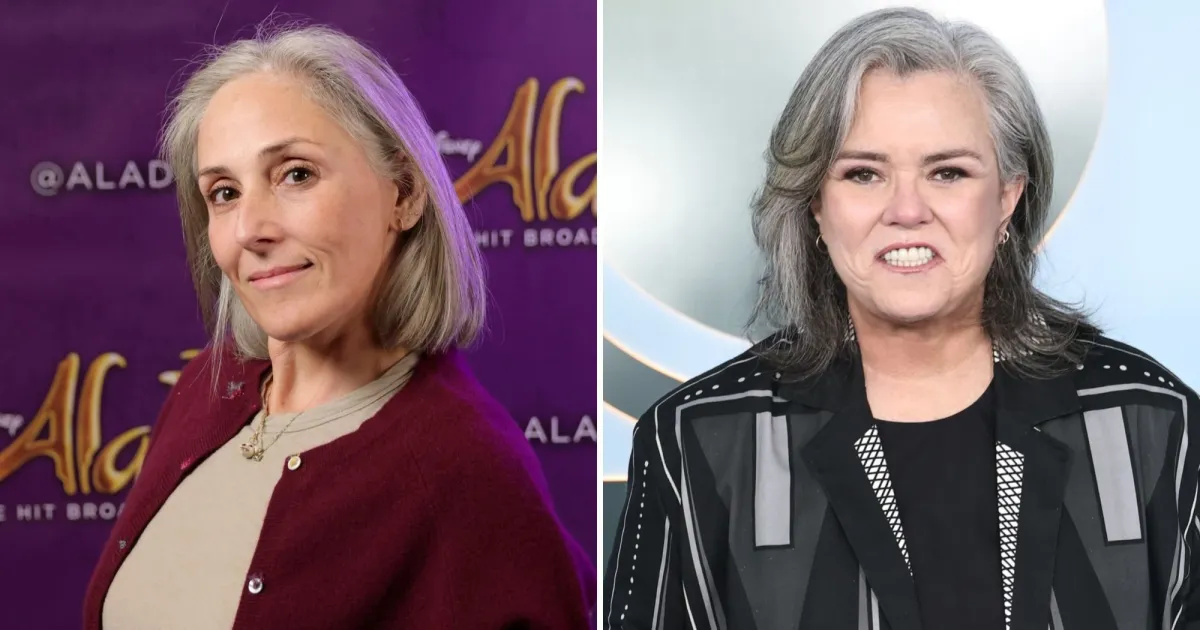
Ricki Lake has spent a lot of her life in front of cameras, and she knows better than most how complicated it can be to watch yourself age in public. So when she recently sat down on The Weekend View on a late October Saturday, she wasn’t shy about opening up a very personal conversation between friends. Lake, now 58, talked about her longtime friend Rosie O’Donnell, 64, and the facelift O’Donnell had after years of being, in Lake’s words, “a little judgy” about cosmetic procedures. “Rosie is my really good friend and we talk all the time. She was judgy,” Lake said with affection. “She would admit it. She was a little judgy about me and my friends that went to this doctor and had these amazing results.” It’s a familiar dynamic among friends, especially women friends: you love each other deeply, you support each other, and sometimes you quietly disagree about the choices you make for your own face and body. But what made this conversation feel so refreshing was the honesty. Neither woman was pretending to be above it all, and neither was pretending that their choices were purely simple. Lake and O’Donnell have both lived their lives in the public eye, so the pressure to look a certain way is not abstract for them. It’s real, it’s constant, and it often comes with commentary from strangers. Yet here they were, two women in their sixties, talking about their faces and their feelings about those faces with the kind of candor that only comes after years of knowing who you are—and being tired of pretending otherwise.
Lake, for her part, has been open about having surgery herself. She underwent what she described as a “deep plane lower face and neck lift along with a mild co2 laser” in 2024, performed by Dr. Allen Foulad in Beverly Hills. The decision didn’t come out of nowhere; Lake said she had lost “a lot of weight” and wanted to address the changes that came with that. It’s a story many people can relate to, even if they’ve never had a facelift. Weight loss changes your body, but it also changes your face, and sometimes the mirror reflects something that doesn’t quite match how you feel inside. Lake was careful to frame her procedure not as a desperate attempt to look younger, but as a way to feel more aligned with herself. And two years on, she’s still satisfied. This past July, she marked the two-year anniversary of her surgery by reflecting publicly on the results, calling them “remarkable, natural, and long-lasting.” That word “natural” matters. Many people fear that cosmetic surgery leaves women looking frozen or unrecognizable, but Lake was insistent that wasn’t her experience. She didn’t want to disappear into a different face; she wanted to look like herself, just perhaps a more rested, more settled version of herself. That’s a delicate line, and Lake seems to have walked it thoughtfully. By talking about it so openly, she’s helping to demystify a process that is often whispered about but rarely discussed honestly. She’s also showing that you can make a choice for yourself without turning that choice into a judgment of someone else’s choices.
And that’s where Rosie O’Donnell comes in. In a May Substack essay, O’Donnell acknowledged that she had once felt “very strongly about facelifts”—though she was quick to note that her opposition wasn’t based on any moral high ground. It was more personal, more instinctive. She had looked at women in her life who had work done and wondered why they felt the “need” to alter themselves. It’s a question that gets asked a lot, usually by women who haven’t yet stood at the crossroads of that decision themselves. But then something changed for O’Donnell. As Lake told it, Rosie lost a significant amount of weight, largely thanks to the GLP-1 medication Mounjaro, and that weight loss shifted something. “Sure enough, she lost a bunch of weight on Mounjaro and she went and had it done,” Lake said. “She looks incredible.” That moment of realization is so powerfully human: the position you hold firmly in theory can soften dramatically when your own body starts changing in ways you didn’t fully expect. In her essay, O’Donnell joked that she had “assigned” herself as the head of all women who would never have a facelift—a funny, self-aware admission that she had become the unofficial spokesperson for a stance she no longer held. It’s a reminder that our beliefs about aging, beauty, and self-care are rarely static. They evolve as we evolve. And sometimes the person we were most convinced we’d never become is exactly who we end up being, not out of weakness, but out of a deeper understanding of ourselves.
Perhaps the most touching part of O’Donnell’s story is what her 13-year-old child, Clay, said to her. Clay tried to discourage her from getting the facelift, telling her that she had “earned” her wrinkles. It’s such a beautiful, pure sentiment—the kind of thing a child says because they love you exactly as you are. But instead of simply making O’Donnell change her mind, Clay’s words helped her realize something important. She needed to teach Clay that bodies do not “belong to an idea.” That’s a profound lesson for anyone, especially in a world that is constantly trying to sell us a fixed notion of what bodies and faces should look like. O’Donnell wasn’t rejecting her child’s love or their perspective. She was expanding it. She was showing Clay that taking care of yourself, or choosing to change something about your appearance, is not necessarily a betrayal of authenticity. It can be an expression of self-respect. The comment also helped O’Donnell think about her own limits. She didn’t want to become someone who is never satisfied, always chasing some unattainable goal, always moving the goalpost. That fear is real for many people who have surgery or even do anything to alter their appearance. Where does it stop? When is enough enough? O’Donnell’s answer came in a quiet moment right before she went under the knife. She grabbed her doctor’s hand and said, “I will never say, ‘God, I wish you did more.’ And I meant it.” That single sentence says so much about the emotional landscape of cosmetic surgery. It’s not just about looking different. It’s about being able to finally rest in your own skin, to stop the internal voice that tells you there’s always something else to fix.
O’Donnell’s reflections after the surgery are almost poetic. She said she didn’t want to become that voice—the one that keeps moving the goalpost, never satisfied, turning their own face into a problem that can never quite be solved. Instead, she wanted a limit. She wanted to still be herself, just “less haunted.” It’s a phrase that lingers. A face can feel haunted, sometimes, by exhaustion, by grief, by years of carrying things you never expected to carry. O’Donnell, who has lived through more than her share of public battles and personal losses, knows something about that haunted feeling. So when she woke up from surgery and looked in the mirror, she wasn’t searching for a different person. She was looking for herself, but with something lifted—not just physically, but emotionally. “I do look like me,” she wrote. “A slightly more well-rested, emotionally stable version of me.” That’s the goal, really, for many people who undergo procedures later in life. It’s not about erasing the past or pretending to be young. It’s about releasing some of the weight that has settled into your features over the years, so that what people see on the outside matches a little more closely how you feel on the inside. And when O’Donnell later appeared on the Tony Awards red carpet in June, she told reporters she probably wouldn’t be having any further procedures for the time being. There was no absolutism, no sweeping declaration. Just a calm, grounded sense of having arrived somewhere she hadn’t expected to be.
What makes this whole story so compelling is the way it weaves together friendship, honesty, and the messy, complicated reality of being a woman in the public eye. Lake and O’Donnell are two women who have known each other for decades, through the highs and lows of careers that demanded they show up and shine regardless of what was happening in their personal lives. They’ve supported each other, laughed with each other, and now they’re being transparent with each other—and with us—about choices that are often kept secret. O’Donnell said it best when she explained why she decided to be so open about her surgery: “Authenticity is the goal in these days and times, and people are lying about everything all day to the American public. It’s very depressing to me and unsettling, and I think all that matters is truth and love.” That’s a remarkable thing to say after undergoing a cosmetic procedure, an industry often associated with secrecy and shame. Instead of hiding, O’Donnell chose to share all the complicated feelings she had—“all the complicated feelings,” as she put it. She didn’t pretend it was simple, and she didn’t pretend it was only surface-level. She admitted that she had judged others, that her own body changed, that her child’s love moved her, and that she ultimately made a choice for herself. In doing so, she gave permission to everyone else who has ever felt conflicted about their own reflection. Lake, too, by telling the story with such warmth and humor, reminded us that we don’t have to have all the answers. We can change our minds. We can make choices that once seemed wrong for us. We can love our friends even when we disagree with them. And we can hope, whatever we decide, that we still recognize the person looking back at us—not as a stranger, but as someone who has been through it all and is still here, still learning, still growing.