



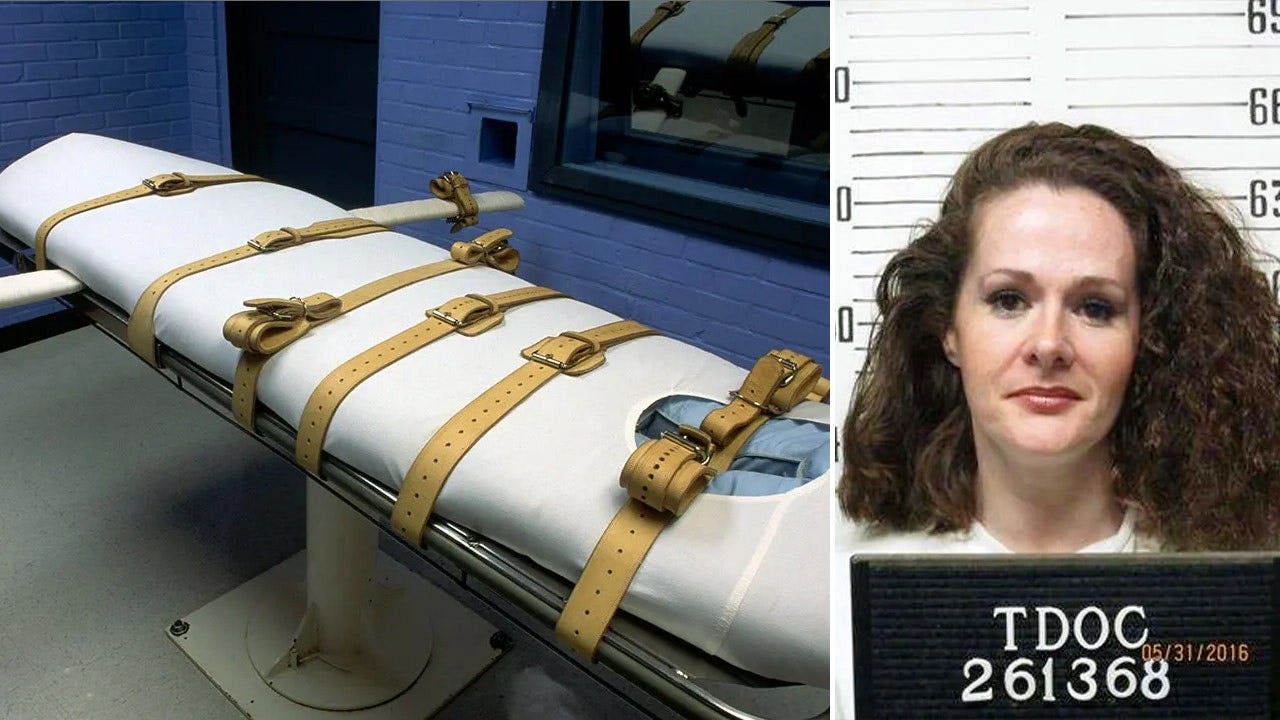
One month after surviving what should have been her final night, Christa Pike is speaking from a place she never expected to be. On September 30, the 50-year-old death row inmate walked into the execution chamber at Riverbend Men’s Prison in Nashville, Tennessee, prepared to die. She had spent years thinking about this moment, and in the last minutes before the state tried to end her life, she said she had made her peace. She thanked the people who had supported her through the long years of appeals and isolation, and she told the witnesses who had gathered to watch her die that she was leaving them in loving kindness. Then the procedure began, and everything went wrong. Instead of dying, Pike survived. Days later, she woke up alone in a hospital, confused and in pain, with no memory of how she had gotten there and no idea what the future might hold. In a statement dictated to her legal team and released Friday, she described the aftermath with unsettling honesty. There has not been a moment since that night, she said, when she has not been in pain. Her body hurts, her arms and hands hurt, her throat hurts, and she still struggles to speak. But the pain, she insisted, is not just physical. It is also in her mind and in her soul. She had never contemplated life beyond that night, and now she must find a way to live in a body and a world that both feel profoundly broken. The statement is not a legal argument or a plea for sympathy; it is simply a human being trying to put words to an experience that should not have happened.
Tennessee’s attempt to execute Pike by lethal injection was supposed to bring an end to a case that had haunted the state for nearly three decades. Instead, it created a new and deeply troubling chapter. Correctional staff administered two doses of pentobarbital, the drug used in the state’s lethal injection protocol, but Pike’s body did not respond as expected. She was rushed from the execution chamber to a hospital, where she remained unconscious for days. Her attorneys were so concerned that they believed she might be brain-dead; at one point, they expected doctors to make the decision to take her off life support. But Pike slowly regained consciousness, began to speak in full sentences, and eventually was strong enough to be discharged and returned to prison. The failed execution reverberated far beyond her hospital room. Tennessee Governor Bill Lee halted all remaining executions for the year and ordered an independent review of what went wrong. Her legal team, meanwhile, argued that the state should not be allowed to try again, and they renewed their demand that Lee commute her death sentence to life without parole. The governor did not grant that request. Instead, he said that Pike remains incarcerated under state law and signaled that her death sentence is unlikely to be overturned. The result is a legal and moral limbo: a condemned woman still under a sentence of death, recovering from a procedure that was supposed to end her life, and waiting to learn whether the state will ever attempt to kill her again.
To understand why Christa Pike is on death row, it is necessary to remember the crime that put her there. In 1995, Pike was 18 years old, a young participant in a federal Job Corps program in Knoxville, Tennessee. She was not alone. Her boyfriend, Tadaryl Shipp, was 17, and another young woman, Shadolla Peterson, was 19. The victim, Colleen Slemmer, was also 19 and was part of the same program. On a day in January, Pike and the others lured Slemmer to a secluded area on the campus of the University of Tennessee in Knoxville. There, Slemmer was subjected to a brutal and horrifying attack: her throat was cut multiple times, her head was beaten with a large piece of asphalt, and a pentagram was carved into her chest. She died there, alone, far from anyone who could help her. The violence of the killing left an indelible mark on the community and devastated Slemmer’s family, who have spent nearly thirty years trying to cope with the loss of a young woman whose life was cut short in the most brutal way imaginable. Pike later confessed to her role in the murder, and in 1996 she was convicted and sentenced to death. The Tennessee Supreme Court affirmed her conviction and sentence. In her statement this week, Pike acknowledged the depth of the harm she caused. She said she continues to think about her victim’s family and the terrible pain and loss they have endured. It is a brief but important acknowledgment, especially because the botched execution has shifted public attention away from the victim and onto the condemned woman. Some former law enforcement officials have argued that the focus should remain on Slemmer and the cruelty of her murder, not on the pain of her killer. That tension is at the heart of this case.
The aftermath of the botched execution has opened a new and painful chapter in a case that has already spanned nearly three decades. Pike’s attorneys have described their client as being in critical condition in the days after the failed lethal injection, and they have argued that the state’s inability to carry out the sentence humanely is itself a reason to commute it. They have asked Governor Lee to step in and impose a sentence of life without parole, a decision that would end the legal uncertainty and spare Pike from another attempt. Lee, however, has not been willing to go that far. He ordered an independent review of the execution and paused further executions for the year, but he has made clear that Pike’s death sentence remains valid under state law. That leaves Pike in a strange and painful limbo. She is no longer on death row in the traditional sense—she is housed in the medical ward of the Debra K. Johnson Rehabilitation Center for women—but her legal status has not changed. She is still a condemned prisoner, still waiting to learn whether the state will try to kill her again. The waiting is not new to her. Pike spent 28 years in solitary confinement, and she says the isolation she has experienced since the failed execution feels like a repeat of that condition. She has been largely separated from other people, denied the human connections that she says mean so much to her. The physical pain from the botched injection is compounded by the emotional pain of being alone, unsure of what comes next. Her attorneys say she is recovering, but recovery, as Pike herself puts it, is not the same as being okay.
Pike’s statement is remarkable not for what it argues, but for what it reveals about a person confronting an unimaginable situation. She says she had not contemplated life beyond the night of the execution; she had made her peace and was prepared to die. She speaks of the incompetence that has put so many people in this terrible position, and she does not exclude herself from that number. She is deeply hurt, she says, not only by the physical pain but by the uncertainty that now hangs over everyone involved. She thinks about her victim’s family, and she acknowledges that no amount of her own suffering can undo what she did. Yet she also asks for something that might seem impossible for a person who committed such a violent crime: to be understood as a human being. She says she is recovering and knows she is getting stronger, but she is careful to draw a line between healing and being okay. She describes the isolation of the prison medical ward, the way it echoes the solitary confinement she endured for 28 years, and the particular kind of pain that comes from being cut off from other people. She does not know why she survived that night. She does not know what comes next. Some days, she admits, finding hope is harder than others. But she is holding on to the love and kindness of so many people who have reminded her that she is not alone. Those words are fragile and tentative, but they are also a sign of life—a reminder that even after a failed execution, even after decades of punishment, a human being still exists behind the legal categories and the headlines.
In the end, the story of Christa Pike’s botched execution is a story about the limits of justice and the unpredictability of human life. The state of Tennessee set out to carry out a lawful sentence, and instead it created a new trauma for everyone involved. For Colleen Slemmer’s family, the failed execution has reopened wounds that never truly closed. They have waited nearly thirty years for a final resolution, and now they must confront the possibility that the legal process will continue, that the closure they have sought will remain out of reach. For the public, the botched execution has raised uncomfortable questions about lethal injection, the secrecy surrounding execution drugs, and whether the death penalty can ever be administered without the risk of cruelty and error. For Pike, the experience has been transformative in ways she is still trying to understand. She walks, she talks, she breathes, but she lives in a body that remembers the drugs meant to kill her. She is isolated, in pain, and uncertain of the future. And yet her statement contains no anger, no demands, no conspiracy theories. It is the statement of a woman trying to make sense of a second chance she never asked for and may not be able to keep. She says she is trying to heal one day at a time, holding on to love and kindness. Whether that is enough to change her fate is unclear. Whether it should be enough is a question that will divide people for as long as this case continues. But her survival has made one thing certain: the search for justice is never as simple as a final injection. It is a messy, human process, full of pain and contradiction, and it does not always end the way anyone expects.