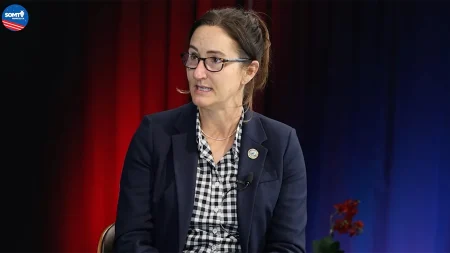



There are some political stories that feel less like policy and more like a cold drink of absurdity, and Alaska’s Senate race has just delivered one of those moments. Imagine showing up to vote, scanning the ballot, and seeing two Dan Sullivans listed. Not one, but two. It sounds like a mistake or a glitch, but according to a report from The New York Times, it was a deliberate and coordinated scheme. The report revealed that the campaign of Democratic Senate nominee Mary Peltola, along with aides from the Democratic Senatorial Campaign Committee and other operatives, worked to place a retired teacher named Dan J. Sullivan onto the ballot. That effort, critics say, was meant to confuse voters and siphon away support from the real Republican Senator Dan Sullivan, a man whose name Alaskans already knew and had voted for before. The Republican National Committee did not hesitate to respond, and its election integrity communications director, Ally Triolo, made it clear that this was not a case of “both sides do it.” Speaking with Fox News Digital, Triolo dismissed any equivalence between the parties. “No, both sides of the aisle don’t do this,” she said. “Our entire effort here at the RNC is securing elections, making them fair and free and honest. We are doing the exact opposite of what Democrats are trying to do.” She went on to point out that Democrats have repeatedly voted against commonsense election safeguards, including the Save America Act, and argued that the Alaska scandal is proof of a deeper problem. “They have ill intentions. They’re trying to disenfranchise voters, and of course trying to be fraudulent,” Triolo said. “This is fraudulent behavior, and they need to be held accountable to the fullest extent.”
For Triolo and the RNC, this moment was not some sudden discovery. The committee had been sounding the alarm for months. They said they tried to draw attention to what they described as a Democratic scheme to trick Alaskans. The plan, as outlined in reporting and echoed by Republican officials, was simple but dangerous: if there were two Dan Sullivans on the ballot, at least some voters might accidentally pick the wrong one. That could mean a retired teacher with no political campaign would receive votes meant for a sitting U.S. senator. It was a classic spoiler tactic, only this time it appeared to come from inside the Democratic Party machine. “Republicans, we tried to fight this months ago and draw attention to this Democrat scheme,” Triolo said. “And look, no wonder Democrats are against election integrity because they don’t want to be held accountable for trying to disenfranchise voters and cheat the system.” She added that it had been clear from the start that the goal was to “sway voters, confuse voters, take votes away from the real Sen. Dan Sullivan.” The frustration in her voice was not just about losing an election; it was about the integrity of the entire process. For ordinary voters, the idea that a campaign would try to win by making the ballot look misleading is almost impossible to accept. But that is exactly what the evidence suggests happened, and it has thrown the state’s election into a strange and contentious fight over fairness, legality, and public trust.
The fallout came fast. The U.S. Department of Justice intervened even before the election, suing to block certification of a potential Peltola win if the votes for the second Sullivan could have changed the outcome. That was a striking move, because federal authorities rarely step into a state ballot dispute so directly. A senior DOJ official later confirmed to Fox News that the criminal investigation into the appearance of Daniel J. Sullivan Jr. on the ballot has intensified, with officials examining possible civil-rights violations under federal statutes that criminalize conspiracies to deprive voters of their rights. The investigation, led by the U.S. Attorney’s Office in Alaska, had been underway for months, and sources said it will extend beyond Election Day. There will be no convenient resolution on Tuesday. Charges and grand jury activity are not expected before then, but the legal pressure is real. That kind of scrutiny was echoed at the highest political levels. Vice President JD Vance said authorities should “certainly look into whether Peltola committed election fraud,” and he described the effort as an attempt to “steal a Senate seat.” Senate Majority Leader John Thune was just as blunt, calling it a “coordinated effort” and “totally dirty pool.” Senator Dan Sullivan, the intended target of the confusion, called the alleged ballot scheme a “scandal at the highest order.” Even President Donald Trump weighed in, saying his team was looking into the matter and warning about the broader implications for Alaska’s elections. Governor Mike Dunleavy also ordered a state investigation, making it clear that this was not just a partisan squabble but a matter of public confidence in the ballot box.
Of course, the story is not without its defenses and complications. Peltola’s campaign and the Democratic Senatorial Campaign Committee have denied any involvement in recruiting the second Dan Sullivan. They have pointed to a familiar argument in politics: that both parties sometimes run spoiler candidates and that putting a similarly named person on the ballot is not unprecedented. But Republicans reject that comparison outright, and the RNC says the details in this case go far beyond ordinary political gamesmanship. The alleged coordination between a campaign, a national party committee, and others to create confusion around a specific sitting senator’s name is different from a candidate simply showing up with a similar moniker. The Alaska Supreme Court previously ruled that the second Dan Sullivan could remain on the ballot under state law, which gave the scheme a legal foothold even if its origins were questionable. That ruling frustrated Republicans, but it also forced them to adapt. Rather than relying on courts alone, the RNC built an extensive ground game in Alaska, with attorneys, observers, and poll workers ready to respond to questions and concerns. Triolo said the committee has been heavily invested in protecting the vote in Alaska since the scheme came to light. “We’ve been fighting it, drawing attention to it, doing everything we can to educate voters,” she said. For voters, that meant seeing warnings on social media, hearing in interviews about the danger of confusing the two Sullivans, and being reminded to check the ballot carefully before casting their vote.
The human side of this story is perhaps the most disturbing part. It is easy to talk about election machinery and legal statutes, but behind all of that are real people, Alaskans who take their civic duty seriously and who deserve a ballot that is honest. No one should need a lawyer or a political operation to explain who is actually running for office. Yet here was a situation where a voter could walk into a polling place, see two Dan Sullivans, and have no idea that one of them was not actually a candidate in any meaningful sense. The retired teacher’s name was on the ballot, but he was not running a Senate campaign. He was not raising money, debating policy, or asking for votes in the traditional sense. He was simply a name, a decoy, placed there to create enough doubt and confusion to change the outcome. That is the kind of tactic that undermines confidence not just in one election but in the whole democratic process. Triolo stressed that the Republican Party is focused on the opposite approach, on securing elections and making them easier to trust. She pointed to the fact that even The New York Times, a media outlet she called left-wing, had no choice but to hold Democrats accountable for the scheme. That, she said, says something. When the mainstream press is forced to report on a Democratic attempt to manipulate a ballot, it shows how far the problem has gone. “So I think what we need to stay focused on, as Republicans, is that we need to keep the majority,” Triolo said. “This is why this midterm election feels like a presidential because so much is at stake.”
In the end, this Alaska ballot scandal is about more than one race or one candidate. It is about the way Americans increasingly view elections with suspicion and fear. When parties believe they cannot win fairly, they are tempted to find shortcuts, and those shortcuts always hurt ordinary people. The Republican National Committee’s response was not just a political talking point; it was a defense of the idea that elections should be decided by voters, not by clever schemes and lookalike names. The Democrats involved have denied wrongdoing, and the investigation will determine the full truth. But the damage to public trust has already been done. Every Alaskan who had to pause and check whether they were voting for the right Dan Sullivan paid a price. Every voter who wondered whether their vote would be tossed out because of confusion paid a price. And every American watching this story unfold had to confront an uncomfortable question: if this can happen in Alaska, where else could it happen? The RNC says it is on the ground, fighting to protect every vote and every ballot. The Justice Department is watching. Investigations are ongoing. But the deepest solution is cultural. Election integrity cannot be left to lawyers and investigators alone. It has to be valued by both parties, protected by leaders, and respected by every candidate who asks for the public’s trust. Until that happens, stories like this one will keep coming, and the quiet confidence that once made American elections a model for the world will keep eroding. For now, the eyes of the country are on Alaska, where the battle over one Senate seat has become a battle over the soul of the ballot itself.