

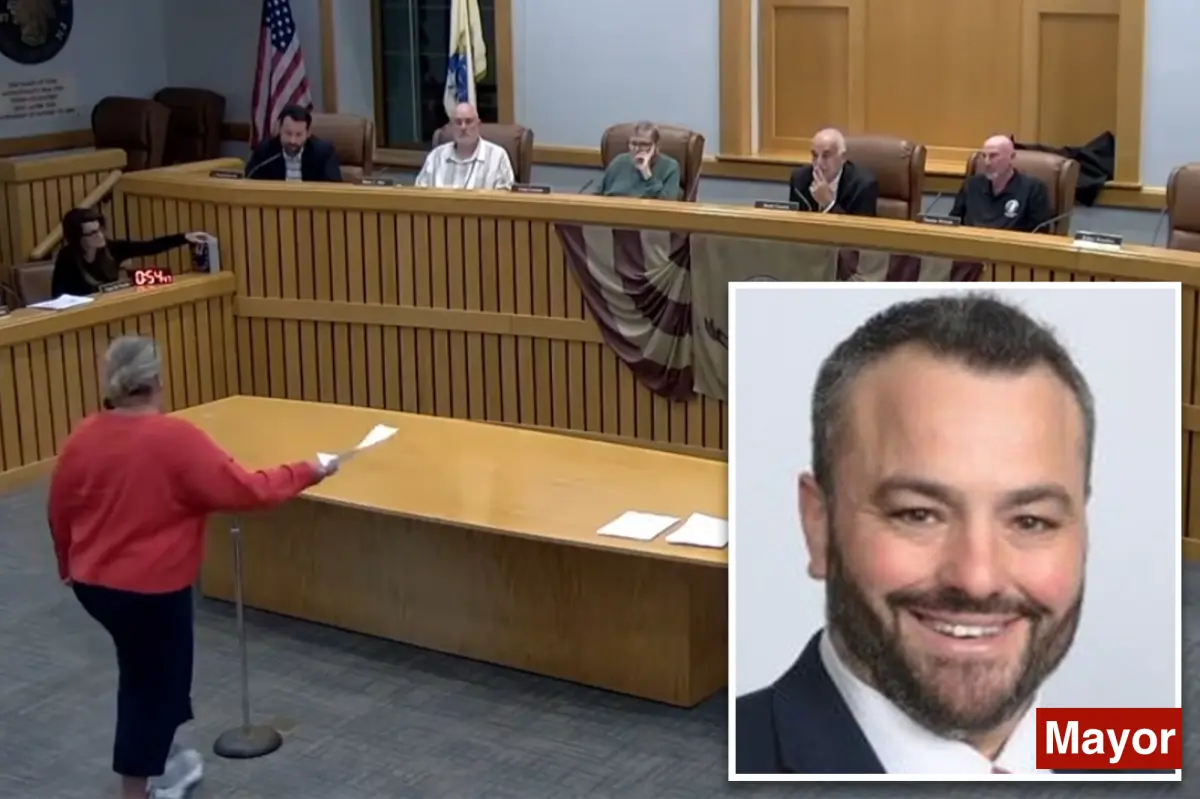
Municipal council meetings are rarely the kind of place where raw human drama erupts. Usually, the fluorescent lights hum over a sparse audience, and the agenda items—zoning variances, budget resolutions, public works contracts—drone on like background noise. But on a recent evening in Toms River, New Jersey, the public comment section of the township council meeting turned into something no one in the room would soon forget. A longtime resident, Dana Tormollan, walked to the microphone with a grievance. She was not a polished political operative or a career activist. She was a homeowner, a taxpayer, a woman who had reached the end of her patience. In her hand was a letter from Mayor Daniel Rodrick’s office, one that had been slipped into her tax bill mailing, and she wanted to know why her own government was using a mandatory financial notice to push political messaging. But instead of receiving an explanation or even an apology, she was met with mockery. The mayor denied sending anything, then sneered at her with a question that had nothing to do with the letter: “Did you get a job yet, Dana? Are you still living in the basement at home?” The gallery groaned. Tormollan’s face reddened. What followed was a cascade of insults, shouting, and raw emotion that turned a bureaucratic meeting into a theater of civic breakdown. It was the kind of moment that makes people wince, partly because it was so public, and partly because it felt so familiar in an era when even small-town politics have become poisoned by contempt.
To understand why Tormollan was so angry, you have to understand what arrived in her mailbox on October 19. Her tax bill came, as it does every year, and tucked inside was a letter from Rodrick’s office listing what the mayor described as his accomplishments in office. To Tormollan, the letter read less like a civic update and more like a campaign flyer, and it was riding along on a document that residents are legally required to pay. She saw figures and claims that she believed were not true. She saw self-promotion disguised as official communication, and it felt like a violation. “We had gotten our tax bills and his letter was in there full of things that were not true,” she later told NJ.com. “I was going to go in and just say, ‘Stop wasting residents’ money by sending out your political nonsense.’” That was her plan. A simple, pointed, reasonable public comment. She wasn’t planning to shout or to slam papers on the desk. She just wanted the mayor to hear her, to acknowledge the letter, and to think twice before doing it again. But when she approached the microphone, the tension in the room was already crackling. Other residents had spoken before her, and some of them, particularly older women, had been mocked by the mayor. By the time Tormollan reached the mic, her voice was sharp, and her opening line—”I told you to stop sending me this crap”—set the tone for an exchange that would spiral far beyond anything she had imagined.
The confrontation itself was ugly and unfiltered. Tormollan accused Rodrick of sending the letter; he claimed he had sent nothing. Then he pivoted to the personal, asking whether she had found a job and whether she still lived in her parents’ basement. It was a cheap attempt to humiliate her, to dismiss her as someone without credibility, someone who had no right to criticize him. The mayor laughed as he said it, stifling his own amusement while the gallery groaned. Tormollan tried to respond, but he kept going, demanding to know where she lived. She finally snapped. “I live in my own house and pay my own bills so back off, jackass, because you’re collecting benefits on these people’s backs. You’re a piece of crap. Shut up.” She slammed the letter on the desk in front of him. “It’s right here you jackass.” Rodrick, unshaken, responded with the same dismissive refrain: “Right, right, get a job.” Tormollan insisted she had one. By then, the rest of the room was no longer silent spectators. People began shouting at one another. The council president, David Ciccozzi, had to ask Rodrick to stop interrupting the public. The moment had become a brawl in words, a public airing of every ounce of frustration that had been building in the community, and it was hard to watch. There were no winners, no moments of clarity, just two people locked in a cycle of provocation and reaction, each convinced the other was in the wrong.
Later, in the quieter aftermath, Tormollan tried to explain what had happened and why she had lost her composure. She told NJ.com that she had been moved to speak not only because of the letter, but because Rodrick had “mocked older women” who had spoken before her. That image stayed with her. “If he was speaking to my mother that way, I would not sit here,” she said. “It’s really gross and extremely unprofessional.” Her words reveal a deeper truth: this wasn’t just about one letter or one insult. It was about dignity. Tormollan is not a public figure. She doesn’t have a campaign staff or a press secretary. She is, by her own account, a resident who pays her own bills and lives in her own home. She came to the meeting as a citizen exercising her right to speak, and she left having been mocked in front of her neighbors. The mayor’s question about her job and her living situation was an attempt to paint her as lazy, as dependent, as someone whose complaints could be ignored. That kind of classism and condescension is exactly what makes ordinary people feel powerless in local government. It says, without saying it directly, that only certain voices deserve respect. Tormollan’s anger, raw and profane as it was, came from a place of deep frustration, the feeling that she had been dismissed before she even finished her sentence. She did not apologize for her outburst, and she didn’t need to. The mayor, after all, had started it.
The fallout was quick, though not exactly decisive. During Tuesday’s meeting, the Toms River Township Council voted 4-3 to pass a resolution of no confidence in Rodrick, citing his “reprehensible behavior, disruption of official proceedings and decorum violations.” That vote is not a removal from office; it is a formal expression of disapproval, a public statement that the council majority believes the mayor has failed to meet the basic standards of professional conduct. The split vote, 4-3, shows just how divided the town has become. Rodrick is no stranger to controversy. In February, he survived a recall campaign after critics failed to gather enough signatures to force a special election. He has clearly built a base of supporters who appreciate his blunt style, who see him as a fighter against the old guard, who are willing to forgive a little roughness in exchange for what they see as bold leadership. But this incident crossed a line for many. Mocking a resident at a public meeting, especially over her employment and living situation, is not the same as aggressive policy debate. It is personal. It is petty. It undermines the entire idea that public officials are answerable to the people they serve. The no-confidence vote was a rebuke, a signal that even the council members who share Rodrick’s politics were uncomfortable with the way he conducted himself. It may not cost him his job, but it costs him something harder to measure: the trust of a significant portion of the community.
Zoom out, and this story is about more than one mayor and one angry resident in a New Jersey township. It is a snapshot of modern public life, where contempt has become a substitute for conversation, where the loudest insult gets the most attention, and where elected officials sometimes forget that their role is to serve, not to sneer. When a mayor asks a citizen whether she still lives in the basement, he is not asking a question. He is drawing a line. He is telling her that she does not belong in the room, that her concerns are invalid, that her voice should not count. That is a dangerous message for any leader to send. At the same time, the way Tormollan reacted—her shouting, her language, her willingness to match his insults—shows how easily civic engagement can degenerate when people feel cornered. She came to speak, but she ended up fighting for respect. Neither side emerges as a perfect hero. But in a democracy, the standard for public officials should be higher. They are the ones with power. They are the ones who set the tone. When they choose mockery over explanation, they are not just hurting one person’s feelings; they are eroding the very foundation of civic trust. In Toms River, the letter, the shouting, and the no-confidence vote will fade from the headlines, but the memory of that night will linger. The question is whether the mayor will learn from it, and whether the community can find a way back to a kind of politics where a resident can raise a complaint without being asked if she has a job, and where a mayor can hear a criticism without resorting to the cheap thrill of humiliation. That is the real work, and it will take far more than a resolution to accomplish it.