



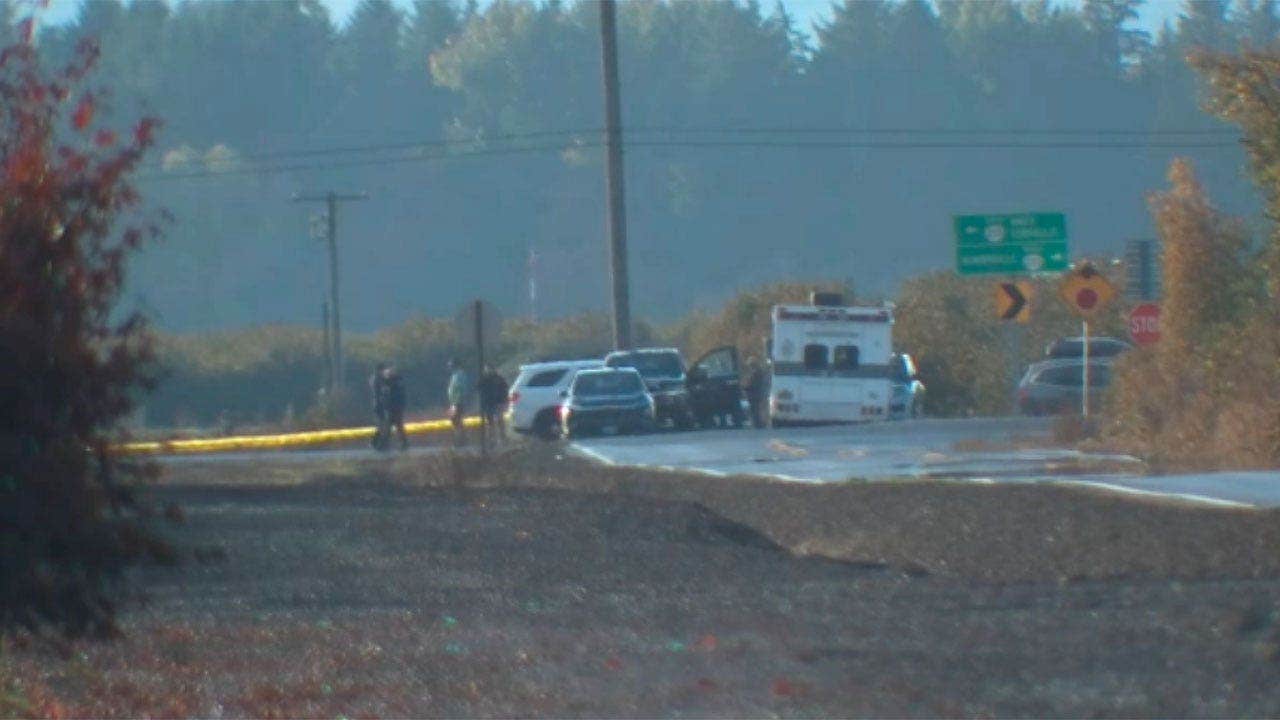
On an otherwise unremarkable Thursday afternoon in Yamhill County, Oregon, the familiar hum of small aircraft and utility helicopters overhead was suddenly replaced by a sound no community ever wants to hear: the violent clash of metal against metal in midair. Just before 2:15 p.m. local time, a Robinson R22 helicopter and an Airbus H125 helicopter collided near McMinnville Municipal Airport, a busy hub for general aviation in the heart of Oregon’s wine country. The impact sent both machines plummeting into a grassy field just off Oregon Route 233, about a mile west of the small community of Dayton. Within minutes, emergency responders were converging on the scene, closing roads, and blocking off the area as word began to spread through the tight-knit town. The Federal Aviation Administration later confirmed that there were three people aboard the two helicopters: a lone pilot in the Robinson R22 and two people in the Airbus H125. But in the hours that followed, officials offered no immediate word on whether anyone had survived, leaving families, neighbors, and aviation enthusiasts across the region waiting with held breath. The scene, with wreckage scattered in the open field and emergency lights flashing against the gray winter sky, served as a stark reminder that even routine, local flights can turn tragic in an instant.
The midair collision occurred during a period of active flying around McMinnville Municipal Airport, a facility known for its strong connection to recreational aviation and its proximity to the Evergreen Aviation & Space Museum, home of the famed Spruce Goose. McMinnville is a place where pilots train, hobbyists tour, and utility operators rely on helicopters for everything from agricultural work to transport. The Robinson R22, a light, two-blade helicopter often used for flight instruction and personal travel, is a familiar sight in such communities because of its relatively low operating cost and versatility. The Airbus H125, on the other hand, is a much more powerful turbine helicopter, frequently used in firefighting, aerial construction, and other heavy-duty operations because of its ability to carry substantial loads and perform in demanding conditions. That one of each type collided only adds to the puzzle that investigators now face: how did these two aircraft, sharing the same sky but performing potentially very different missions, end up on the same path at the same time? The FAA’s initial statement was clinical and sparse, confirming the basic facts but offering no explanation. Officials noted that the agency had not yet provided information about possible injuries or fatalities, leaving the condition of all three individuals unclear. That absence of information, while standard in the early stages of an aviation incident, only deepened the anxiety for those who knew the pilots and passengers and for a community that could do little more than wait for official updates.
As emergency personnel worked the scene, transportation officials moved quickly to protect public safety and secure the area. Mindy McCartt, a spokesperson for the Oregon Department of Transportation, told reporters that the crash site was in a field off Oregon Route 233, a rural highway that runs through scenic farmlands and open countryside in the western part of the state. At the request of emergency responders, the highway was shut down, along with several nearby county roads, preventing curious onlookers from getting too close and allowing investigators and rescue crews to do their work without interference. McCartt explained that there was no estimated time for reopening, a common point of frustration in the immediate aftermath of a disaster, but also a clear signal that the response would be thorough and careful. The closure disrupted local traffic and forced some residents to contemplate alternate routes through narrow back roads, a small inconvenience compared to the gravity of the event but one that underscored how deeply a single accident can ripple through a rural area. Meanwhile, McMinnville Airport Manager John Paskell tried to reassure the public that the facility itself remained fully operational. He confirmed to Fox News Digital that the collision occurred off airport property, so there were no closures, restrictions, or interruptions to normal airport operations. Planes and helicopters could still land and take off, and the airport continued to function as a lifeline for the region even as the investigation began to unfold.
One of the most striking details to emerge in the first hours after the crash was the fact that both helicopters were based at McMinnville Municipal Airport. That seemingly simple fact ties the tragedy closely to the local aviation community, where pilots and crews often know one another by name and where the sight of helicopters coming and going is taken almost for granted. Paskell said he believed both aircraft called the airport home, but he could not confirm what activities they were conducting or how the collision occurred. In all likelihood, the Robinson R22 was engaged in some form of training or personal flying, while the Airbus H125 could have been preparing for any number of commercial or utility missions. The collision raises sobering questions: Were the pilots in communication with air traffic control, or were they operating without a tower, as is common at smaller airports? Did visibility or weather play a role, or was the crash the result of a momentary lapse in situational awareness? Did one helicopter suddenly appear in the other’s blind spot, leaving the pilots with only seconds to react? These are the kinds of questions that families and investigators will grapple with, and the answers may not come quickly. In the meantime, the silence from official sources, including the Yamhill County Sheriff’s Office and the National Transportation Safety Board, which both declined to comment when reached by Fox News Digital, left room for speculation but also allowed the investigation to proceed without public missteps.
The investigative process itself is now the central focus, and it will likely be painstaking and methodical. The FAA, which reported the collision and confirmed the basic details, has said that it will work alongside the NTSB, with the NTSB taking the lead in determining the probable cause of the tragedy. In any midair collision, investigators must examine a wide range of evidence, including the wreckage itself, the positions and angles of impact, maintenance records for both aircraft, pilot experience and medical histories, weather conditions leading up to the accident, and any available radar or flight tracking data. They will also interview witnesses who may have seen the helicopters in the moments before the collision and listen to communications between the pilots and any relevant air traffic services. The wreckage in the field will be carefully documented, and components will likely be sent to specialized facilities for further examination. The NTSB is known for its thoroughness, and while this particular accident may initially appear to be a straightforward case of two aircraft flying too close to one another, the investigation will dig much deeper. Could a mechanical issue have forced one aircraft off its intended path? Was there a radio communication failure? Were both pilots following established visual flight rules and responsibility to see and avoid other aircraft? The preliminary information released so far is, as the FAA itself cautioned, subject to change, and the public should expect updates over the coming days and weeks as investigators piece together a clear and honest timeline.
For now, the focus must also turn to the human side of the tragedy, which is too easy to lose in the technical details. Three people went up in those helicopters, each with a life, a family, a purpose, and a story. They were likely pilots or passengers who loved aviation or depended on it for their livelihoods, people who had probably flown that same sky many times before. Their loved ones are now facing an agonizing wait for news, a wait that no amount of investigation can speed up. The community around McMinnville, a place that takes pride in its aviation heritage and its close ties to the sky, is left to process the shock, to offer support to those affected, and to reflect on the fragility of a profession and passion that is both thrilling and inherently risky. In the coming days, there will be vigils, conversations at the airport coffee shop, and stories shared about the people involved. NTSB updates will arrive in measured, factual increments, and the void of information will slowly be filled. But the crash off Oregon Route 233 will remain a sobering reminder that in aviation, even the smallest helicopter flight carries weight, and that the sky, for all its beauty and freedom, demands a level of vigilance that never truly relaxes. Until the official cause is determined, and even long afterward, the memory of that Thursday afternoon will linger in the field near Dayton, in the hangars of McMinnville, and in the hearts of all who look up at the sound of rotors overhead and wonder, for just a moment, if everything will be alright.