


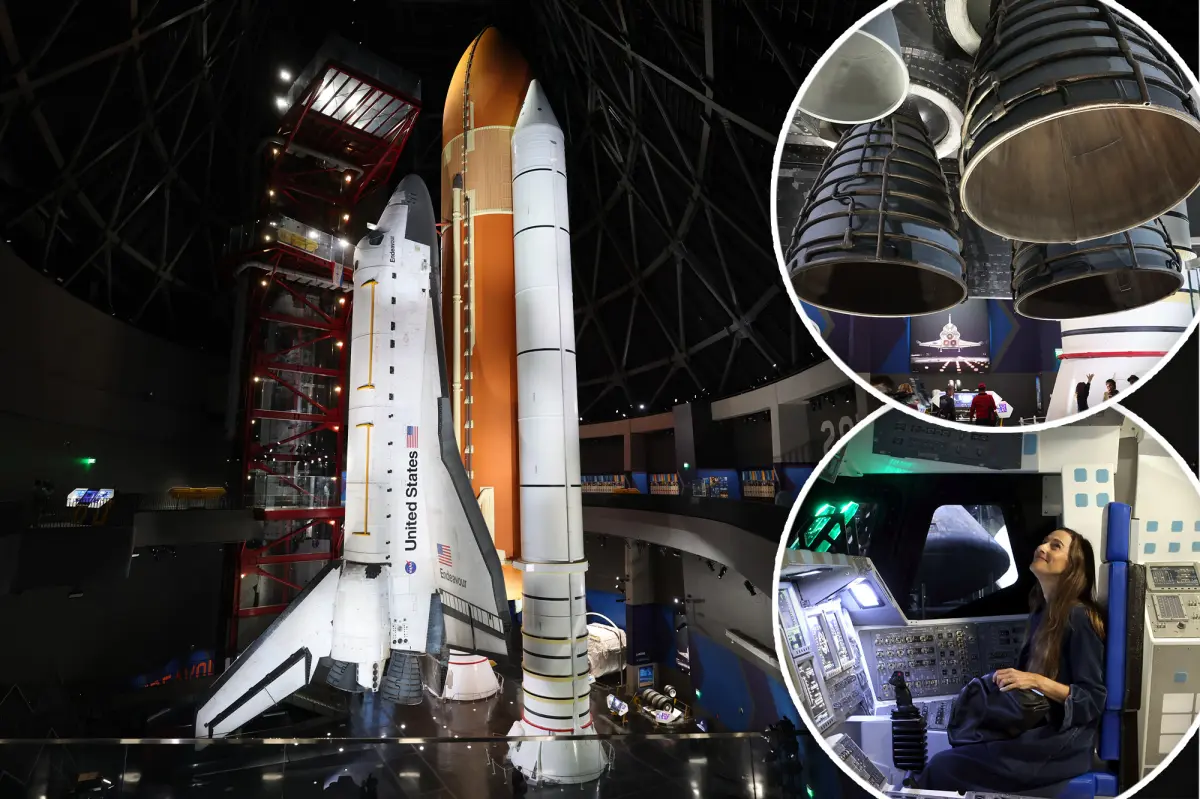
There is something almost mythical about a space shuttle poised for launch, and starting this fall, Los Angeles will have one permanently on display, pointed skyward as if it might ignite at any moment. The California Science Center is throwing open the doors to its extraordinary new Samuel Oschin Air and Space Center on November 13, and at the heart of it all sits Endeavour, the legendary NASA orbiter, now mounted in a towering 20-story launch configuration. This is not a static museum piece in a quiet hangar; it is a dramatic, full-stack marvel—an authentic space shuttle flanked by real solid rocket boosters and an external fuel tank, all arranged exactly as they would have been on the launch pad. For decades, science center leaders, architects, and space enthusiasts have dreamed of giving Endeavour a home that matched its monumental legacy, and with this grand opening that dream finally becomes a reality. Jeffrey Rudolph, the president and CEO of the California Science Center, put it plainly, calling the opening the fulfillment of a decades-long ambition to create one of the world’s leading science centers. But you do not need to be a rocket scientist to feel the electricity in the air. This is a place where history and imagination collide, where a retired workhorse of space exploration is being transformed into a beacon of possibility for everyone who looks up at the stars and wonders what lies beyond. The sheer scale of the space itself is breathtaking, and as visitors approach, they will understand why so many people worked for so many years to make this moment happen. It is not just an exhibit; it is a cathedral of human curiosity.
The numbers alone tell an inspiring story. The Samuel Oschin Air and Space Center is a massive 200,000-square-foot addition that nearly doubles the California Science Center’s exhibition space. Inside, visitors will discover more than 100 aerospace artifacts and 100 hands-on exhibits focused on science and engineering, making it a playground for curious minds of all ages. But the true centerpiece is, of course, Endeavour itself. This is the fifth and final orbiter to join NASA’s space shuttle fleet, a spacecraft with a powerful history that reaches back to tragedy and triumph. Endeavour was built to replace Challenger after the devastating 1986 disaster, and it first soared into orbit on May 7, 1992. Over the course of its working life, it completed 25 successful missions, carrying astronauts, satellites, and scientific experiments into space, and helping build the International Space Station. Now, after years of careful planning and an unforgettable journey through the streets of Los Angeles, Endeavour stands vertical, surrounded by the very hardware that helped it reach orbit. The California Science Center proudly notes that this is the only complete, authentic space shuttle system on public display anywhere in the world. There is no other place where you can see the orbiter, its solid rocket boosters, and its external fuel tank assembled together in launch position. It is a once-in-a-lifetime sight, and it promises to leave a lasting impression on everyone who walks through the doors. Rudolph calls this experience an enduring source of inspiration for generations of scientists, engineers, and explorers, and it is easy to see why. For a young child standing at the base of that towering stack, the message is unmistakable: humans built this, humans flew this, and maybe one day, you will reach even farther.
But Endeavour is more than a collection of engines and thermal tiles; it is a veteran of the cosmos, a ship with stories etched into every surface. Its name itself honors the first ship commanded by British explorer James Cook, fitting for a vessel meant to push boundaries and chart new frontiers. From its maiden voyage in 1992 to its final mission in 2011, Endeavour served as a floating laboratory, a construction site, and a symbol of international cooperation. It flew missions that deployed satellites, serviced the Hubble Space Telescope, and delivered critical components to the International Space Station. Its final mission, STS-134, commanded by Senator Mark Kelly, was a fitting capstone to an incredible career. After retirement, Endeavour went on a different kind of adventure, one that captured the hearts of Angelenos. In 2012, the shuttle was carefully transported through the streets of Los Angeles, inching along boulevards, squeezing past buildings, and thrilling crowds who lined up to catch a glimpse of the historic spacecraft. Trees were trimmed, power lines were moved, and the city essentially paused to welcome its new iconic resident. That journey was already legendary, but now Endeavour has reached its final, most dramatic resting place. Displayed vertically, with its nose pointing toward the heavens, the shuttle looks alive, as if it is merely waiting for the countdown to begin again. Visitors will not just observe this marvel from a distance; they will get to experience it up close in ways that feel almost personal. There is a 140-foot elevator ride up the launch structure, leading to a glass-floor observation platform high above the orbiter. From that vantage point, you can look down at the spacecraft and truly grasp the immense engineering that made space travel possible. It is a perspective that very few people have ever had, and it is now available to anyone who walks through the doors.
The interactive experiences are designed to make every visitor feel like part of the mission. You can try a shuttle landing simulator and see if you have what it takes to bring a spacecraft safely back to Earth. You can explore a replica flight deck and imagine yourself commanding a crew on a journey to orbit. And for those who want a little more adrenaline, there is a 45-foot slide designed to evoke the shuttle’s fiery return through Earth’s atmosphere, a playful nod to the intense heat and speed of reentry. These hands-on exhibits are not just entertainment; they are powerful teaching tools that make complex ideas about physics, engineering, and exploration feel tangible and exciting. Children can play, tinker, and experiment, while their parents find themselves rediscovering the wonder of space. The goal is to spark curiosity, to encourage young people to ask questions, and to show them that careers in science and technology are within reach. It is about making the impossible feel possible, one exhibit at a time. The new center is also a testament to the power of generosity and vision. Its namesake, Samuel Oschin, was a longtime philanthropist who passed away in 2003, but his spirit lives on in this remarkable project. His widow, Lynda Oschin, chairs the Mr. and Mrs. Samuel Oschin Family Foundation, one of the lead donors, and she has spoken beautifully about what Endeavour represents. She described how the shuttle exemplifies so many of her husband’s passions, including astronomy, math, science, exploration, and helping children achieve their dreams. That sense of purpose is woven into every corner of the center, from the artifacts on display to the classrooms and activity spaces designed for the next generation of dreamers. This is not just a tribute to the past; it is an investment in the future, a place where young people can look at Endeavour and see a mirror of their own potential.
The opening celebration on November 13 is expected to be nothing short of spectacular. About 30 astronauts are scheduled to attend, including all six crew members from Endeavour’s final mission, STS-134, commanded by Senator Mark Kelly. Imagine the moment when the people who actually flew this shuttle gather beneath it, sharing stories, posing for photographs, and reflecting on the incredible journey that brought them here. For visitors, it will be a rare and moving opportunity to connect with living history, to meet the men and women who risked everything to push the boundaries of human achievement. Their presence will serve as a powerful reminder that behind every great spacecraft are the people who built it, flew it, and dreamed it into existence. The celebration will be a community event, a chance for Los Angeles and the world to come together in awe and gratitude. It will also be a testament to the collaborative spirit of the entire project. So many people contributed to making the Samuel Oschin Air and Space Center a reality—architects, engineers, construction workers, educators, philanthropists, and space enthusiasts—and their collective effort is something to behold. As the astronauts look up at Endeavour, they will see not just a machine, but a monument to human courage and curiosity. And as visitors look up at the astronauts, they will see that the path to the stars is not closed to them. It is open, waiting for the next generation to take the first step.
For those planning to visit, there is some practical information to keep in mind. General admission to the California Science Center is free, which is wonderful news for families and travelers alike. However, timed reservations are strongly encouraged for the new attraction, and online reservations carry a $4 service fee. Demand is expected to be incredibly high, especially in the weeks and months after the opening, so it is wise to plan ahead and secure your spot early. The experience promises to be unforgettable, but it is also the kind of thing that will draw crowds from around the world, so patience and preparation will be key. Whether you are a lifelong space enthusiast or simply someone looking for an inspiring day out, the Samuel Oschin Air and Space Center is destined to become one of California’s most iconic destinations. It is more than just a museum; it is a celebration of the human spirit, a place where the boundaries of what is possible are pushed a little further with every visit. Standing beneath Endeavour, feeling the weight of its history and the lightness of its promise, you cannot help but feel a sense of hope. This is what we can achieve when we work together, when we dare to dream, when we refuse to accept the limits of gravity. The shuttle is silent now, its engines forever still, but it still speaks to us. It tells us that exploration matters, that knowledge matters, and that the curiosity of a child is worth protecting and nurturing. When the doors open on November 13, a new chapter begins, not just for the California Science Center, but for everyone who believes that the stars are not out of reach. Come see Endeavour. Come be inspired. Come dream the impossible.