


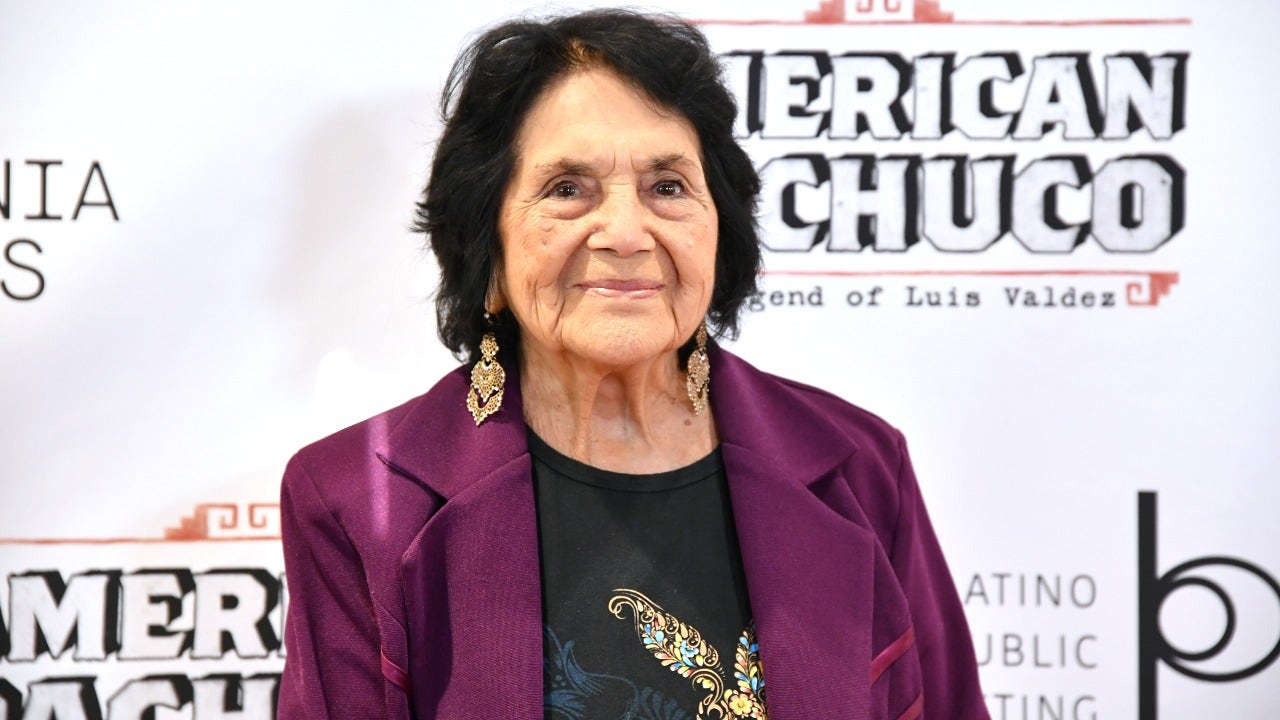
Dolores Huerta, one of the most tenacious and consequential labor leaders in American history, has died at the age of 96. She passed away on Wednesday at her home in Bakersfield, California, surrounded by her close family, according to an announcement from her foundation. The news resonates far beyond the farmlands where she spent so much of her life, because Huerta was never just a witness to history; she was a force of nature who helped bend the arc of the country toward justice. Svante Myrick, president of the progressive advocacy group People For the American Way, where Huerta served on the board of directors for 22 years, remembered her as “unstoppable.” In a statement mourning her loss, he called her “one of the fiercest and most consequential activists in our nation’s history,” and recalled that she was “the first to get started in the morning and the last to quit at the end of the day.” That rhythm defined her life. Born in New Mexico and raised by a single mother in California’s San Joaquin Valley, Huerta learned early what it meant to struggle, and what it meant to survive. Her mother, who worked as a cannery worker and waitress, taught her that ordinary people could accomplish extraordinary things if they organized and refused to accept injustice. Huerta carried that lesson into a career that began in a classroom. As a young schoolteacher, she watched her students come to school hungry, exhausted, and sometimes without shoes, children whose parents toiled in fields yet could not afford basics. She realized that teaching them to read would do little good if they returned home to malnutrition, exploitation, and hopelessness. So she left the classroom and stepped into the streets, into community halls, and into the fields, determined to change the conditions that shaped her students’ lives.
Her early activism took root in the grassroots organizations of California, where she helped establish a local chapter of a community organization that challenged segregation, police brutality, and the everyday indignities suffered by Mexican American families. Those years taught her that the labor movement and the civil rights movement were inseparable, and that the fight for dignity had many fronts. Eventually, her attention turned to the people who picked the nation’s food. Working alongside César Chávez, the charismatic farmworker leader, she helped build the National Farm Workers Association in 1962. Four years later, that association merged with another union to form the United Farm Workers, which remains to this day the longest-standing labor union representing agricultural workers in the United States. Huerta was more than a co-founder; she was the strategist, the negotiator, the voice that could move crowds and the organizer who could move mountains. She understood that the union’s strength depended on families, on women, on those who had never before been asked to speak. While Chávez was often the public face of the movement, Huerta was its nervous system, connecting workers, volunteers, clergy, students, and politicians in a web of solidarity. For decades, the public saw them as partners in a sacred mission. Only in the final years of her life did she reveal the profound betrayal that shadowed that partnership, a disclosure that complicated her legacy and challenged the movement to confront its own flaws. But even that painful truth did not diminish her commitment to the cause; if anything, it showed her courage in facing the past without letting it silence the work.
Perhaps her defining moment came in Delano, California, where the struggle for farmworker justice exploded into national consciousness. In September 1965, thousands of Filipino and Mexican farmworkers walked off the grape fields, accusing growers of paying starvation wages and treating them as disposable labor. Huerta was among the leaders who transformed that local strike into a moral crusade. Along with a coalition of farmhands, she helped turn the Delano grape strike into a nationwide consumer boycott of table grapes, urging housewives, church groups, students, and ordinary shoppers to refuse to buy until growers agreed to bargain fairly. It was a strategy that required astonishing patience and discipline. Huerta traveled constantly, organizing in cities across the country, speaking in church basements and union halls, convincing people who had never been near a vineyard that the grapes on their supermarket shelves were soaked in exploitation. Her rallying cry, “¡Sí, se puede!” — “Yes, it can be done!” — captured the spirit of the movement. It was not a slogan of vague hope but a declaration of certainty, rooted in her belief that ordinary people can affect political change. The strike lasted until the summer of 1970, when the United Farm Workers signed collective bargaining agreements covering 10,000 workers. It was a historic victory, and Huerta was at the center of it. But she never treated that triumph as an endpoint. She saw it as proof that the movement could grow, that the poor could stand up to concentrated wealth, and that people of color and immigrant workers could claim a voice in a country that too often ignored them.
Beyond the fields, Huerta became a prominent civil rights and women’s rights advocate, fighting discrimination on multiple fronts. In a labor movement dominated by men, she insisted that women’s voices be heard at the bargaining table and on the picket lines. She challenged sexism within her own union and in the broader world, advocating for gender equality in an era when women were often expected to take minutes rather than make demands. Her activism expanded to include campaigns against police brutality, environmental racism, and anti-immigrant policies. She understood that the dignity of working people could not be separated from their identity as Latinos, as women, as immigrants, as human beings. Her contributions were recognized at the highest levels of American life. In 2012, President Barack Obama awarded her the Presidential Medal of Freedom, the nation’s highest civilian honor. At the ceremony, Obama joked that he had borrowed her famous slogan, “¡Sí, se puede!” for his own 2008 presidential campaign. It was a moment of public validation that Huerta had earned over more than half a century of struggle, but she remained characteristically restless. Even into her 90s, she continued to deliver speeches, attend rallies, and speak out on issues ranging from civil rights to national politics. She was a familiar figure at marches, often one of the oldest people in the crowd but one of the most energetic. Her voice, worn by decades of shouting into bullhorns and addressing restless crowds, never lost its edge. She was not interested in being an icon; she wanted to be an organizer. She wanted to remind people that the fight for justice does not end with one election or one contract, but continues for every generation.
No account of Huerta’s life can avoid the painful revelation she chose to share earlier this year. In March, in an account published by The New York Times, Huerta publicly accused César Chávez of raping her in 1966, after driving her out to a grape field in Delano, where the strike was unfolding. She also described another incident in August 1960, when Chávez allegedly pressured her into having sex with him in a hotel room in San Juan Capistrano. The newspaper’s report also included allegations from two other women who said Chávez sexually abused them as girls during the 1970s. Huerta said she became pregnant following both encounters with Chávez, who died in 1993, and later arranged for the children to be adopted and raised by other families. In a statement address the allegations, she explained that she had kept both the assaults and the children secret for decades because she feared that others in the Latino civil rights movement would not believe her. She also worried that speaking out against Chávez, one of the movement’s most prominent and revered figures, would damage the cause and the shared objectives that had consumed her life. That painful admission added a layer of tragedy to her story, but it also underscored her honesty. She could have died without ever revealing the truth. Instead, she chose to complicate her own legacy rather than allow history to remain a comfortable myth. The revelation was met with shock, grief, admiration, and anger, sometimes all at once. But Huerta refused to let it define her. She encouraged people to continue fighting for their rights, and she insisted that the labor movement was bigger than any single person, including herself and Chávez. In doing so, she gave her followers a lesson in forgiveness, accountability, and the courage to face the truth.
In the end, Huerta’s legacy is impossible to measure in a single phrase. She was a woman who spent her life fighting for people who had been told they did not matter. She was a labor organizer who helped build a union that gave dignity to farmworkers. She was a feminist in a movement that too often forgot its women, and she pushed that movement to be better. She was a mother, a grandmother, a partner, and a friend. Her personal life was as complex as the movement she helped build; she had seven children from two previous marriages and four more with Richard Chávez, César’s brother, who was her lifelong partner beginning in the early 1970s. Her home was filled with family, with debate, with the chaos of a life spent in motion. Yet she always found time to mentor young activists, to answer letters, to show up at community meetings where no one else from the national movement would appear. She believed that change comes from the bottom up, from people who have the courage to say, “Yes, it can be done.” That phrase, “¡Sí, se puede!” now belongs to the world. It has been painted on banners, shouted at rallies, translated into dozens of languages. But for Huerta, it was never just a phrase. It was a way of living. It meant you get up when you are tired. You keep going when you are afraid. You tell the truth even when it costs you. You stand with those who have the least and fight not only for their wages but for their humanity. Dolores Huerta could have rested years ago. She had earned every honor, every award, every moment of peace. But she did not want peace if it meant accepting injustice. She wanted to keep moving, keep organizing, keep believing that the world could be remade. And now that she is gone, the work remains. It remains in the farmworkers who sat at her kitchen table, in the students who listened to her speak, in the women who found their voices because she had found hers. There is a grief that comes with losing someone who seemed immortal, but there is also a gratitude that she lived, and that she chose to spend her life so fully. Huerta’s body is gone, but her voice will not disappear. It echoes in every chant of “¡Sí, se puede!” in every strike, in every act of defiance by those who refuse to be invisible. She knew, better than almost anyone, that ordinary people can do extraordinary things. She proved it with her own life, and she leaves behind a movement that will keep proving it for generations to come.