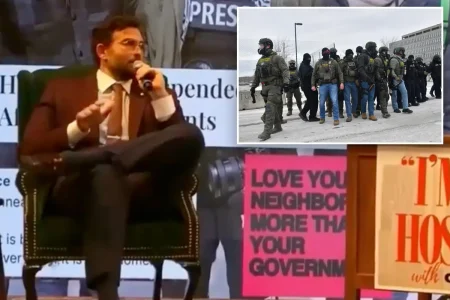





There’s a tendency in Washington to reduce every controversy to a headline, but the situation swirling around Representative Ilhan Omar of Minnesota is far more layered than a simple news alert. Omar, a Democratic congresswoman known for her progressive voice and unapologetic style, is now the subject of two separate federal investigations—one focused on allegations of immigration fraud, and another on a sharp discrepancy in her financial disclosures that reportedly changed dramatically in just one year. The stakes are high, and legal observers have begun to weigh in on what could happen if the allegations are proven. Among them is Nathan Hansen, a former immigration judge and attorney with 23 years of experience, who has offered a candid assessment: Omar could potentially face criminal charges, and in a separate legal arena, she could also confront the possibility of denaturalization. Hansen, who was appointed to his immigration judge role earlier this year by former Attorney General Pam Bondi and served for four months, is careful not to overstate certainty. He emphasizes that a criminal conviction alone does not automatically strip a naturalized citizen of their citizenship. But he also makes clear that the legal system provides multiple paths, and in a case involving alleged fraud tied to one’s entry into citizenship, the consequences could be far more serious than a fine or a prison sentence.
To understand what might happen next, it helps to untangle the two distinct legal processes at play. On one side is the criminal justice system, which would punish any proven wrongdoing with the usual tools of the law—penalties, probation, or incarceration. On the other side is denaturalization, a separate civil proceeding brought by the Department of Justice, often on behalf of the Department of Homeland Security, with the specific goal of revoking citizenship that was obtained improperly. Hansen points out that denaturalization is not an automatic byproduct of a conviction. “If somebody who’s a naturalized citizen—which I believe Ilhan Omar is—is convicted of a crime, that doesn’t automatically mean that they face denaturalization or anything like that,” he explained. “They would be handled by any type of other normal punishment that would come from the court.” Instead, denaturalization requires its own case, its own burden of proof, and its own discretionary decision by officials at the highest levels of the Justice Department. If there is a clear connection between the criminal conviction and how someone became a citizen—for example, if the very paperwork at the heart of the citizenship application was fraudulent—then the likelihood of seeing a denaturalization proceeding increases. But Hansen is careful to frame this as a judgment call, not a foregone conclusion. “If there was some sort of nexus between the criminal conviction and somebody’s citizenship, it might be more likely that the Department of Justice would bring a denaturalization proceeding,” he said. “But I think it would be a discretionary matter within the people who are running the Justice Department.”
The investigation into Omar’s citizenship status reportedly centers on the name and details provided on her naturalization paperwork, with sources familiar with the investigation saying her “real name” is Ilhan Nur Said Elmi. The allegation is that Omar, or her late father on her behalf, may have filled out certain immigration and citizenship forms in a way that was misleading or inaccurate. This kind of case, Hansen notes, is rarely simple. Immigration law is dense, bureaucratic, and often unforgiving, and the difference between an honest mistake and intentional fraud can be incredibly difficult to parse from the outside. Still, the gravity of the situation was made plain in October, when Homeland Security Investigations—the principal investigative arm of the Department of Homeland Security—raided Omar’s home in Washington, D.C., in the early morning hours. According to reports, investigators seized her phone, passport, and computer, and Fox News later confirmed that authorities also obtained her DNA. For any member of Congress, having federal agents enter your home and take your personal effects would be jarring. For Omar, it has intensified the public scrutiny and fueled speculation about what investigators believe they already know and what they are still hoping to find.
One of the most common questions to emerge in the wake of the raid is whether the statute of limitations might bar any prosecution. The idea, as some observers have suggested, is that the alleged conduct took place years ago, and if the legal clock has run out, the entire investigation might be nothing more than a costly exercise in futility. Hansen rejects that reasoning, at least as a general principle. In cases involving fraud, he says, the law often allows the clock to stop when someone has actively hidden the truth. “My view of that is generally that fraud stops any statute of limitations,” Hansen said. “In other words, if something isn’t disclosed or something’s hidden, then it would be unfair to the other party to toll a statute of limitations against them. That’s just sort of a general principle of law.” In plain language, this means that if someone lied or omitted important information, the legal clock may not even start ticking until the lies are discovered. This is a critical point, because it means that even old allegations can become actionable if the government can show that the person deliberately concealed the truth. It also underscores how serious fraud cases can become, especially when the alleged fraud is tied not just to a government benefit, but to the foundational question of who is allowed to call themselves an American citizen.
But beyond the specific situation facing Omar, Hansen’s comments also shine a light on a broader systemic issue that has been straining the immigration courts for years. As a judge, Hansen saw firsthand the sheer volume of cases moving through the system, and the numbers are staggering. Nationwide, the United States is facing what Hansen describes as millions of people coming through immigration channels, and the machinery designed to process those cases is buckling under the weight. In Minnesota alone, he said, there are between twenty and thirty thousand removal cases currently pending that do not even have a scheduled court date. This massive backlog is not just a logistical headache; it has real consequences for people who are trying to navigate the system honestly, as well as for the courts that are trying to administer justice fairly. “Whether you want to call it fraud or whatever, it’s like an overwhelming of the system and the system is not being used in the way in which it was intended,” Hansen explained. The result is a slow, frustrating, and often chaotic experience for everyone involved—immigrants, lawyers, judges, and government officials alike. And into that gap, Hansen suggests, bad actors can slip through, submitting claims and applications that would never survive a more efficient and more careful review.
One of the main drivers of the backlog, according to Hansen, is the proliferation of bogus asylum claims. Asylum, at its core, is meant to protect people who have a well-founded fear of persecution based on specific protected grounds—race, religion, ethnicity, political opinion, or membership in a particular social group. The idea is to offer refuge to people who are genuinely fleeing danger, not to provide a backdoor path into the country for those who simply want a better life or are unhappy with their circumstances. In an ideal world, every asylum claim would be carefully examined on its merits, and genuine refugees would be distinguished from those who are abusing the system. But Hansen says that during his time on the bench, he regularly encountered claims that “just totally didn’t add up,” and documents that were “clearly fake.” He also saw applications that were legally meritless from the start. One example he offered was people claiming asylum because they were insulted in their home country. “My response to that is, ‘Your country probably provides more protection against insults than the United States. In the United States, we have freedom of speech, and for the most part, you can be as rude as you want to someone and insult them, and it’s not a crime,’” he said. His point was not to mock genuine suffering, but to illustrate how overstretched and vulnerable the system has become. When courts are flooded with claims that have no legal foundation, the limited time and resources left for legitimate cases shrink even further, making the entire process less just and less efficient.
What makes all of this feel so human, and so unresolved, is that the story of Ilhan Omar is also a story about identity, family, and the complicated lengths people go to in order to belong. Omar is a naturalized American citizen, a woman of Somali descent who came to the United States as a refugee, eventually rose to become one of the most recognizable progressive politicians in the country, and now finds herself defending the legitimacy of the very citizenship that allowed her to take office. No matter where one falls politically, there is something profound about that arc, and there is something deeply consequential about the questions being asked. Hansen’s reflections offer a reminder that the law is not an abstract machine; it is applied by people making judgment calls, under enormous pressure, with incomplete information and imperfect tools. The immigration system is overwhelmed. Asylum claims are being abused. Statutes of limitations are being debated. Citizenship itself—once assumed to be permanent and sacred—is being scrutinized in ways that would have seemed unthinkable just a few years ago. In the end, Hansen does not pretend to know how Omar’s case will unfold, and he does not offer easy answers about the broader crisis in immigration courts. What he does offer is a grounded, pragmatic perspective: the system is human, it is flawed, and it is being asked to do more than it was ever designed to do. Whether justice is served in Omar’s case, or in the thousands of backlogged cases across Minnesota and the nation, will depend not on headlines but on the painstaking, often messy work of judges, investigators, and legal advocates trying to find the truth within a system that is struggling to hold itself together.