


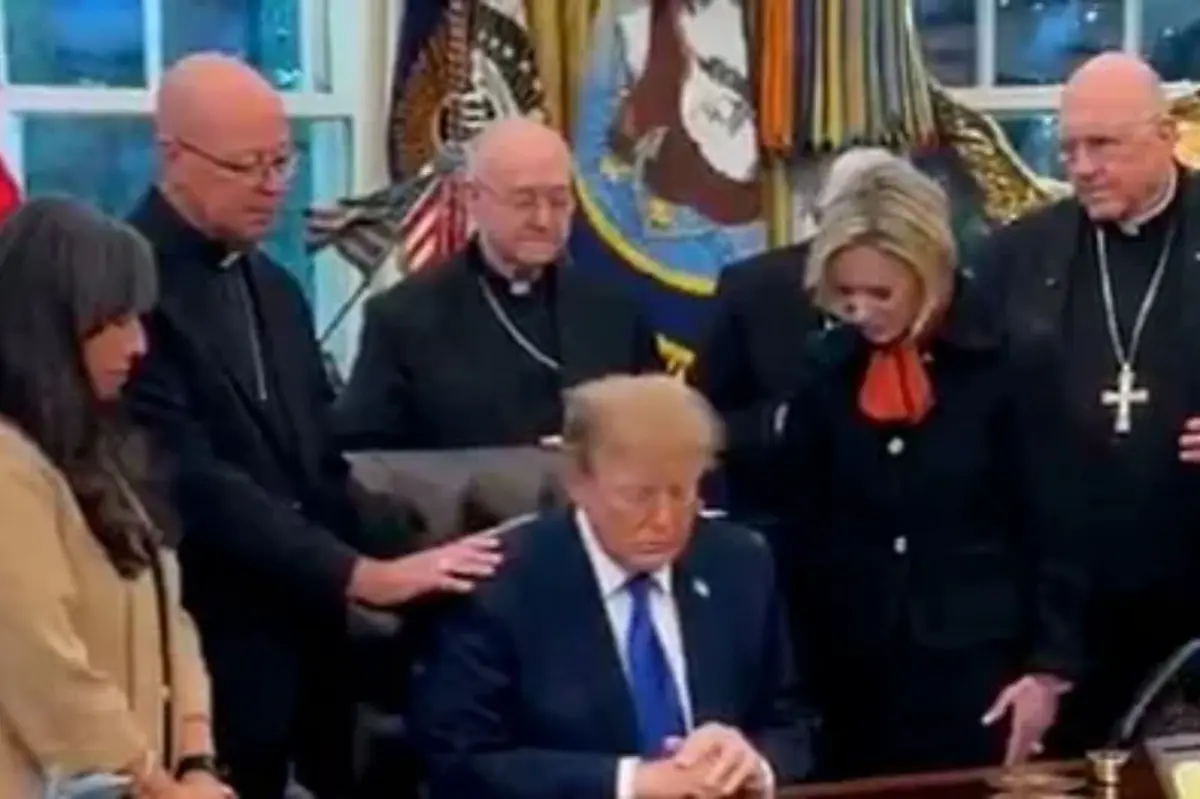
On a quiet Thursday afternoon, a group of twelve Catholic bishops walked into the White House carrying something more fragile than policy briefs: they carried hope. They had come to Washington, as Milwaukee Archbishop Jeffrey Grob later explained, in good faith, seeking to ease suffering, to build up the common good, and to pray with the President of the United States. The meeting had been arranged by the Heritage Foundation, and on the table were serious Catholic priorities: immigration enforcement, religious worker visas, and the protection of vulnerable people. After a ninety-minute conversation with White House domestic policy staff and advisors, the bishops were invited into the Oval Office. President Trump presented them with commemorative tokens. Then they bowed their heads and prayed together. In that moment, whatever their political differences, they were doing what pastors do: asking God to bless a nation and its leaders. But when the White House later distributed photographs and video of that prayer without asking their consent, the moment was transformed into something they never intended. For Grob, it became a source of profound sadness. In a public apology released just days later, he described feeling that something sacred had been manipulated, and he apologized to Catholics who saw the images as a political endorsement. It was a painful awakening for a man who had arrived with reservations, but who had chosen to trust that a prayer in the Oval Office could be exactly what it appeared to be: an act of faith, not a campaign prop.
The White House saw no betrayal in that moment, only a record to be proud of. In response to Grob’s apology, White House spokeswoman Taylor Rogers defended President Trump in forceful terms, calling him the greatest president for Catholic Americans in history. She pointed to his record: stopping the weaponization of the federal government against Christians, defending and expanding religious rights, pardoning pro-life activists, stopping the chemical mutilation of children, and protecting parents’ rights. For the administration, the Oval Office prayer was a symbol of that alignment, a visual confirmation that the President stood with Catholic Americans on the issues that mattered most to them. But the bishops who participated did not see it that way. They had not come for a photo opportunity. They had not understood that the meeting would be publicized, let alone recorded. Grob said the group was unaware the video was being filmed, and the release of that footage without their consent felt less like hospitality and more like exploitation. The gap between those two perspectives is enormous. What the White House celebrated as a moment of solidarity, the bishops experienced as a violation. It is the kind of misunderstanding that happens when people from different worlds meet in a room filled with symbols: one side sees a pastor blessing a president; the other sees a political prop being used to bless a campaign. The photograph itself may be small, but the wound it caused is large, because it touches on something deeper than any single policy debate: the question of whether faith can be shared across a dividing line without being swallowed by it.
The details of that day matter. The meeting was meant to address real concerns about immigration enforcement and religious worker visas, issues that directly affect Catholic ministries and families. For ninety minutes, the bishops sat with White House officials, trying to advocate for the Church’s priorities. It was serious work, the kind of quiet diplomacy that religious leaders have engaged in for generations. Then came the Oval Office portion of the afternoon. Trump presented commemorative tokens, a gesture that might have been gracious in private, but in the presence of cameras became something else. The bishops prayed. They prayed for the President, for the country, for wisdom and mercy. For them, it was a pastoral act, rooted in a tradition that teaches Christians to pray for those in authority, regardless of agreement or disagreement. But when the White House shared the images, the prayer was removed from that sacred context and placed in a political one. Without their consent, the bishops discovered that their humble act had been repackaged as an endorsement. Grob later said he felt a heavy sadness, not only for the pain he caused, but for the fact that something so sacred to a group of religious leaders would be manipulated in that way. The word “manipulated” is key. It captures the sense of being used, of having one’s vulnerability exposed for someone else’s advantage. The bishops walked into the White House as shepherds; they were treated, at least in the eyes of many Catholics, as pawns. And the apology that followed was not just about a photograph. It was about the realization that good faith can be taken advantage of, and that even well-intentioned prayers can be twisted into weapons in a culture at war.
Other bishops were quick to voice similar regrets. Des Moines Bishop William Joensen published a statement saying that none of the bishops intended to endorse any political party or candidate, and he acknowledged that they were all aware the meeting was happening on the cusp of a national election. Joensen went further, quoting Jesus’ admonition to his disciples: “Behold, I am sending you like sheep in the midst of wolves; so be shrewd as serpents and simple as doves.” He admitted, with striking honesty, that he wished he had been more shrewd and less simple, like those who exploited the meeting for partisan purposes. His words reflect a deeper dilemma that many religious leaders face in politically charged times: how to remain innocent without becoming naive, how to be present without being used. Denver Archbishop James Golka, who actually led the prayer, offered a more measured defense. He said he wasn’t sure what to do at first. It was a great opportunity to raise important issues for the Church’s benefit, but he knew people might be upset. He had originally thought it would be a private meeting, though he suspected it might be shared and used for political purposes. In the end, he decided to participate because praying for people is what Catholics do. “No matter whether we agree or disagree on anything, we always pray for our country and leaders,” he said. Golka’s explanation is deeply human. It speaks to the tension between duty and prudence, between the call to engage and the risk of being compromised. His choice was not reckless; it was rooted in a tradition that sees prayer as a gift that transcends politics. But in the aftermath, even he acknowledged the difficulty of navigating a world where even prayer can be turned into a partisan symbol.
This controversy does not exist in a vacuum. Catholic leaders have been in tension with the Trump administration long before this moment, and that tension is not simply partisan. The United States Conference of Catholic Bishops sued the administration in February 2025 over the suspension of refugee resettlement funding, a program that many Catholic agencies rely on to serve the most vulnerable. Immigration policy has been a particular flashpoint, with bishops repeatedly urging compassion and restraint while the administration pursued tougher enforcement measures. Those differences are not just political disagreements; they reflect deep theological convictions about the dignity of every human being, the importance of the family, and the moral duty to welcome the stranger. At the same time, not all Catholic leaders share the same approach. Some, like Bishop Robert Barron, a member of Trump’s Religious Liberty Commission, have encouraged continued engagement with the administration. In a May interview, Barron cautioned against demonizing the President despite disagreements over immigration and other policies. He said he did not want the Church to become known for demonization, but rather for principled engagement. This is the wider landscape in which the Oval Office prayer controversy belongs. It is not simply a story about one meeting or one photograph. It is a story about how religious institutions navigate power in a deeply polarized country. When bishops meet with presidents, they carry the weight of their traditions, their responsibilities, and their people’s expectations. Every gesture can be interpreted, every prayer can be politicized, and every act of good faith can be turned against them. The bishops who attended that meeting were not naive about politics, but they may have underestimated how quickly their pastoral presence could be weaponized.
In the end, this is a story about trust, betrayal, and the fragile boundary between faith and power. It is easy to imagine the bishops that Thursday afternoon, tired after a long meeting, perhaps hopeful that their voices had been heard. It is easy to imagine them praying sincerely, their eyes closed, not thinking about cameras or press releases. And it is easy to imagine their shock when they saw themselves portrayed not as pastors but as political props. The photographs showed unity, but they concealed a more complicated truth: that the bishops were divided, cautious, and uncertain, trying to do good in a world where good intentions are often used against those who hold them. The White House, for its part, saw the meeting as a victory for religious liberty and for Catholic priorities. The bishops saw their sacred act distorted. Neither side is likely to convince the other, but the incident offers a powerful lesson for all of us. In an age of instant images and viral moments, we must be careful about how we use the symbols of faith. A prayer is not a political statement, a blessing is not an endorsement, and a handshake with a president is not a surrender of conscience. Religious leaders will continue to engage with power, because they are called to speak for the vulnerable and to seek the common good. But they must do so with the wisdom of serpents and the innocence of doves, aware that even the most sacred moments can be captured, framed, and used in ways they never intended. The Milwaukee archbishop’s apology is not a sign of weakness; it is a sign of integrity. He saw that a line had been crossed, and he said so. In a world that increasingly demands that everything be political, his sadness is a reminder that some things should remain holy, protected from the spin of the news cycle. The prayer was real. The photographs were real. But they told very different stories. And perhaps the most human thing we can do is to sit with that tension, honor the sincerity of those who prayed, and recognize the danger of reducing sacred moments to campaign tools.