


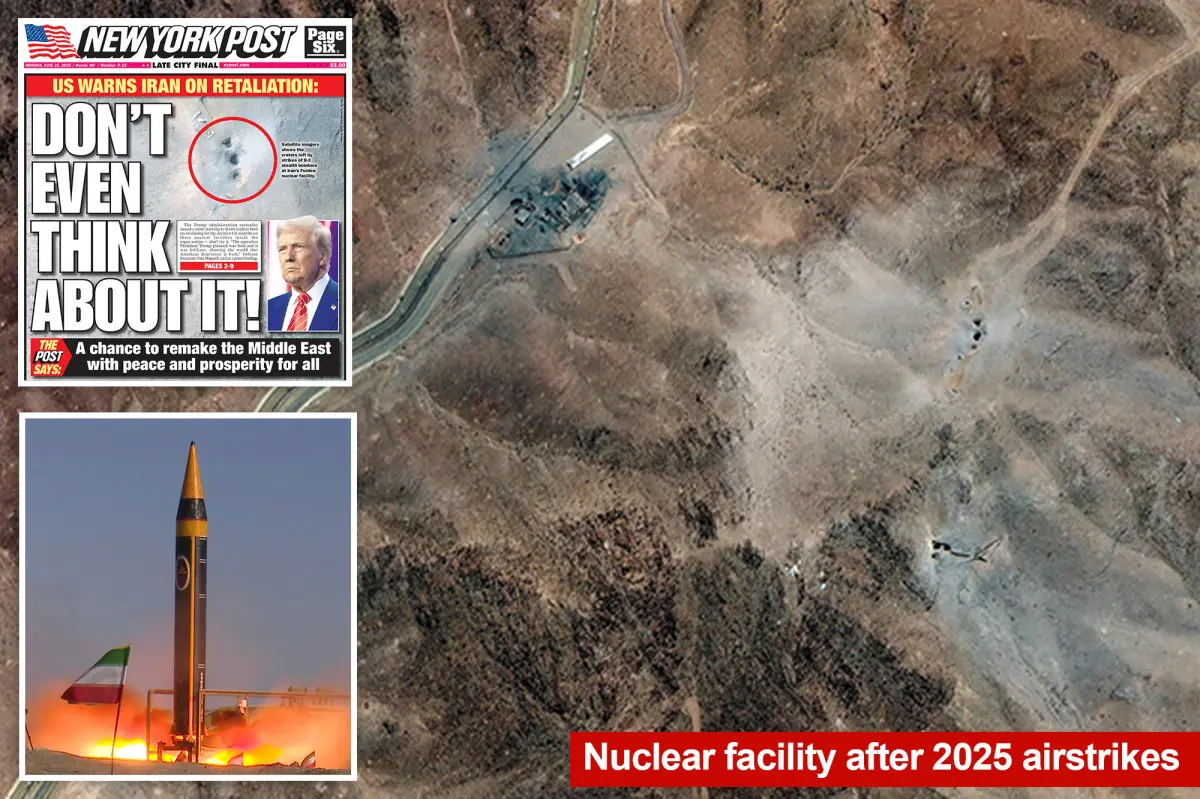
It begins not with a mushroom cloud, but with the quiet hum of bulldozers moving earth beneath the arid plateau of central Iran. Satellite images, pored over by analysts and arms-control experts, have revealed a steady and unmistakable rhythm of construction at some of the Islamic Republic’s most sensitive military and nuclear installations. The work is not hidden; it is visible from space, a fact that makes the message all the more deliberate. Among the most telling sites is the facility known to intelligence officials as Pickaxe Mountain, a hardened base buried more than three hundred feet beneath the rugged terrain near Natanz, the country’s primary uranium enrichment complex. There, even as diplomats in ornate halls speak of de-escalation and possible agreements, the physical machinery of a nuclear program continues to grind forward. It is a stark reminder that beneath the surface of words and negotiations, there is a deeper, more obdurate reality: the infrastructure of ambition, built in concrete and steel, does not wait for treaties to be signed or promises to be kept. It simply continues, day and night, under the watchful gaze of satellites and the quiet anxiety of the international community.
The documented surge in activity is not confined to a single site. According to satellite networks and independent think tanks that monitor Iran’s sprawling nuclear and missile architecture, construction is ongoing across multiple facilities, from the sprawling complexes at Natanz and Isfahan to the missile-development workshops scattered across the country’s central desert. What makes the Pickaxe Mountain site particularly noteworthy, however, is not just its depth or its proximity to Natanz, but the rhythm of work taking place inside it. Analysts describe a flurry of excavation, tunneling, and hardening activities that suggest a program preparing for the long haul. It is a program that anticipates disruption, airstrikes, sabotage, and sanctions—and is being built to survive them all. The underground galleries, reinforced against bunker-busting munitions, are meant to withstand the kind of preemptive strikes that have been threatened, and at times executed, by Israel and the United States. In this sense, the construction is not merely technical; it is psychological. It tells observers that Iran has calculated the risks, absorbed the lessons of past assassinations and cyberattacks, and decided that the only way to safeguard its nuclear future is to go deeper, literally and metaphorically, into the earth.
Retired four-star General Jack Keane, a former vice chief of staff of the U.S. Army and a longtime observer of Iranian strategy, put it plainly in a recent interview. “They certainly haven’t given up on it. It defines their regime,” he said. “We’re dealing with a diabolic regime.” Keane’s words, while blunt, capture a sentiment widely shared among defense and intelligence officials who have watched Tehran maneuver through decades of negotiations without ever surrendering its core strategic objectives. “They recommitted themselves to the same goal they always have: to recover their nuclear program. To accelerate their ballistic missile program because they recognize what a threat that was for their opponents,” Keane added. His remarks underscore a fundamental tension in international diplomacy: can a regime that derives its identity from resistance—and whose leadership has repeatedly described the nuclear program as both a matter of national pride and a necessary deterrent—ever truly consent to its own disarmament? The evidence on the ground, in the form of reinforced tunnels and new missile assembly lines, suggests not. For Keane and others, the current bout of peace talks is less a genuine opening than a strategic interlude, a period during which Iran buys time, builds resilience, and prepares to present the world with a fait accompli.
Yet to understand the current uptick in construction, one must look beyond the immediate crisis and into the deeper logic of the Iranian state. The nuclear program is not, for Tehran, merely a weapons program in waiting. It is the crown jewel of a revolutionary narrative that has long framed national survival in terms of technological self-sufficiency and defiance of foreign domination. For decades, Iranians have been told that their country was once subjugated by foreign powers, its resources plundered, its sovereignty disregarded. The nuclear and missile programs are, in this telling, instruments of liberation—proof that Iran can stand alone, that its scientists can achieve what colonial powers sought to prevent, and that its leaders will never again bow to Western ultimatums. This narrative is not confined to the elite; it resonates deeply within segments of the Iranian public, many of whom view the nuclear program with a mixture of pride and resignation, even as they suffer under economic sanctions. For the regime, therefore, the program is existential in the most literal sense: to abandon it would be to admit that the revolutionary project itself was built on a lie. That is why, even in times of apparent diplomatic thaw, the work never stops. The machinery of the state, with all its vested interests, military commanders, nuclear engineers, and revolutionary guards, has no intention of dissolving into history.
Humanizing this story means appreciating the people behind the satellite images—the engineers who descend into those tunnels each morning, the families who have grown up under sanctions, the scientists who work in laboratories ringed by air-defense batteries. They are not a monolith. Some are true believers, committed to the revolutionary cause. Others are professionals who take pride in their technical craft, seeing the nuclear program as a legitimate national project rather than a source of international confrontation. And still others are simply workers, following orders, earning a living in a country where economic opportunity has been strangled by sanctions and mismanagement. Their lives are shaped by decisions made in rooms they will never enter, by leaders whose names they may know only from television. Yet collectively, their labor is what gives the Iranian program its resilience. When a centrifuge spins, it spins because a technician calibrated it. When a tunnel is dug, it is dug because an engineer designed its angles. The abstraction of “Iran’s nuclear program” is really thousands of individual acts of work, each one small, each one mundane, and yet together they constitute one of the most consequential strategic challenges of the twenty-first century. To humanize is to remember that the regime is not a single hand but many hands, and that the choices those hands make are often constrained by fear, habit, and the desperate need for employment.
Still, there is a tragic dimension to this perseverance. Every kilogram of concrete poured into Pickaxe Mountain, every new missile rail that emerges from a workshop, deepens the mistrust that has poisoned relations between Iran and the West for more than four decades. It invites further sanctions, further sabotage, further threats of military action. It pushes the region closer to a precipice where miscalculation becomes all but inevitable. The peace talks, which have flickered on and off like a candle in a storm, are repeatedly undermined by the very programs they seek to constrain. And yet, neither side seems willing or able to break the cycle. Iran’s leaders believe that giving up the program is a form of suicide; their adversaries believe that allowing Iran to continue is a form of surrender. In the middle are the people of the Middle East—Israelis who have lived under the threat of missile attack, Gulf Arabs who fear the collapse of the regional order, and Iranians who long for neither nuclear weapons nor war, but simply for the ordinary dignity of a decent life. They are the ones who will pay the price, in blood and treasure, if diplomacy fails and the guns begin to speak. The satellite images show construction; they do not show the fear, the exhaustion, or the quiet hopes of those watching from below.
There is, perhaps, no clean conclusion to this story. The acceleration of work at Pickaxe Mountain and other sites is not an event with a clear end; it is a condition, a state of being, a slow-motion trajectory that will continue as long as the underlying logic of the regime remains unchanged. General Keane’s verdict—that Iran’s leaders have recommitted themselves to their old goals—may be disheartening, but it is also clarifying. It strips away the comforting fiction that a nuclear deal or a summit photograph can erase decades of strategic rivalry. The reality is that Iran is building for the long term, preparing for a future in which it emerges as a nuclear-capable state, whether declared or not, and in which its ballistic missiles give it the ability to project power far beyond its borders. That future may be years away, but it is being built now, in the dark beneath a mountain, by workers who will likely never see the war their labor makes possible. What the world chooses to do with that knowledge—whether to accept, deter, or confront—will define the next era of Middle Eastern history. But one thing is certain: the earth-moving machines at Pickaxe Mountain will keep running, regardless of what is said in any negotiation room. And that is the most human truth of all.