


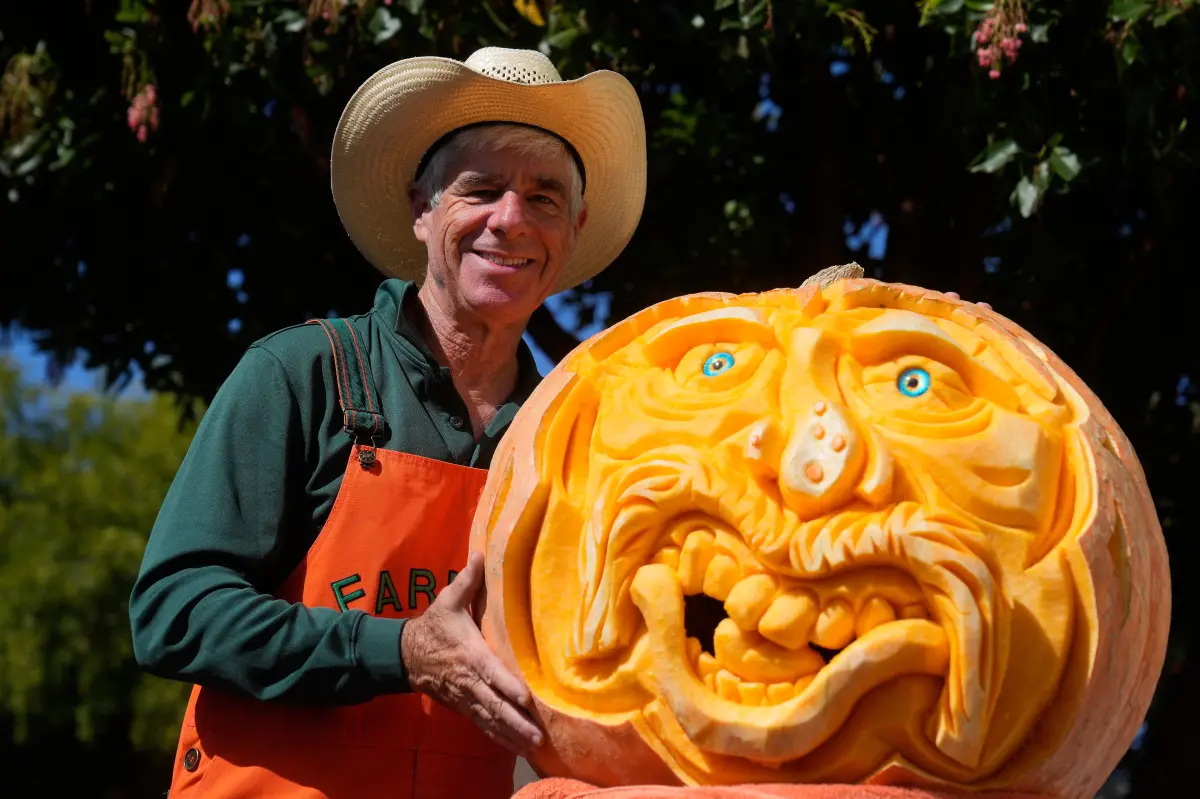
When the first chill of fall settles in and the leaves along the California coast begin to shift from green to gold, Mike Valladao starts to feel the pull of something older than his job title. By day, he is a systems engineer at a cybersecurity company, a man who spends his working hours thinking about networks, logic, and the careful architecture of digital defenses. But when October creeps closer, he slips into his other skin: orange overalls, a weathered farmer hat, and the name that festival crowds have come to love. He becomes “Farmer Mike,” the so-called “Picasso of Pumpkin Carvers,” a self-taught artist who has spent more than four decades turning enormous gourds into grinning witches, fire-breathing dragons, seaside vistas, and beloved pop culture faces like Yoda and Charlie Brown. There is no formal training behind him, no art school diploma hanging on his wall. Instead, his inspiration comes from the world itself. He visits museums and lets paintings linger in his imagination. He walks down ordinary streets and watches strangers pass, studying the curve of a jaw, the slant of a grin, the way someone’s ears sit just a little unevenly. “Sometimes I’ll look at somebody and I’ll think, oh, I like the teeth or I like ears or the way the nostrils flare,” he says. It is a peculiar kind of vision, the eye of an engineer and the heart of a folk artist, and it has made him one of the most beloved figures in the strange, fleeting world of pumpkin carving.
Valladao didn’t set out to become an artist. In the mid-1980s, living in San Jose, he began growing giant pumpkins in his own garden, partly out of curiosity and partly because he liked the challenge of raising something enormous from a tiny seed. But once the harvest came in, he found himself staring at a problem: what exactly do you do with a pumpkin that weighs more than a grown man? You can’t just put it on the porch like an ordinary jack-o’-lantern. You can’t bake it into a pie without feeding the whole neighborhood. So he pulled out a knife and started cutting. At first, it was just a way to make something of the oversized fruit, a curious experiment with a sharp blade. But as his hands worked, something clicked. He realized that he approached carving the same way he approached building a piece of hardware at work: one layer at a time, carefully, patiently, always thinking about structure and depth. “I’m an engineer by trade and I tend to look at it as building something the same way I would build a piece of hardware, one layer at a time,” he explains. That engineering mindset set him apart. He wasn’t just scratching designs into the rind; he was constructing faces the way a sculptor constructs a relief, thinking about what could be cut away and what should remain. In 1986, a picture of his carved pumpkins made its way to the organizers of the Half Moon Bay Art & Pumpkin Festival, the famous two-day celebration on the coast south of San Francisco known for its giant pumpkin weigh-off. They invited him to come showcase his skills. It was a homecoming of sorts: his own family had opened the town’s first feed and seed store in the nineteenth century. He has been returning every October ever since, carving on stage so that crowds can watch the magic happen in real time.
The pumpkins Valladao works with are not your average grocery store gourds. He uses Atlantic pumpkins, enormous fruits that can weigh anywhere from a hundred to a thousand pounds. Their thick, dense skins give him room to carve deeply and precisely, allowing him to create the illusion of three-dimensional form. With a shallower cut, he can suggest a shadow; with a deeper cut, he can make a nose thrust outward from the face. The eyes can sink into dark sockets while the cheeks and brow remain round and strong, giving each character a kind of living presence. “It’s really about the illusion of depth,” he says. “I can make it so that it’s three-dimensional, such that the eyes are inset and the nose sticks out. So it’s a little bit of carving, but it’s just adding a little more magic to it.” That magic is what draws people to him at the festival. They stand shoulder to shoulder, watching him work under the autumn sun, seeing a lumpy orange field slowly become a dragon’s snarling face or a witch’s crooked smile. He doesn’t use fancy power tools or digital design software. His tools are simple, small knives and carving implements, the kind of thing that fits in the hand and moves the way a pencil moves across paper. But under his fingertips, the pumpkins seem to come alive, each cut a deliberate step toward a moment of surprise. After forty years of doing this, Valladao still retains the focused joy of someone who gets to share their favorite secret with a crowd, and the audience feels it too. There is always a collective gasp when a face finally emerges from the thick orange skin, as if everyone watching has been let in on the same wonderful trick.
Over the years, Valladao’s reputation has spread far beyond Half Moon Bay. His carvings have drawn requests from across the United States, and he has taken his artistry to some of the most unlikely stages imaginable. He has appeared on “The Tonight Show,” carrying his pumpkins into late-night television and carving them live for millions of viewers. He has been invited to carve at the San Diego Zoo, where you might expect to see animals in cages but not necessarily animals carved into pumpkins. He has worked at the California Academy of Sciences and the State Fair of Texas, bringing his folk-art sensibility to audiences who might never have thought of a pumpkin as anything more than a seasonal decoration. Each venue offers its own kind of inspiration. At the zoo, he might carve a lion or a monkey; at the academy, perhaps a dinosaur or a whale; at the state fair, a rodeo cowboy or a longhorn steer. But no matter where he goes, he remains the same humble, grinning figure in his farmer overalls, carrying a set of knives and an endless supply of ideas. He doesn’t work from sketches or stencils. He looks at the pumpkin, considers its curves and imperfections, and lets the shape suggest what it might become. That improvisational spirit is part of what makes his work feel so alive. He is not copying a picture; he is having a conversation with the gourd. And because he has spent so many years doing this, the conversation flows easily. He knows exactly how much pressure to apply to the blade, how deep to cut to create a shadow, how to angle the knife to make a tooth catch the light. It is a skill that cannot be taught in a classroom, only learned through years of patient practice and a genuine love for the medium.
For all the joy his pumpkins bring to others, Valladao has a surprisingly philosophical attitude toward his own creations. He doesn’t name them, and he doesn’t get attached to them. He knows that what he makes is temporary, that the intricate face he spends hours carving will begin to soften and sag within days. The pumpkin is alive in its own strange way, slowly aging, slowly collapsing, slowly returning to the earth. But rather than mourning that decay, he finds something wonderful in it. “It never really bothers me when a pumpkin starts to age because in some cases they’ll build character,” he says. There is a quiet wisdom in those words. A fresh carving is bright and crisp, but an older pumpkin has a different kind of beauty, a wrinkled, lopsided charm that only comes with time. The eyes might begin to droop, the smile might widen into something wilder, and the whole face seems to relax into a new expression. It is a reminder that everything beautiful is borrowed, that nothing lasts forever, and that the fleeting nature of art is precisely what gives it meaning. Valladao understands this better than most. He has spent four decades creating things that are destined to rot, and yet he keeps creating them anyway. There is something almost heroic in that persistence, a refusal to let the impermanence of his medium steal the joy of making it. For him, each pumpkin is not a monument but a moment, a chance to share a laugh or a gasp with a stranger before the whole thing fades away. And there are always more pumpkins. Every fall brings a new harvest, new shapes, new faces waiting to be discovered in the thick orange skin. He never runs out of material, and he never runs out of ideas, because the world is always showing him something new to carve.
After forty years at Half Moon Bay, you might think Valladao would be ready to hang up his carving knives. But he has no plans to stop. The work is too much a part of who he is, too deeply woven into the rhythm of his year. “It’s fun, it’s enjoyable and, quite frankly, it’s a piece of me,” he says. That simple statement says everything about why he keeps doing it. It’s not for fame or money or even the applause. It’s because carving pumpkins feels like coming home to himself. When he puts on the orange overalls and the farmer hat, he becomes the person he was always meant to be, a man who brings a little more magic into the world with nothing more than a knife and a gourd. As another autumn approaches, he will soon gather his tools, load up his pumpkins, and make the familiar drive to Half Moon Bay. The leaves will be turning, the air will smell like salt and rain, and the festival crowds will gather to watch the Picasso of Pumpkin Carvers do what he does best. He will stand on stage, smile at the people in front of him, and begin to cut. And in that moment, an engineer from San Jose and a folk artist called Farmer Mike will be exactly the same person, united by a lifetime of practice, a love of imperfection, and the simple, beautiful act of making something out of nothing. That is the real secret of his art. It is not about pumpkins at all. It is about showing us that ordinary things can become extraordinary, that a big orange fruit from a field can hold a dragon, a witch, a friend, a memory, a moment of wonder. As long as there are pumpkins to carve, and people willing to watch, Mike Valladao will be there, carving his way through the season, one layer at a time.