


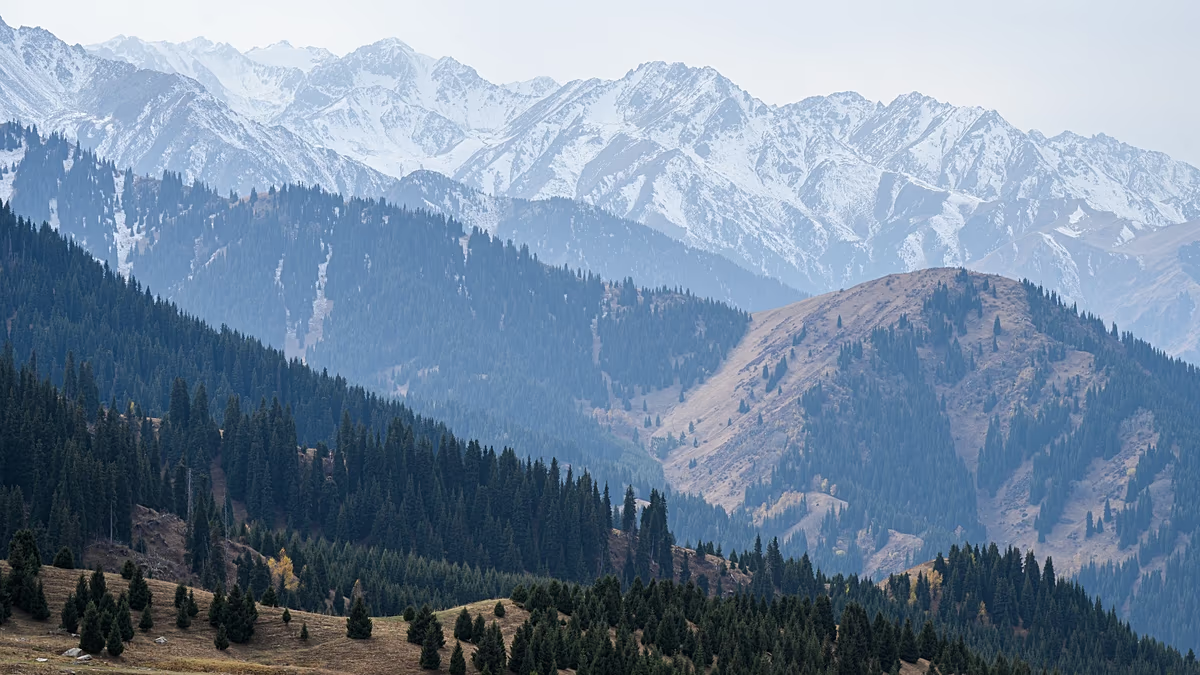
The first thing that catches you about Almaty isn’t a monument or a mall. It’s the rim of the world: the snow-capped crest of the Trans-Ili Alatau hanging right behind the rooftops, close enough to feel like part of the city’s nervous system. Those mountains don’t just decorate postcards; they shape the way people live, move, and even speak. Because Almaty is laid out largely on a grid, locals often skip the usual compass words. Instead of saying “north” or “south,” they’ll tell you to head “up” — toward the white peaks — or “down,” away from them. I loved that instantly. It makes every journey feel like a small decision about altitude, about inclination, about which way your day is leaning. You might start with coffee in the centre and then, on a whim, head “up” for a walk or a late breakfast in the foothills. That’s the magic of this city: the mountains aren’t a weekend-only escape. They’re part of an ordinary Tuesday morning. You can go from espresso to pine-scented trails in minutes, and the city seems to exhale as you climb. Even when you’re temporarily lost, you know exactly which way the mountains are, and so you know which way you’re going. There’s something quietly profound about that kind of geography — a whole metropolis oriented not by left and right, but by a living, glowing horizon. It makes Almaty feel open, legible, and strangely intimate from the very first hour.
To actually step into that skyline, you make your way to the Medeu base station and take the cable car up to Shymbulak Mountain Resort. In winter, this is where skiers and snowboarders come to carve down slopes that feel a world away from the city below. But even if you’ve never touched a pair of skis, Shymbulak is worth the ride. I’m not much of a winter athlete myself, but I found myself completely happy just standing at the top, watching the light move across the ridges and the city sprawl far beneath. The air is cleaner up there, sharper, and the silence has a way of resetting your thoughts. In warmer months, the same mountain terrain turns green with walking and hiking trails, and the cable car becomes a kind of scenic staircase for people who simply want a view, a slow afternoon, or a meal with an unforgettable backdrop. You can sit in a mountain café, order something warm and hearty, and feel like you’ve earned it just by breathing in that high-altitude brightness. What struck me most was how unpretentious it all felt. You don’t need fancy gear or a grand plan. You just go up. Whether it’s snow-covered or sun-drenched, the mountain welcomes anyone who wants to trade the noise of the city for a little altitude. And because the resort is so close, you can be back in your hotel, or at a dinner table in town, before the light fades. It’s adventure without the hassle, nature without the long journey.
If you pull your eyes away from the peaks for a moment, Almaty reveals a cultural life that runs deep. This was Kazakhstan’s capital until 1997, and that history still hums through the streets. Walk through older neighborhoods and you’ll see layers of the city’s artistic past pressed into the buildings themselves: brightly colored mosaics embedded in facades. Many of these date from the 1960s to the 1980s, when monumental artists from across the Soviet Union came here to work. Some have been damaged or lost over the years, which makes the surviving pieces feel even more precious. I found myself stopping in front of ordinary apartment blocks, staring at ceramic heroes, cosmic patterns, and abstract flowers, imagining the hands that set them there decades ago. But Almaty isn’t only a museum of faded murals. The wooden Ascension Cathedral, completed in 1907, is a gorgeous riot of color and ornament, and it somehow survived a major earthquake just four years after it was built. It stands there like a fairy tale, bright and stubborn. For a contemporary contrast, the Almaty Museum of Arts opened last year, designed by the British firm Chapman Taylor. Its two interlocking forms — one clad in limestone, the other in aluminium — are meant to echo the relationship between mountains and city. Inside, the collection spans modern and contemporary art from Kazakhstan, Central Asia, and beyond. It’s a reminder that Almaty has never stopped becoming something new. The past is still visible if you look closely, but the present has plenty of room to speak.
And then there’s hunger. The Green Bazaar is one of the best places in the city to discover just how rich Almaty’s food culture really is. Apples, dried fruit, nuts, spices, and local produce spill across the stalls in a riot of color and scent. The bazaar feels ancient and alive at once, full of vendors who know exactly what they’re selling and customers who take their time choosing. Around the bazaar, the wider food scene moves easily between Kazakh staples and dishes that will feel familiar to anyone who has traveled across Central Asia. You have to try beshbarmak — meat served over flat pieces of pasta, simple and deeply satisfying. You should also look for kazy, a traditional horsemeat sausage with a rich, slightly smoky flavor that surprises most first-timers. Dairy lovers will find their own adventures: kurt, those salty dried curd balls that are the perfect pocket snack, and kumys, fermented mare’s milk with a tangy, effervescent edge that definitely takes getting used to. I’ll admit I approached kumys with some hesitation, but that first cautious sip turned into real appreciation. Make room for plov, the beloved rice pilaf; for lagman noodles, chewy and warming; and for steamed manty dumplings, which arrive at the table like little parcels of joy. Every one of these dishes tells a story about the communities, trade routes, and traditions that have shaped Almaty into what it is. Eating here isn’t just fuel. It’s a way of tasting the city’s memory, bite by bite.
Almaty’s appeal changes with the seasons, and that’s exactly why it rewards more than a quick visit. In winter, the ski slopes come alive, and the city turns its face toward the cold with a certain cheerfulness. Spring and summer bring green foothills, mountain walks, picnics, and long golden evenings. Autumn, when I came, is a slow burn of amber trees and crisp air, with the mountains already wearing their first veils of snow. But even when the weather forces you indoors, Almaty has plenty to hold your attention. The museums are worth exploring at a gentle pace. The markets are always alive, no matter the month. And the food scene, as I discovered, is a reason in itself to stay. What I appreciated most is how the city seems to breathe with the calendar. It doesn’t try to be the same place year-round. Instead, it shifts its colors, moods, and rhythms, inviting you to meet it differently each time. One day I was walking through a leafy park under a warm sun; a few days later, I was watching snowflakes settle on the rooftops from a café window. Both felt like Almaty. The city has a way of making every season feel like the right season. If you let it, it will show you a different face every morning, and you’ll find yourself wanting to see them all.
For many travelers, Almaty is also a natural starting point for a longer Central Asian journey. It has flight connections to Europe and East Asia, and it sits next to Bishkek in Kyrgyzstan and Tashkent in Uzbekistan, making it a convenient stopover on a bigger itinerary. You could easily use Almaty as a gateway, arriving, catching your breath, and then heading onward to new countries and landscapes. But I think that would be a mistake. Almaty deserves more than a night’s sleep and a hasty glance. It deserves a few unhurried days — time to get lost in the bazaar, to ride up into the mountains, to trace the mosaics on old buildings, to linger over a bowl of plov and wonder where the next road will take you. The city has that rare quality of feeling both like a destination and like a doorway. It invites you to move on, but it also makes you want to stay. And maybe the best way to honor it is to do both: give Almaty its own space on your journey, not just as a transfer point but as a place with a heart, a memory, and a voice. Leave a few days for the city itself, and you’ll discover that the mountains, the colors, the tastes, and the stories stay with you long after you’ve gone.