


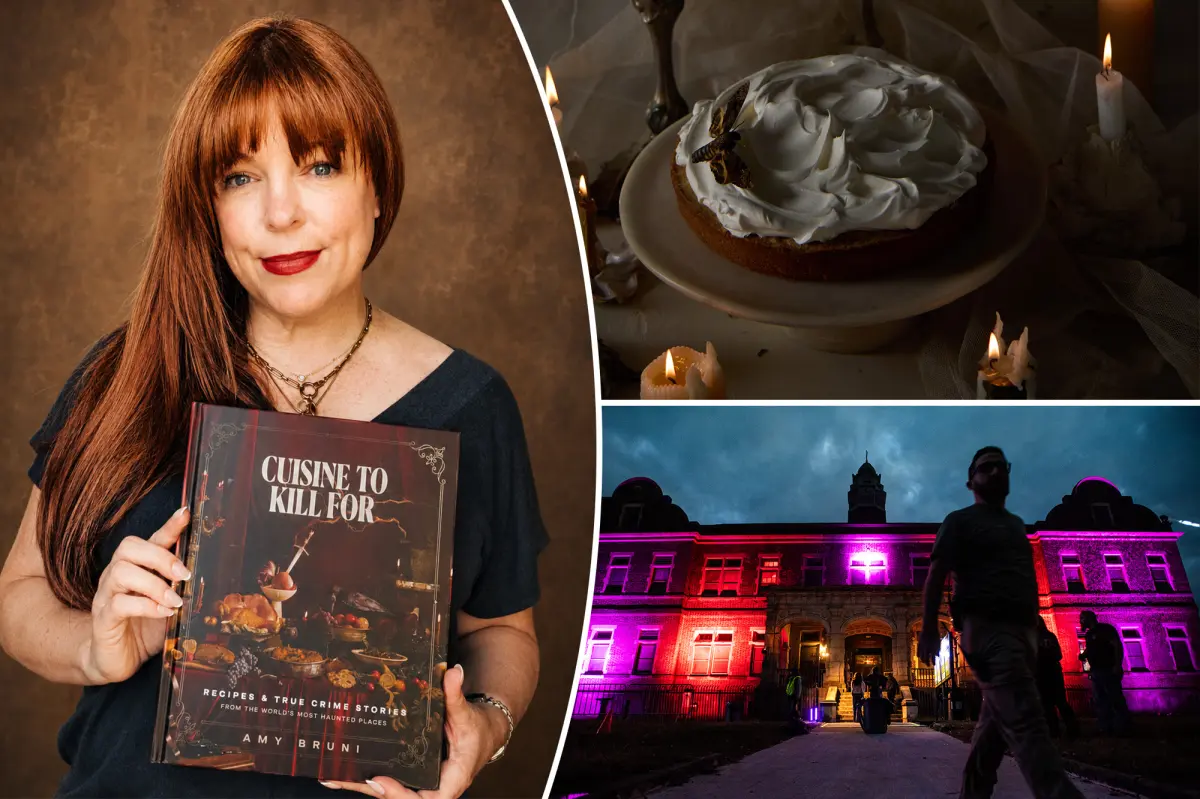
Bone appetite! There is something undeniably strange about sitting down to a meal that was once served in a place where the dead refuse to leave. Amy Bruni has built an entire career on that strangeness. For thirty years, she has investigated haunted locations, spoken with spirits, and tried to understand what lingers after death. But her latest project is perhaps her most unexpected: she writes cookbooks. Not ordinary cookbooks, but collections of recipes from famously haunted places, each one tied to the stories of the people who once cooked and ate there. Her first book, Food to Die For, invited readers into America’s most legendary haunted locations through more than fifty recipes. One reader’s experience in the Rhode Island farmhouse that inspired The Conjuring showed just how powerful those recipes can be. An employee at the farmhouse decided to make the Sunday pot roast recipe that Bruni had received from the Perron family, the people who once owned the haunted house. She was alone in the house, cooking and recording the process, when strange things began to happen. Footsteps sounded overhead. A door closed by itself. Voices seemed to drift through the air. Bruni was not surprised. That roast had been the Perron family’s Sunday tradition for years. If any spirits still recognized the smell, the sounds, the rhythm of that meal, they would naturally be drawn to it. “No one thinks to use food as an investigative tool,” Bruni said, “but we may be onto something.” It is a delightful thought: the way to a ghost’s heart might be through its stomach, just as it is for the living. Food carries memory. It anchors us to home, to family, to ritual. Why should that connection end at death? The idea that a ghost might drift down a hallway because someone is cooking the same pot roast that used to fill the house with warmth on Sunday afternoons is somehow both chilling and deeply comforting.
The idea for these cookbooks came from an unexpected artifact. Bruni once came across a recipe card for meatloaf written by Lizzie Borden, the Massachusetts woman tried and acquitted in 1893 for the brutal ax murders of her father and stepmother. Bruni wondered if anyone would actually make it. After Food to Die For hit shelves in 2024, she got her answer. Many readers told her the recipes were genuinely good. They also asked for darker stories. So Bruni wrote Cuisine to Kill For, a second collection of over fifty recipes and true crime stories from haunted places around the world. This time she expanded beyond the United States, taking readers into asylums, restaurants, and residences. The book includes stops at the Paris Catacombs, Bran Castle in Transylvania, and the Five Fishermen Restaurant in Halifax, Canada, which once served as a funeral home for victims of the Titanic disaster. Each location carries its own weight of tragedy, and each recipe is a way into that history. The food is not just food; it is a tangible connection to the people who lived, loved, and died in these places. Bruni’s approach is both practical and poetic. She collects recipes from property owners, historians, and descendants, then pairs them with the stories that make the places unforgettable. The result is a strange and wonderful hybrid: part cookbook, part ghost story collection, part historical tour. It invites readers to cook a meal from a haunted place in their own kitchens, to taste what the dead once tasted, and to wonder whether the past can be summoned through something as simple as a Sunday roast or a slice of carrot cake. There is a vulnerability in that act, too. When you cook a dead person’s recipe, you are trusting them with something intimate. You are letting them into your kitchen. And maybe, just maybe, they decide to stay for dinner.
One of the most haunting stories in Cuisine to Kill For comes from the Valley Inn Restaurant in Portsmouth, Rhode Island. The property was the site of one of the earliest and most bizarre murder cases in American history. In 1673, Rebecca Cornell was found burned to death on the floor of her bedroom, half inside the fireplace. At first, her death seemed accidental. But her brother, John, came forward with an extraordinary claim: Rebecca had appeared to him in a dream and said, “See how I was burnt with fire?” She told him she had been murdered. Based on that ghostly testimony, her son Thomas was convicted of the murder and executed. It remains the only time in American history that someone was executed based on the testimony of a ghost. Bruni has investigated the Valley Inn multiple times and says she has communicated with Thomas’s ghost. Thomas is buried in the parking lot outside the restaurant, with no grave marker. His family is buried elsewhere. Bruni and her team asked him if he wanted to be reunited with his family. His answer was no. There is something deeply sad about that detail. A man accused of killing his mother, executed, buried alone in a parking lot, still choosing to stay there centuries later. Perhaps he feels he belongs to that place now. Perhaps he cannot leave. Perhaps he has made peace with his solitude. The recipe from the Valley Inn is penne vodka, a dish that seems anachronistic for a seventeenth-century estate but somehow fits the modern restaurant that now occupies the site. It is a reminder that history is layered. The dead and the living share the same ground, and sometimes the same table. Bruni does not judge Thomas. She simply listens. That is what makes her work so compelling. She approaches even the most disturbing stories with empathy, treating ghosts as people with their own complicated histories rather than as monsters to be feared.
Manhattan makes an appearance in the book with a recipe for carrot cake from Fraunces Tavern in the Financial District. The tavern is one of the oldest buildings in the city, and it is also home to a ghost story. In 1798, a ballerina named Anna Gardie was stabbed to death by her husband with a carving knife as she lay in bed, in a murder-suicide. To this day, people still claim to see her apparition. Bruni includes the carrot cake recipe as a way to remember Anna, a woman whose life ended violently but whose presence still lingers. Another recipe, Shrimp Wiggle, comes from Pennhurst Asylum in Spring City, Pennsylvania, a facility known for its mistreatment of residents. It was used to feed patients, and the name alone is enough to make anyone pause. Bruni investigated the asylum and had her own unsettling experience there. While exploring, she heard scratching coming from inside an attic closet. Convinced that a rabid animal was trapped inside, she and her team opened the door and jumped back. The closet was completely empty. The scratching continued for a moment, then stopped. It is the kind of experience that cannot be explained away easily, and it is exactly the sort of story that fills Bruni’s books. She does not pretend to have all the answers. She simply records what she has seen, heard, and felt, and lets readers decide for themselves. The recipes serve as anchors, familiar and grounding, in the middle of stories that are anything but ordinary. A carrot cake from a tavern where a ballerina was murdered. A creamy shrimp dish from an asylum where people suffered terribly. These are not just recipes; they are memorials. They keep the dead in our kitchens, in our mouths, in our memories. And there is something beautiful about that, even when the stories behind them are dark.
Bruni’s fascination with the paranormal began in the Alameda, California, house where she grew up. The house was haunted by the ghost of a young man who had died in World War II. Her first clear memory of seeing a ghost came when she was eight years old. She saw a man standing outside the second-story window of her house, wearing all green. She ran to get her mother, expecting fear or disbelief. Instead, her mother looked at her matter-of-factly and said, “Oh yeah, he’s a ghost. I call him Mr. Green Jeans.” That casual acceptance shaped Bruni’s understanding of the paranormal. Ghosts were not something to be feared; they were simply part of the fabric of life. For thirty years, she has pursued that understanding, investigating haunted places, speaking with spirits, and trying to help both the living and the dead find peace. Her new paranormal television series, It Followed Me Home, premieres on Halloween on BeaconTV. The title suggests something personal, something that follows you, and Bruni has always been drawn to the idea that the dead are not so different from the living. They have unfinished business. They have attachments. They have favorite meals. Her work is a way of honoring those attachments, of taking them seriously without losing a sense of wonder. She approaches ghosts with respect, but also with a kind of warmth. She talks to them the way you might talk to a neighbor. She asks them questions. She listens. And sometimes, she cooks their recipes. There is no dramatic séance, no theatrical fear. Just a woman in a kitchen, stirring a pot, wondering who else might be standing there with her.
At the heart of Bruni’s cookbooks is a simple but profound idea: food is memory. The smell of a pot roast can carry you back to a childhood kitchen. A slice of cake can bring back a birthday, a wedding, a funeral. When we cook a recipe from a haunted place, we are not just making a meal. We are participating in a ritual that the dead once performed. We are sharing a table with them. Bruni’s readers have embraced this idea. They make Lizzie Borden’s meatloaf. They cook the Conjuring house’s Sunday pot roast. They bake Fraunces Tavern’s carrot cake. And sometimes, they report strange experiences. Footsteps. Doors closing. A feeling of being watched. Whether those experiences are caused by ghosts or by the power of suggestion, they are real to the people who experience them. Bruni does not mind the ambiguity. She is not trying to prove anything. She is trying to connect. Her books are an invitation to look at the world differently, to imagine that the past is not really past, and to believe that a meal can be a bridge between the living and the dead. So the next time you find yourself in the kitchen, maybe think about the history of the recipe you are making. Who cooked it before you? Who sat at the table? Who might be standing just behind you, hoping for a taste? Bone appetite.