


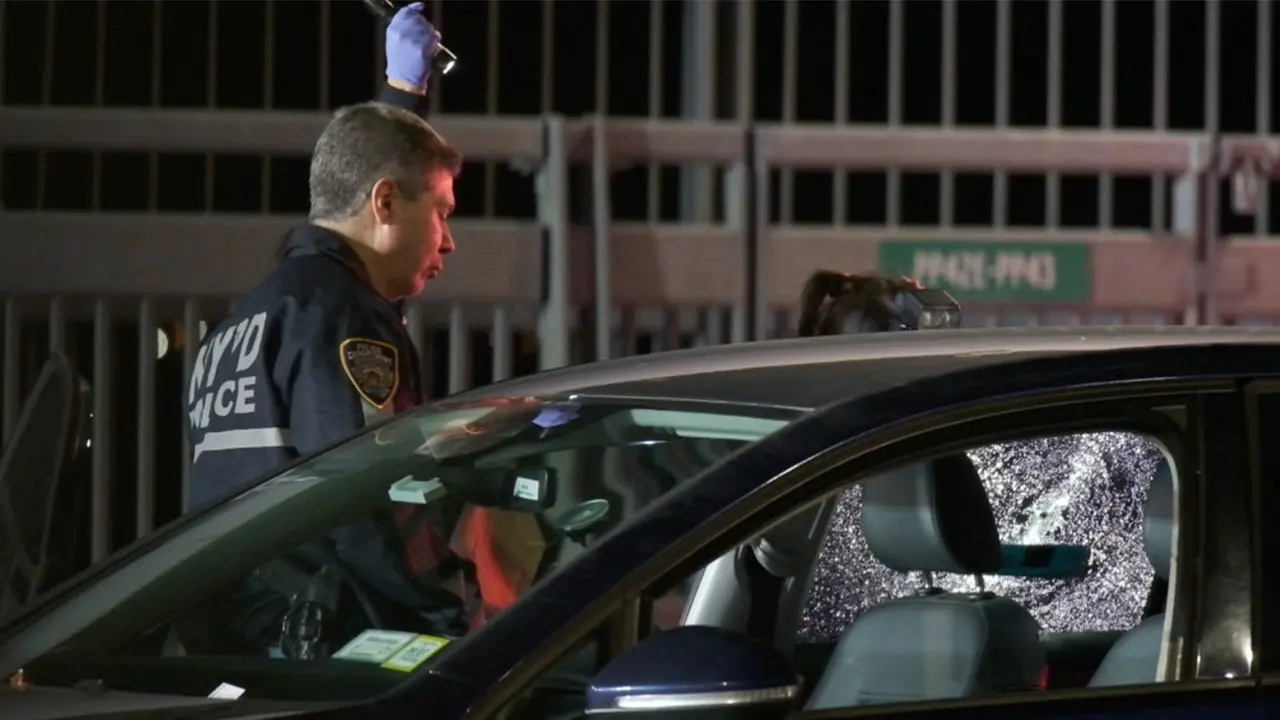
A routine evening commute across the George Washington Bridge turned into an unspeakable nightmare on Tuesday, when a moment of road rage escalated into gunfire and left a 46-year-old Con Edison worker dead. The victim, Koran Irvine, was simply trying to get home after a day of work, his life abruptly cut short by a single bullet fired by a man who once swore to protect the public. That man, Victor Romero, a 62-year-old former NYPD detective, now sits in custody facing first-degree manslaughter charges. It is a story that defies comprehension: a retired police officer, someone trained to de-escalate and protect, allegedly using a gun to settle a traffic dispute on one of the busiest bridges in the world. The George Washington Bridge, a structure that carries thousands of commuters daily between New York and New Jersey, became a crime scene filled with shattered glass and a dying man at the wheel. The details emerging from prosecutors paint a chilling picture of impulsive violence, one that has left Irvine’s family mourning and a community questioning how such an encounter could spiral so fatally. Behind the legal charges and the surveillance footage are real people—families who will never be the same, and a defendant whose own life and career have now been destroyed as well.
According to prosecutors, the fatal encounter began when Romero and Irvine nearly collided as they approached the bridge, a near-miss that could have ended with nothing more than a honked horn and some frustrated glances. Instead, surveillance video shows Romero tailgating Irvine’s car closely and aggressively, his anger escalating as both vehicles crossed the span. What happened next is almost too shocking to process: Romero pulled alongside Irvine’s moving vehicle and fired a single shot from his driver’s seat. That one bullet pierced the rear passenger window of Irvine’s car, striking him in the right shoulder. It was a wound that proved fatal, and the video shows Irvine’s vehicle suddenly lurching into the far-right lane before coming to a stop in the middle of active traffic. Imagine the terror Irvine must have felt in those final moments—bleeding, alone, struggling to control his car while cars whizzed past. He was not a stranger to the bridge; as a Con Edison worker, he likely crossed it regularly, maybe even knew its rhythms and traffic patterns. But none of that mattered in the split second that Romero chose to pull the trigger. The violence was so sudden and senseless that it leaves onlookers searching for an explanation, for any logic that could make sense of a life taken over something as trivial as a near-collision.
Romero’s background makes the case even more troubling. He was not some random gun-toting motorist with a history of violence; he was a former NYPD detective who had spent years in law enforcement. At the time of the shooting, he worked as a driver and private security guard for QVT Financial, a biotech and energy investment firm, and was driving an employer-owned Range Rover assigned to him for his role as a driver for the company’s CEO, Dan Gold. The irony is painful: Romero was employed to protect people, to drive them safely, to guard against threats. Yet prosecutors say he used his position and the vehicle provided to him by his employer to commit a deadly act of road rage. QVT Financial has said it is aware of the press reports and is cooperating with authorities, but the association has undoubtedly cast a shadow over the firm. It also raises uncomfortable questions about how someone entrusted with the safety of a high-profile executive could behave with such reckless disregard for another human life. The Range Rover, once a symbol of his trusted role, is now evidence in a homicide investigation, and Romero’s career and reputation have been eviscerated in a matter of hours.
After firing the fatal shot, Romero did not stop. He did not call 911. He did not rush to help the man he had just wounded. Instead, he sped past Irvine’s vehicle, crossed the bridge, and fled northbound on the Palisades Interstate Parkway toward his home in Rockland County, according to authorities. It was a flight that speaks volumes—not just about legal guilt, but about the complete breakdown of the humanity that once defined a police officer. Detectives later located Romero and the employer-issued vehicle the following day at his Manhattan workplace, as if he were showing up for another ordinary day of driving an executive around the city. When authorities recovered a revolver from him, Romero admitted that he carried it daily, prosecutors said. A subsequent search of his residence turned up two additional handguns, all three of which are now undergoing forensic processing. The image of a former detective carrying a revolver every day and storing more guns at home might have seemed prudent to him, even protective, but now it looks like the arsenal of a man who was ready to use deadly force. The coldness of his actions—leaving a fellow human being to die on a bridge while he calmly headed home—makes the tragedy even harder to bear.
In court on Thursday, the emotional weight of the case was impossible to miss. Members of Koran Irvine’s family sat in the courtroom, listening as Assistant District Attorney Matthew Sears laid out the evidence against Romero. With the family present, Sears pointed to the strong surveillance video, the severe mandatory prison sentence Romero faces if convicted, and his flight from the scene as reasons for setting bail at $1 million. The judge granted the request, and Romero was ordered to return to court on October 27. He faces a charge of first-degree manslaughter, a felony that carries significant prison time. For Irvine’s family, the proceedings are likely a painful reminder that no verdict will bring Koran back. They came to court seeking justice, but they left with the knowledge that a long legal process lies ahead. For Romero, a 62-year-old man with a distinguished past in law enforcement, the courtroom appearance marked the final chapter of a life that had been built on service and trust. The former detective now stands accused of throwing all of that away in one terrible moment. The contrast between the two men—one a victim whose life was shattered, the other a defendant whose freedom is now gone—underscores how fragile life truly is and how one stupid decision can destroy everyone in its path.
As the case moves forward, there are far more questions than answers. Why did Romero, a trained former officer, allow a traffic near-miss to escalate into gunfire? Why did he fire at all, and why did he leave the scene without attempting to render aid or call for help? Was there something more behind the road rage—stress, anger, fear—or was it simply a moment of inexplicable violence? These are questions that may never be fully answered, even as the legal system does its work. Romero’s attorney, Alan Abramson, has not yet commented, and Romero has the right to be presumed innocent until proven guilty. But regardless of the outcome, the tragedy has already left two families permanently altered. Koran Irvine’s loved ones will never see him walk through the door again, never share a meal or a laugh with him, never experience the ordinary moments that make life meaningful. And Romero, whatever his fate, will be remembered not as a former detective who protected the streets of New York, but as the man who shot a stranger on the George Washington Bridge over an argument that should have ended with both drivers going their separate ways. In the end, this story is more than a crime report; it is a sobering reminder of how quickly life can change, how fleeting self-control can be, and how important it is to choose compassion over rage in the split seconds that define us.