


The World Series is a stage where legends are made and careers are defined in the span of a few heartbeats, where every pitch, every swing, and every defensive decision is magnified under the harsh glare of October’s spotlight. For the Tampa Bay Rays, Game 2 against the Milwaukee Brewers at American Family Field began like a dream. After just one inning, they had staked themselves to a commanding 4-0 lead, a cushion that felt almost invincible given the Rays’ reputation as the most defensively efficient team in baseball. The dugout was alive, the fans were silenced, and the promise of a commanding two-game series lead seemed well within grasp. But baseball, in all its cruel unpredictability, has a way of humbling even the most confident of teams. The lead began to evaporate, inning by inning, and with it went the composure of a young superstar who could only watch as his team handed the opposition opportunity after opportunity. By the time the seventh inning rolled around, the score was tied, and then the Brewers took the lead. The air in the visitors’ dugout was thick with frustration, and at its center was Junior Caminero, a player whose patience had finally snapped.
Caminero, the Rays’ star third baseman, had been a beacon of calm and elite play all season, but on this Saturday night, October 24, his emotions boiled over in a visceral, human moment captured by the Fox broadcast cameras. Between the sixth and seventh innings, with the game tied and the momentum firmly shifting toward Milwaukee, Caminero exploded in the dugout, unleashing a verbal outburst that drew the attention of everyone nearby. The broadcast did not show precisely who the outburst was directed toward—whether it was a teammate, a coach, or the collective frustration of a team self-destructing—but the reason for his fury was not difficult to decipher. The Rays were not merely losing; they were beating themselves. A defense that had been the gold standard of the regular season had suddenly turned into a sieve, gifting the Brewers extra pitches, extra outs, and extra runs in the most critical game of the year. For a player like Caminero, who had grown accustomed to the airtight professionalism of his teammates, watching the game slip away through preventable mistakes was an intolerable torture.
The unraveling began in the second inning, a frame that would set the tone for the rest of the night. With the Rays still leading comfortably, first baseman Jonathan Aranda committed the first of what would become a series of costly defensive lapses. A foul pop-up off the bat of William Contreras drifted toward the protective netting behind first base, a routine play that any professional ballplayer is expected to make nine times out of ten. Aranda tracked it, positioned himself, and then inexplicably dropped the ball, letting it fall harmlessly to the ground. The miscue extended the at-bat, and Contreras made the Rays pay for their generosity, lacing an opposite-field single that allowed the Brewers to score their first run of the night. It was a gift, pure and simple, and it gave Milwaukee life. But Aranda’s nightmare was far from over. Later in the same inning, with a runner on third base, a routine ground ball was hit directly at him. It skittered between his legs, under his glove, allowing the runner to race home and the Brewers to cut the deficit to a single run. Two errors, two runs, and a palpable sense of unease began to creep into the Rays’ dugout.
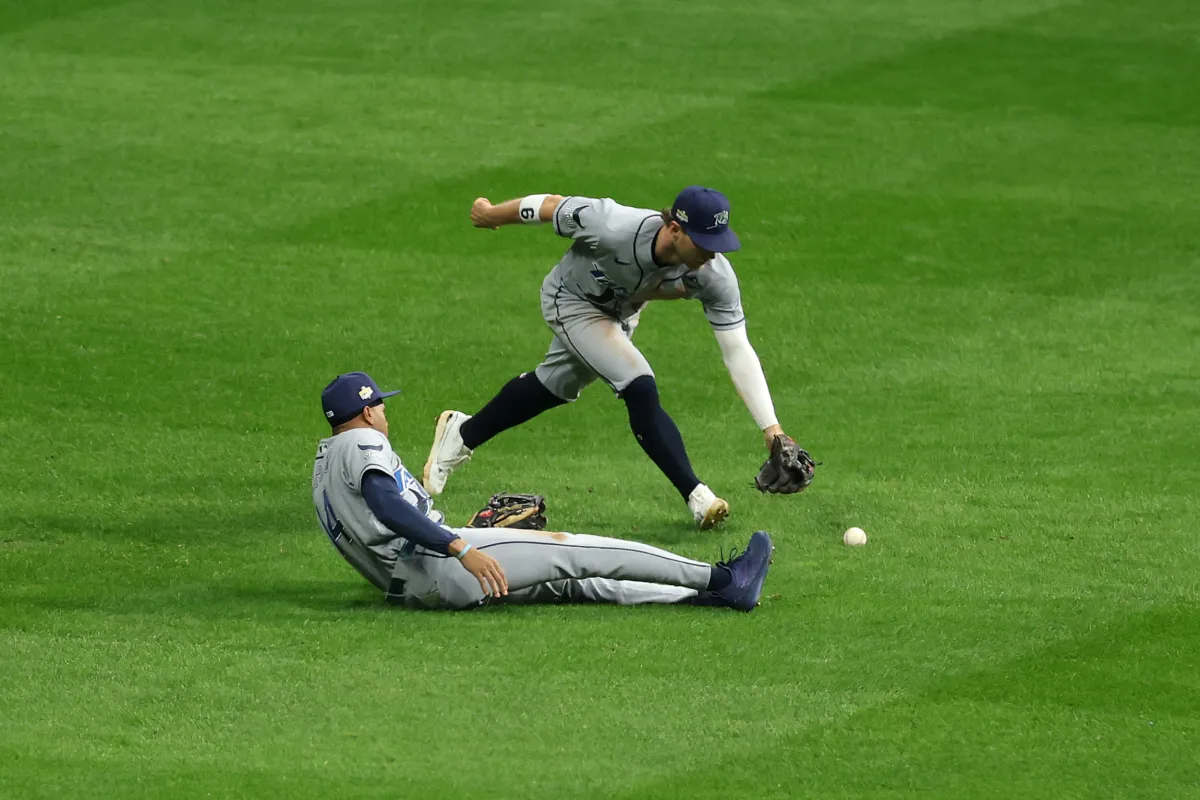
The middle innings offered little respite for Tampa Bay. The offense, which had exploded in the first inning, went quiet, and the defense continued to crack under the weight of the moment. In the sixth inning, the Brewers finally caught up. Sal Frelick, a young outfielder with a flair for the dramatic, launched a solo home run off pitcher Ian Seymour to tie the game at 4–4. The blast sent a jolt through the Milwaukee crowd, and suddenly the pressure shifted squarely onto the Rays. But the inning did not end there. A long, grinding frame grew longer when Chandler Simpson, a left fielder renowned for his defensive range and reliability, misjudged a fly ball hit by Christian Yelich. The ball fell in for a single, officially scored as a hit rather than an error, but the consequences were the same: the inning extended, Seymour’s pitch count ballooned, and Tampa Bay was forced to pull their starter earlier than they had hoped. It was a small play, barely noticeable in the box score, but it epitomized the nervous, uncharacteristic play that had infected the Rays’ defense all night.
Then came the bottom of the seventh inning, the moment when the Brewers seized control for good. With a runner on base, Brice Turang took off from first, advancing into scoring position on a perfectly executed play. Cooper Pratt, a rising star in Milwaukee’s lineup, then stepped to the plate and delivered an RBI single that scored Turang, giving the Brewers a 5–4 lead. The American Family Field crowd erupted, while in the visitors’ dugout, the frustration reached its breaking point. Caminero’s eruption was a reflection of the collective despair felt by every player on that bench. This was not a team that lost games by beating themselves. They had led Major League Baseball in defensive efficiency during the regular season, posting a sterling .723 mark that was the best in the sport. Simpson had been among the best defensive left fielders in the game, and Aranda, despite his struggles this night, was a reliable infielder. To watch such a disciplined, fundamentally sound team commit the kind of meltdown they did in Game 2 was astonishing, and it happened at the worst possible time—on the grandest stage, with a World Series title on the line.
Caminero’s outburst was more than just a moment of anger; it was a human reaction to the cruel, capricious nature of baseball. Athletes are taught to maintain composure, to treat each play with the same measured focus, but they are not machines. When a teammate of his caliber sees a game, a lead, and perhaps a series slipping away due to mistakes that would never have happened in April or May, the emotional dam can break. For Caminero, who had played his heart out all season and had every reason to expect resilience from his surroundings, the sight of his defense unraveling must have felt like a betrayal of everything the Rays stood for. He was not lashing out at any single player in particular; he was lashing out at the situation, at the absurdity of a team that had been so flawless suddenly becoming its own worst enemy. It was a raw, unfiltered expression of passion, the kind that fans often criticize but privately understand, because they know that the men on that field care deeply, and sometimes that care manifests as a shouted word in a dugout, between innings, when the world is watching.
In the end, the Rays could not recover from their early generosity. The 5–4 deficit would stand, and Tampa Bay would fall, leaving the World Series tied and their dreams of a championship momentarily deferred. But the true significance of the night was not just the final score; it was the reminder that baseball is a game of human fallibility. No matter how brilliant a defense may be over the course of a season, the postseason has a way of exposing vulnerabilities, amplifying pressure, and revealing that even the best players are susceptible to moments of doubt. For Caminero, the lesson was bitter but familiar: sometimes, the only thing you can do after a frustrating loss is channel that anger into the next game. The Rays would not dwell on this meltdown, at least not publicly, but the memory of it would linger. They had been handed a stark reminder that the World Series does not care about regular-season accolades, and that any lead, no matter how comfortable, can vanish in a heartbreak of errors and missed opportunities. As the lights dimmed at American Family Field, the Rays walked off the field with heavy hearts, knowing that they had let one slip away—and that their season now rested on the fragile, uncertain shoulders of baseball’s next unpredictable moment. For Caminero, the fire in his chest would not soon fade, but it was the same fire that made him the player he was, and it was the same fire he would carry with him into the future, hoping that the lessons of this night would make both him and his team stronger, more resilient, and better prepared for whatever came next.