

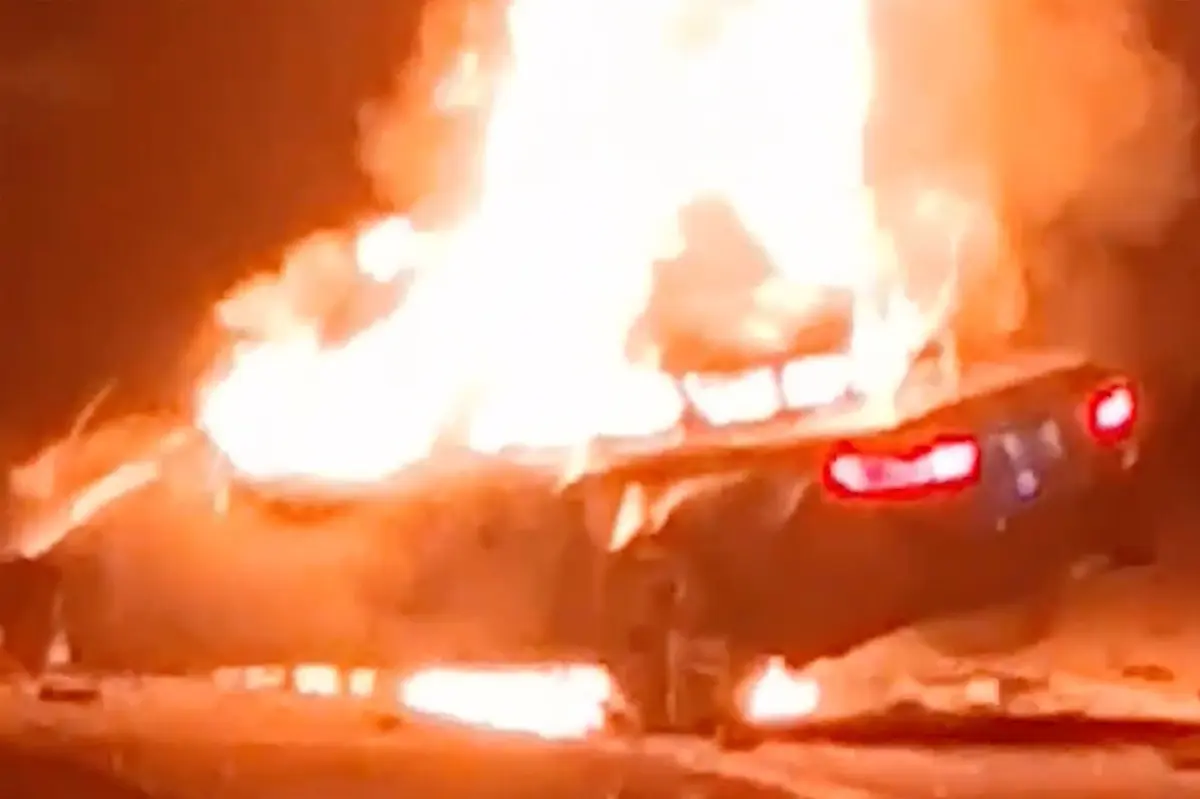
The predawn hours around Los Angeles International Airport are never truly quiet. There is always a low hum of tires on asphalt, the distant roar of engines, the blinking lights of planes descending through the marine layer, and the steady movement of cargo trucks and shuttle vans carrying travelers and workers through the city’s restless overnight pulse. Imperial Highway near South Hughes Way, in particular, is the kind of place that rarely makes the news—just a functional stretch of road near the airport, dotted with logistics hubs and the infrastructure that keeps one of the world’s busiest travel corridors moving. But just after five o’clock on a Saturday morning, that unremarkable stretch of pavement became the site of a horrifying tragedy. A single vehicle slammed into a freeway pillar with immense force, and within moments, flames erupted, sending towering fire into the dark sky. Emergency crews from the Los Angeles Police Department, the Los Angeles Fire Department, the California Highway Patrol, and LAX Police scrambled to the scene, their sirens cutting through the stillness and their headlights illuminating a scene that would stay with many of them long after the smoke cleared. Video captured at the scene showed firefighters desperately battling the blaze as the vehicle burned with a furious intensity. When the fire was finally extinguished, what remained was not so much a car as a shell—blackened, twisted, and unrecognizable, its front end catastrophically crushed from the impact. One person was pronounced dead at the scene, a life ended in an instant, with no other medical transports reported. The victim’s identity had not yet been released, and authorities were left with the grim task of piecing together what had happened.
For the person killed in that car, the day had almost certainly begun like any other. Perhaps they were heading to work, perhaps they were returning home after a long shift, perhaps they had somewhere important to be or someone waiting for them. The vehicle, now reduced to a smoldering wreck, had once carried them through countless ordinary moments—morning commutes, late-night drives, conversations with loved ones, music playing on the radio, thoughts drifting as the road stretched ahead. In a fraction of a second, all of that was gone. The impact with the freeway pillar was so severe that the car appeared to have suffered catastrophic damage to its front end, a detail that speaks to the sheer violence of the crash. Investigators from multiple agencies would spend hours at the scene, documenting skid marks, measuring debris fields, and examining the wreckage, all in the hopes of understanding exactly how this single vehicle left the roadway and met such a brutal end. But no piece of evidence could fully answer the deeper, more painful question: why this person? Why this morning? Why here, just yards from a road that thousands of people travel every day without ever thinking about death? The anonymity of the early report made the tragedy feel both distant and intensely personal—a reminder that behind every fatality statistic is a human being with a name, a history, and a community that will mourn their absence for the rest of their lives.
Perhaps the most visceral glimpse into the terror of that moment came from a witness who had been sleeping in his car when the crash occurred. Waking up to the sound of the impact, he described the horrifying realization that another person’s life had just been violently extinguished only feet away. “I think somebody in that car, bro,” he yelled, his voice raw with shock and disbelief. “I just heard a big boom. I was in the car asleep. Oh, god.” His words were not polished or rehearsed—they were the unfiltered reaction of someone thrust without warning into the middle of a nightmare. To be asleep in a car near the airport is to be in a state of vulnerability, often invisible to the rest of the world. Whether he was a rideshare driver taking a break, a traveler waiting for a flight, or someone who simply had nowhere else to go, his sudden wakefulness transformed him from a passive observer into a witness to grief. He had been resting in a fragile cocoon of safety, and in one deafening moment, that bubble was shattered. The image of him standing near the wreckage, shouting into the darkness, captures the way tragedy intrudes upon ordinary life—without warning, without mercy, and without any chance to prepare. His account also underscores how close we all are to disaster, even when we think we are safe, even when we are simply asleep in our own cars, even when the world seems calm and still.
The response to the crash was massive and immediate, a coordinated mobilization of city agencies that reflected both the severity of the incident and its proximity to critical infrastructure near LAX. The Los Angeles Fire Department took the lead in fighting the flames, arriving quickly enough to prevent the fire from spreading beyond the vehicle itself. LAPD’s West Traffic Division handled the investigation, assisted by the California Highway Patrol and LAX Police, whose presence highlighted the unique security and operational concerns of the area. The crash occurred near a FedEx hub, a facility that operates around the clock and means that at any given moment, a steady flow of workers and vehicles are moving in and out of the surrounding streets. That context added another layer of eeriness: this was not an empty, isolated stretch of road. It was a place where people were nearby, going about their work, unaware until the sirens came that a life had just ended beside them. Officials had not yet released details about the victim, and it was unclear whether alcohol had played a role in the crash. That unanswered question left a lingering unease, because it speaks to the many possible explanations that investigators must sift through—speed, distraction, fatigue, impairment, mechanical failure, or simply an inexplicable moment of lost control. All of these possibilities would be carefully weighed in the days to come, but for now, the scene was defined by the aftermath: burnt metal, steaming asphalt, and the heavy silence that settles over a place where sudden death has occurred.
The deadly wreck came at the end of a week that had already reminded Los Angeles travelers of how fragile safety can be. Just days earlier, passengers aboard a United Airlines flight from Hawaii to Los Angeles had endured a terrifying turbulence incident during their descent, a moment that reportedly saw the plane plummet more than 3,500 feet in a single minute and lifted passengers violently out of their seats. Four flight attendants were injured, their training and composure pushed to the limits as the aircraft shuddered and dropped around them. The incident left passengers shaken, many of them clinging to armrests and each other as the cabin filled with screams and the chaos of loose objects flying through the air. It was a stark reminder that the skies, like the roads, can turn hostile without notice. Together, these two events—one in the air, one on the ground—formed a sobering counterpoint to the routine ways we move through the world. We board planes and get behind the wheel of cars with an unspoken faith that we will arrive safely, that the ordinary journey will remain ordinary until the destination is reached. But sometimes, in a fraction of a second, that faith is shattered. The turbulence aboard the United flight was a warning of how quickly the familiar can become terrifying, and the fiery crash near LAX was a reminder that the consequences can be fatal.
In the end, this story is not just about a car crashing into a pillar or a plane dropping thousands of feet. It is about the fragility of human life and the sudden, irreversible way it can change. Somewhere, a family is waiting to hear whether their loved one was the person killed in that burning vehicle, bracing for a call they never expected to receive. The witness who woke up to the boom will carry that sound with him, forever associated with the knowledge that someone else’s life ended just feet from where he had been sleeping. The firefighters and police officers who responded will do their jobs, write their reports, and move on to the next call, but the image of a consumed car and a lost life will linger at the edges of their memories. For the rest of us, the instinct is to look away, to treat this as just another tragic headline in a world full of them. But perhaps the more human response is to pause—to sit with the discomfort it brings and remember that behind every statistic is a person with a story, a family, and a place in the world that now carries an absence. The investigation may provide answers in the coming days, but it will not provide comfort. The cause of the crash, whether human error or bad luck or something in between, will not undo what happened. What remains is the quiet, painful truth that life can change in an instant, and that all we can do is hold on to each other a little tighter, pay attention a little more carefully, and hope that the roads and skies we travel will be kinder to us than they were to one soul near LAX that Saturday morning.