

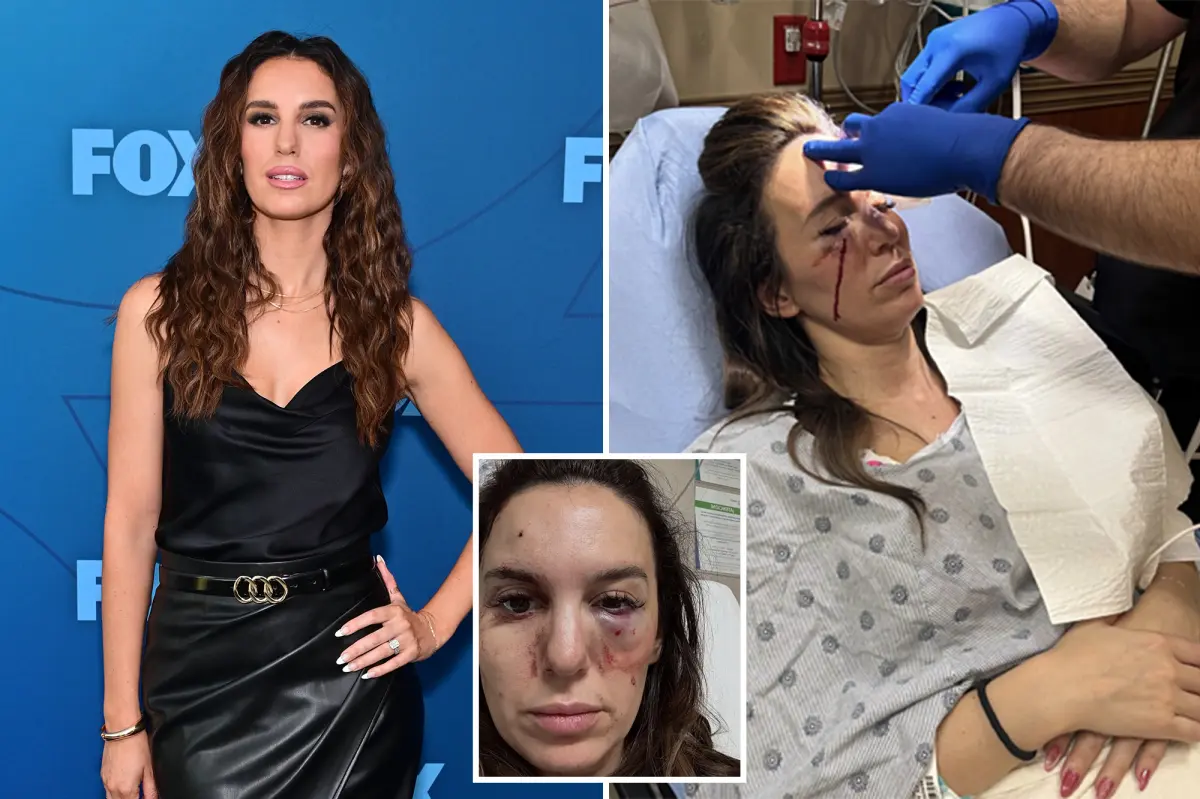
On a bright Texas afternoon in 2025, what was meant to be a joyful birthday celebration for Christy Carlson Romano’s husband, Brendan Rooney, turned into a moment of sheer terror that nearly cost her everything. Romano, the beloved former Disney star known for “Even Stevens” and the voice of “Kim Possible,” had suggested clay pigeon shooting as a fun outdoor activity, thinking her husband, a former Marine, would love it. But another member of the party failed to handle their firearm responsibly, firing too close to her direction. “I was peppered with birdshot at about 250 feet away, and I was struck in a fat pocket under my eye, and also in my forehead,” she later recalled. The small lead pellets used in shotgun shells tore through the air, and one lodged perilously behind her eye. The injury left her with a terrifying reality: fragments of birdshot remain in her head, separated from critical structures by about a millimeter. “If it were to move, I would go blind,” she said. In that split second, the woman who had once voiced an animated teenage crime fighter felt completely powerless, certain she was watching her life end on the ground of a shooting range, thinking only of her young daughters and the husband she might be leaving behind.
The accident unfolded with surreal speed. Romano wrote in her new memoir, “Once Upon a Trainwreck,” that she collapsed in front of the group, her mind racing between disbelief and a deep, primal fear. “Am I dead? … Oh God — my girls,” she remembered thinking. As she lay there, her vision began to blur, and what looked like a “dark liquid” spread across her contact lenses, obscuring the already frightening sight of the sky above her. Her husband and the remorseful shooter rushed to her side, but in that moment, Romano found herself looking up at the man she had been married to for over a decade, silently saying to herself, “It’s been a good run, right?” She described the Texas sky as “big and beautiful,” noting that the cicadas hadn’t yet woken from their winter nap, and that the mild February weather made for what she grimly called “a beautiful day to die.” As she grew increasingly lightheaded, Rooney desperately urged her to stay awake, refusing to let her slip away. The drive to the hospital was a blur of fear and frenzied speed, with Romano attempting to break the tension as they raced down an empty freeway at 112 miles per hour, hurtling toward help and hope as her body fought to stay conscious.
At the hospital, Romano’s fate rested in the hands of specialists who understood just how close she had come to catastrophe. Her oculoplastic surgeon, Dr. Sean Paul, later explained that the birdshot had entered beneath her eye and lodged into bone farther back, narrowly missing her eyeball, optic nerve, and eye muscles by roughly a millimeter. She also suffered a subconjunctival hemorrhage, but remarkably, the pellet did not penetrate the eyeball itself. The surgeon told Romano that in his career, he was more accustomed to removing objects from children’s eyes after Nerf gun accidents, not dealing with such a severe birdshot injury to a patient’s face. “I really almost survived through a miracle,” Romano reflected. “I think there was any amount of outcomes when it came to having birdshot striking my skull and my face.” Doctors determined that attempting to remove the tiny fragments would be far too risky, so they left them in place, permanently embedded near her delicate optical nerves. “I’d have a scar and two pieces of birdshot permanently in my head, but I’d live. That’s all that mattered,” she wrote. In the aftermath, she described her recovery as “pretty miraculous,” and she has carried deep gratitude for the medical staff at St. David’s South Austin Medical Center who cared for her during those terrifying hours.
The shooting accident, however, was only one chapter in a much longer, more complicated story that Romano has chosen to tell with remarkable honesty. “Once Upon a Trainwreck” is not just about a near-fatal injury; it is a memoir about growing up in the spotlight, navigating childhood fame, and surviving toxic relationships and a chaotic lifestyle long before she became a mother. Romano has been open about the pressures of being a Disney child star, the complex emotions that came with growing up in front of cameras, and the difficult path she walked as a young woman trying to find her own identity outside of her famous roles. After turning 40, she explained, she began experiencing a series of health scares that forced her to reflect deeply on her life. She felt compelled to write letters to her daughters within the pages of her memoir, sharing the hard-won wisdom of a woman who has faced down death, loss, and the weight of her own past. She wanted them to understand not just who their mother is, but also the lessons that only come from surviving chaos and tragedy. The book, for Romano, became a way to make sense of a life that has been equal parts glittering, complicated, and raw.
Her journey has also been shadowed by illness and grief in ways that resonate far beyond the shooting range. Romano and her husband underwent cancer screenings because of her family’s deep history with the disease. Both of her parents battled cancer; her mother survived, but her father ultimately died from it, and her maternal grandmother also lost her life to lung cancer. In February 2026, Romano revealed on Instagram that she had received a positive result from a cancer screening, a terrifying and vulnerable announcement that paralleled the trauma of the birdshot accident. Her husband’s screening result came back negative, offering some relief, but the emotional weight of waiting, wondering, and facing her own mortality has been profound. Surviving the shooting and then confronting the possibility of losing her vision and her health has given Romano a renewed sense of purpose. She admitted that she had lived such a chaotic life until she became a mother, and these brushes with death forced her to strip away everything that no longer mattered and focus on what truly did: her family, her faith, and her own personal growth.
Today, Romano sees her memoir and her public vulnerability as a way to connect with others who have felt alone in their struggles. “My life today is one that’s really focused on personal growth,” she said. “I think that my faith has become very big to me, and I have been praying just to really understand my calling and my purpose.” She has come to understand that life is short, and that being attuned to what one truly wants is essential to building a good life. The woman who once spent years feeling lost in the wilderness of fame has emerged with clarity, determined to let her scars—both visible under her eye and invisible in her heart—serve as reminders of what matters most. She does not know exactly what the future holds, whether the birdshot will ever move or what the results of her cancer screenings will ultimately reveal, but she has chosen to live without hiding from the fear. “I really believe that if the book could help people feel a little less alone, that it would have been worth all of my vulnerability and all of my sharing,” she said. “And I’m hoping the right people find it.” With every word she writes and every truth she shares, Christy Carlson Romano is proving that even in the midst of uncertainty, grace and resilience can still find a way to shine through.