


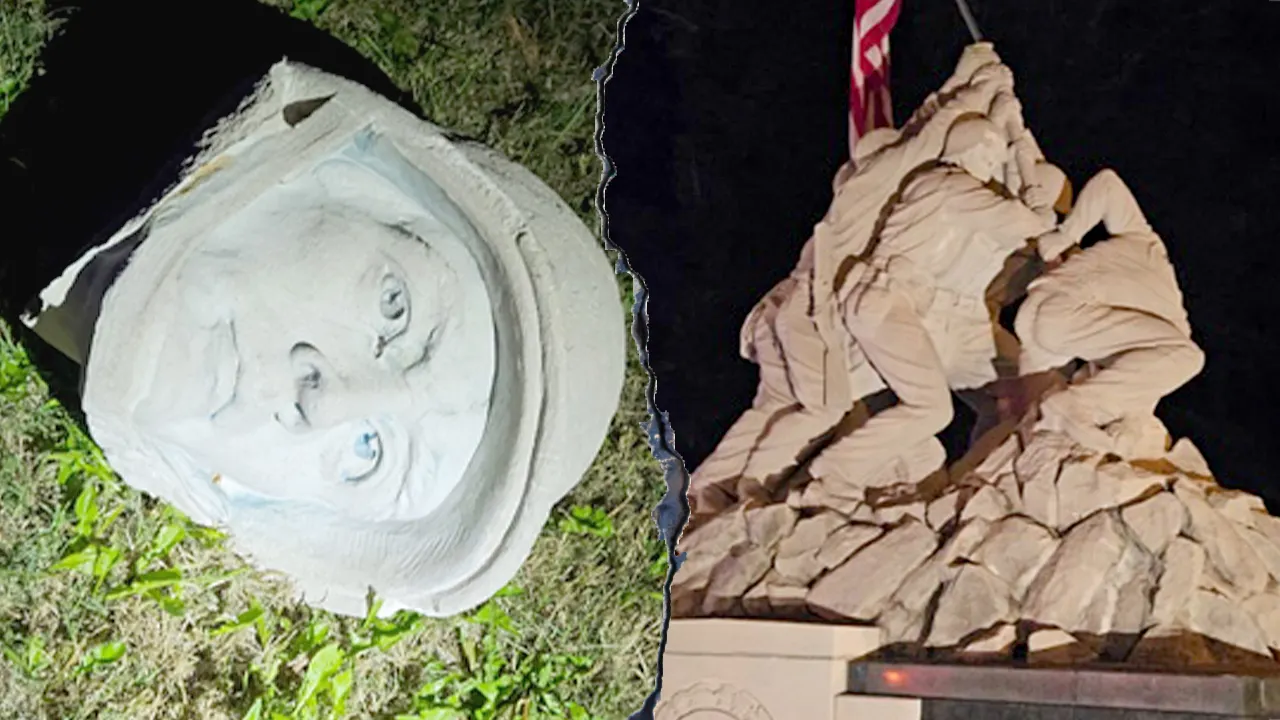
On a quiet Wednesday evening in Quantico, Virginia, a scene of inexplicable violence unfolded at a site dedicated to one of America’s most sacred military memories. Just after 10:13 p.m. on October 21, Prince William County police officers responding to a call near Richmond Highway and Fuller Road discovered a man striking a limestone monument with a sledgehammer. The monument was not just any sculpture; it was a nine-foot-tall depiction of the iconic flag-raising on Iwo Jima during World War II, a moment forever etched into the nation’s collective consciousness. The suspect, identified as 27-year-old Miguel Alonso Maldonado Soriano of Stafford, Virginia, was detained on the spot, but not before he had inflicted catastrophic damage. Authorities soon realized this was no minor act of vandalism but a brutal assault on a historical artifact, with repair costs estimated in the hundreds of thousands of dollars. What should have been an evening of peaceful reflection near the entrance to Marine Corps Base Quantico became a somber reminder of how fragile our shared memorials truly are, especially in an era when symbols of sacrifice and unity can become targets of senseless rage.
In the aftermath, the gravity of the charges against Maldonado Soriano reflects the seriousness of the offense. He now faces felony destruction of property, trespassing with intent to damage property, and felony injury to a monument. He is being held without bond, though a court date has not yet been announced. Law enforcement has not disclosed any possible motive, leaving the public to grapple with the painful question of why anyone would deliberately attack a tribute to the Marines who fought and died in one of the bloodiest battles of the Pacific Theater. The sheer randomness of the destruction feels almost incomprehensible. One might expect anger directed at a living person, or a political statement carved into a wall, but to take a sledgehammer to the head of a Marine figure in the dark of night suggests either a deep personal turmoil or a chilling disregard for what these symbols represent. The community, particularly veterans and active-duty service members, is left stunned. The absence of an explanation makes the act even harder to process, transforming what might have been a simple crime story into a deeper meditation on why some seek to tear down what others have sacrificed so much to build.
The damaged monument itself carries immense historical weight. It is a nine-foot limestone reproduction of the famous photograph taken by Joe Rosenthal on February 23, 1945, showing six Marines raising the American flag atop Mount Suribachi after a grueling and costly assault. That battle, the Battle of Iwo Jima, became a defining moment in American military history, not only for the strategic victory but for the extraordinary courage displayed by the Marines who fought against a determined and entrenched enemy. The sculpture was created by Felix de Weldon, the same artist who later sculpted the massive bronze Marine Corps War Memorial in Arlington, Virginia, which many mistakenly refer to as the Iwo Jima Memorial. The smaller statue near Quantico was meant to serve as a powerful introduction for visitors approaching the National Museum of the Marine Corps, a place dedicated to telling the stories of those who have worn the Marine uniform. According to police, the vandalism was extensive: the figure farthest to the right had its head completely removed, another Marine’s helmet and face were gouged, and a third figure had damage to a bayonet attached to a firearm slung over his back. The images of the defaced sculpture are heartbreaking, showing not only broken stone but also a profound disrespect for the lives that monument was designed to honor.
To truly understand the impact of this act, one must look beyond the physical damage and consider what these figures represent. Memorials are not simply inanimate objects; they are vessels of memory, gratitude, and national identity. They give shape to the grief of families who lost loved ones, and they stand as silent witnesses for veterans who carry the weight of war long after they have returned home. The image of six men straining together to raise a flag on a volcanic island remains one of the most powerful symbols of unity and determination ever captured. Each figure in the statue represents a real person, many of whom did not survive the battle. Three of the six flag raisers—Sergeant Michael Strank, Corporal Harlon Block, and Private First Class Franklin Sousley—were killed in action just weeks after the photograph was taken. When someone smashes the head of one of those figures, it is not just limestone that breaks; it is an act of desecration aimed at the memory of those men and the ideals for which they fought. For veterans who visit the statue to pay homage to fallen brothers, seeing it scarred and headless is akin to witnessing an attack on their own history. The emotional toll on these individuals cannot be measured in dollars, no matter how high the repair bill climbs.
The location of the monument adds another layer of significance. It stands near the entrance to Marine Corps Base Quantico, a sprawling installation in northern Virginia that has served as a cornerstone of military training and education for generations. For decades, Marines have passed this statue as they began their journeys through Officer Candidates School, the Marine Corps University, and countless other training programs. It is a landmark of pride, a silent mentor watching over young men and women as they transform into the next generation of warriors. The surrounding area, known as the Quantico Marine Corps Base Historic District, was listed on the National Register of Historic Places in 2001, encompassing 122 buildings, two landscapes, a sculpture, and a water tower. This historic designation underscores the importance of preserving the physical remnants of the Marine Corps’ legacy, not only for those who serve but for the entire nation. To damage a sculpture within this hallowed district is to tear a page from a collective storybook that has been passed down through the decades. It also raises practical concerns: with the National Museum of the Marine Corps just nearby, the statue is a favorite photograph spot for families, school groups, and military history enthusiasts from around the world. Now, instead of capturing a vibrant symbol of courage, visitors are met with the sight of yellow tape and broken stone, a stark contrast to the heroism the sculpture was meant to inspire.
As the investigation continues, the future of the damaged statue remains uncertain. Will it be restored to its original glory, or will the scars remain as a permanent reminder of this senseless act? Restoration of intricate limestone sculptures is a delicate and expensive art, requiring specialized craftsmen and historical reference materials. The cost, estimated in the hundreds of thousands of dollars, could take months or even years to cover, depending on insurance and fundraising efforts. But beyond the logistics of repair, there is a deeper need to restore the sense of reverence that was violated. Incidents like this serve as stark reminders that monuments are only as strong as the community that protects them. They require not only physical maintenance but also a collective commitment to remembering why they exist. For those who witnessed the aftermath, the emotion was not just anger but a profound sadness—a feeling that something sacred had been stolen in the night. In the wake of this crime, one can only hope that justice is served, that the community rallies to heal the wound, and that the image of broken Marines will inspire a renewed resolve to protect these symbols of sacrifice. The headless figure now stands as a chilling metaphor for what happens when a society forgets the past. But it can also become a rallying point for remembrance, a reminder that the spirit of Iwo Jima, like the spirit of America, can endure even the most violent attempts to tear it down. The ultimate honor we can pay to the six men forever immortalized in stone is to ensure that such an act never fades into the forgotten annals of news cycles, but instead reawakens in us a commitment to guard not just a sculpture, but the very values it embodies.