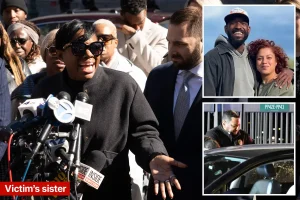



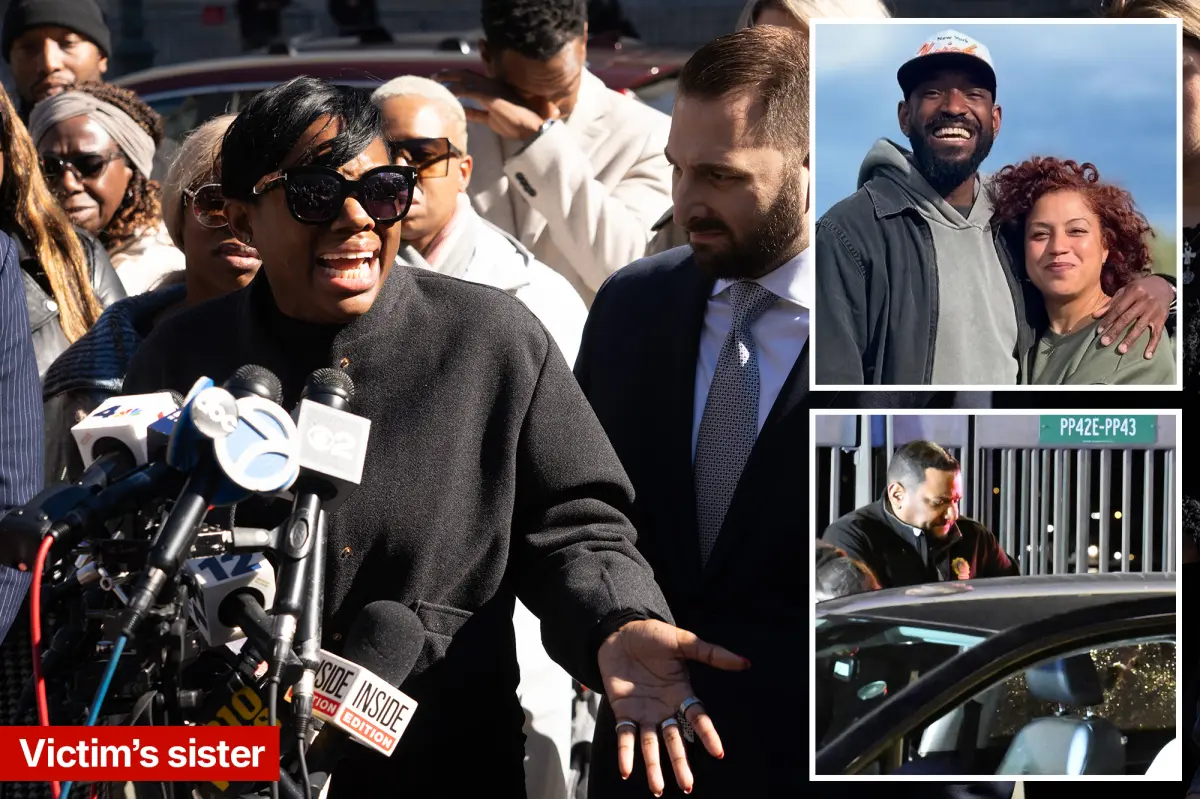
The sound of grief filled a Manhattan courtroom on Thursday, a raw and unguarded wave of sobs that seemed to sweep the room before the judge had even finished reading the charges. A dozen relatives of Koran Irvine, a 46-year-old father of two who worked for Con Edison and was loved by everyone who knew him, had come to see the man accused of ending his life. As prosecutors laid out the cold facts of what happened on the George Washington Bridge just two nights earlier, the family’s tears turned into quiet, trembling anguish. They had come for answers, but what they heard instead was a story of senseless violence, a single moment of rage that snuffed out a good man’s life and left a family shattered forever. The name of that man, according to authorities, is Victor Romero, a 62-year-old retired NYPD detective, a man whose own past was built on protecting people, and who now stood accused of manslaughter in a road-rage shooting that even the most jaded observers could only call avoidable.
The story begins on Tuesday evening, as the George Washington Bridge hummed with the ordinary flow of traffic. It was just after 7:15 p.m., and Koran Irvine was driving his car toward New Jersey, probably thinking about home, about his children, about the ordinary rhythm of a workday ending. It was the kind of commute that millions of people make every single day, unremarkable and routine. But that ordinary drive turned deadly because, according to prosecutors, Romero began tailgating Irvine, hovering close behind his car in a way that was confrontational and aggressive. The details that emerged in court painted a disturbing picture: a dangerous game of intimidation on a crowded bridge, a spark of anger that should have been nothing more than a bad moment, but instead became a death sentence. As the two cars moved over the span, Romero allegedly pulled out a gun and fired a single shot. The bullet traveled through the rear passenger window of Irvine’s car and struck him in the right shoulder. It was a wound that likely would have been survivable in a different context, but the force and trajectory proved fatal. Irvine was rushed to Englewood Hospital, but by the time he arrived, there was nothing anyone could do. He was pronounced dead, leaving behind two children who would never see their father again and a community that would have to reconcile the absurd cruelty of losing him to a highway argument.
What made the case even more haunting, according to Manhattan Assistant District Attorney Matt Sears, was what Romero did not do in the immediate aftermath. Rather than stopping to render aid, rather than picking up his phone and dialing 911, rather than any of the simple humane actions that might have given Irvine even a slim chance at life, Romero simply left the scene. Sears paused at the arraignment and let the weight of that reality settle in the room. “The defendant left the scene. He did not call 911, and he did not turn himself in,” he said. Those words hit the victim’s family with a fresh wave of pain. It was one thing to know your loved one had been shot and killed, but another to learn that the person who fired the shot had driven away, leaving a dying man alone on the bridge. Prosecutors later noted that Romero allegedly did try to surrender to the NYPD, but went to the wrong stationhouse, an excuse that raised more questions than it answered. Whether that was a genuine attempt to do the right thing or a desperate, misguided effort to control an already spiraling situation remained to be tested in court. But for now, the image of a retired police officer driving away from a fatal shooting was too powerful to ignore.
The circumstances of Romero’s life before that night only made the tragedy more confusing. He had retired from the NYPD a quarter century ago, a man who had once served in the Brooklyn North Narcotics division before leaving the force in July 2001. In the years since, he had built a quiet, comfortable life for himself in the small town of Haverstraw, Rockland County, where he lived with his wife in a serene townhouse community. Neighbors described him as an almost perfect neighbor, someone who kept to himself, maintained his home, and seemed anything but the type of man who would end up in a courtroom on manslaughter charges. At the time of the shooting, he was working as a driver and private security guard for a Manhattan hedge fund, a job that presumably required trust, calm, and the kind of judgment that he allegedly abandoned in a flash of fury on the bridge. The contrast was jarring: a decorated former officer, a devoted husband, a man with deep ties to his community, reduced to a defendant staring at years in prison because he could not let go of a moment of highway frustration. Defense attorney Alan Abramson tried to lean into that history, asking the judge for a lower bail and reminding the court that his client had once been a hero police officer. It was a plea that acknowledged the man’s former service, but it could not erase the fact that a man was dead and that the evidence seemed to point toward a single, avoidable act of violence.
In the end, the judge sided with the prosecution, ordering Romero held on $1 million bail. The mansion court heard enough to determine that this was a case where the accused had already shown a willingness to flee, even briefly, and where the stakes were too high to take a chance on release. Romero stood before the court, a retired cop now wearing the weight of his choices, as the victim’s family looked on from the gallery. There was no easy path forward for anyone. For the family of Koran Irvine, the legal process would now open another chapter of pain, full of hearings, evidence, and the slow grind of a system that could never bring their husband and father back. For Romero, the hallway of his former career had become the arena of his downfall. A man who once wore a badge and swore to protect the public now faced accusations that he had violated the most basic standard of humanity, not just by pulling a trigger, but by abandoning the person he had hurt. The charge of manslaughter suggested that this wasn’t a premeditated murder, but it was still a life taken, a family destroyed, and a promise of safety broken.
There is no way to make sense of a road-rage killing, because there is no justification for it. It is a reminder that our streets and highways are not just places of traffic and transit, but places where ordinary people must exist side by side, often frazzled, often tired, and dangerously close to the edge. On that Tuesday night, two men found themselves at the intersection of that human frailty and the consequences became permanent. One man went home to his wife in a quiet townhouse community, while another man’s wife and children will spend the rest of their lives wondering why their father had to die over a few moments of tailgating. The story is a tragedy in percentages: one bullet, one instant of rage, one turn of a steering wheel, and everything changed. As the courtroom emptied, the family of Koran Irvine carried their grief out into the streets of Manhattan, their sobs giving voice to a loss that no verdict can ever truly remedy. For them, the trial is not just about a retired detective’s guilt or innocence; it is about remembering the man who was taken, a father of two who went to work at Con Edison and simply should have come home. And in that human truth, the case is not about legal strategy or bail calculations, but about the fragile, irreplaceable nature of a single life.