


Most of us never stop to think about the air we move through every day. It feels smooth, invisible, almost like nothing at all—until the wind pushes against your face, or you inflate a tire, or you block the opening of a syringe and feel the plunger resist you. Pressure, we learn, is a force spread over an area. But that tidy definition hides a wild reality. The air is actually a storm of billions upon billions of tiny molecules, each one moving at hundreds of metres per second, colliding with your skin, the walls, the windows, and every other surface they can find. The pressure you feel is not one push but a staccato drumroll of microscopic collisions, arriving at an almost unimaginable rate. At sea level, every square inch of your body is struck by roughly twelve quintillion molecules each second. No single one of those impacts is enough to feel. Their average force, though, is what we call air pressure. It is a statistical masterpiece: a crowd performance so coordinated, so even, that the underlying chaos becomes completely invisible. Yet a force must begin with something smaller. Behind the crowd, each molecule is a solitary actor. And for the first time, scientists have managed to isolate the force of a single one of those particles. It is an achievement that feels almost like overhearing one heartbeat in a packed stadium.
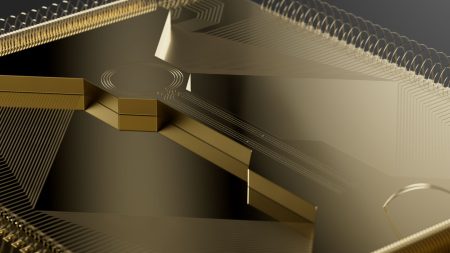
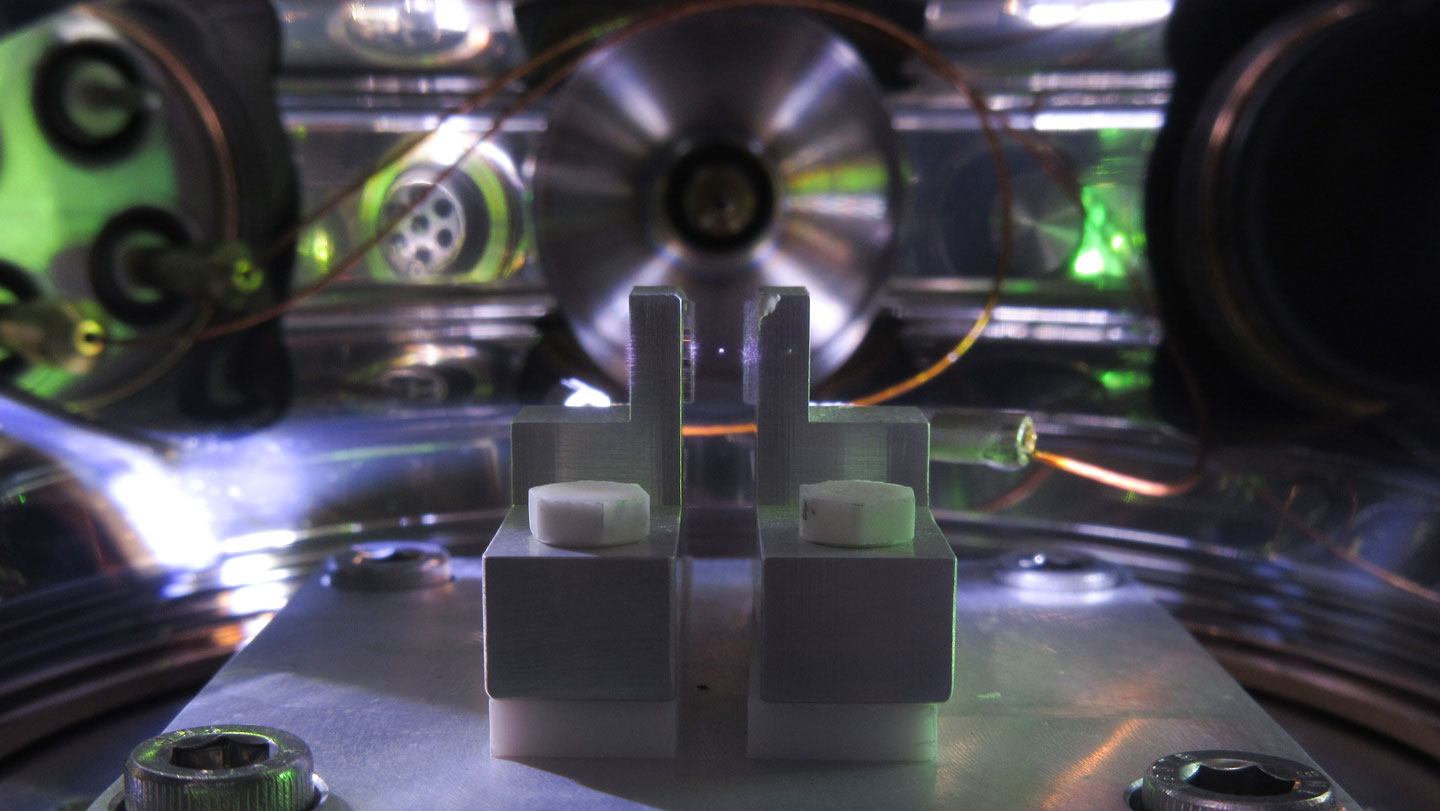
Why was that so hard? To capture a lone particle’s force, you cannot simply place your hand near the air and wait. The moment you do, you are engulfed by the crowd. The normal world is far too noisy. A detector sensitive enough to register the kick of one molecule would be swamped by the vibrations of the room, the jitter of electrons in its electronics, and the relentless buffet of the surrounding gas. Think of trying to hear a single raindrop strike a pond during a thunderstorm. At ordinary pressures, a small surface is hit by countless molecules in the same instant, so the individual impacts blend into a constant hum. To isolate one particle, scientists had to create a space almost empty enough to count collisions on an abacus. They worked at extremely low pressures, in carefully chilled vacuum chambers, with a tiny mechanical sensor suspended inside. The sensor might be a microscopic cantilever—a sort of diving board at the scale of a speck of dust—or an ultra-small bead floating in an optical trap, held by the gentle pressure of focused light. They watched it with lasers, measuring positions so tiny that a human hair would look as wide as a continent by comparison. The key was patience. In that ultracold, nearly empty chamber, collisions became rare. For long periods, the sensor would simply hover in silence, a tiny island alone in the void. Then, occasionally, a single gas molecule would arrive. It struck the sensor with a fleeting, momentary push. The cantilever flinched, and that flinch—recorded by the laser—was the force of one lone particle, isolated and measured for all to see.
At bottom, this is a story about momentum. Every gas molecule has momentum, the product of its mass and velocity. A nitrogen or argon atom moving at many times the speed of sound carries a small but real amount of motion. When it collides with a surface and bounces away, its momentum changes direction. That change, divided by the time of contact, is a force. For a single molecule, the force is almost inconceivably small—on the order of a trillionth of a newton, far less than the weight of a speck of dust. But because it takes place in such a short span of time, it is still enough to nudge a carefully engineered sensor. In the everyday gas around us, collisions happen too quickly and too densely for anyone to separate one event from another. The sensor is hit again before it even begins to respond; the individual kicks merge into a steady pressure. But at ultra-low density, the sensor waits for the one lonely collision. When it comes, it registers as a clean, sharp pulse in the data—a tiny ringing like a bell struck with a feather. The beauty of this measurement is that it connects two worlds. On one side is the everyday, continuous world of pressure, the force that pushes sails and powers pumps. On the other side is the discrete world of atoms, where a particle has no intention of pressing on anything. It simply flies, hits, and careens away. The pressure we feel is an illusion created by a vast, coordinated coincidence. The lone-particle experiment strips away that illusion and shows the true texture of matter: not a smooth sheet, but an endless procession of single, separate encounters.
There is something deeply human in this story. Our lives, too, are made of countless tiny events. A day feels continuous, but it is a mosaic of individual moments: a sip of coffee, a footstep, a word spoken, a breath taken. Alone, each such moment may seem too small to matter. Together, they form the steady pressure of a life. The scientists who isolated the force of a lone particle are, in some sense, paying attention to the moment rather than the average. They are asking what the crowd means by turning to one of its members and saying, “Tell me your story.” It took remarkable precision to do that. The instruments had to be isolated from the vibrations of the building; the floor itself may have been suspended on springs. The laser had to be tuned with exquisite care; the data analyzed with a kind of reverence. But what they saw is a reminder that every large effect is built from small actors. The pressure of the atmosphere, the roar of a rocket engine, the hiss of a balloon deflating—all of these are simply the summed voices of particles that had no plan, no leader, and no message except their own momentum. The lone molecule does not care about pressure. It does not know it is part of a crowd. It simply obeys the laws of motion, always moving, always colliding. The meaning of pressure is something we impose, like a story told over the noise of a thousand conversations.
Beyond the wonder, the experiment has real practical consequences. Understanding the force of a single particle is not just an exercise in curiosity; it touches the very foundations of measurement and technology. At the nanoscale, the distinction between average and individual matters enormously. In a tiny machine, a few molecules striking a component can create noise that is not a steady pressure but a random series of kicks. This is known as random noise, and it sets a fundamental limit on how sensitive a sensor can be. By watching one particle’s force directly, scientists can test the predictions of statistical mechanics—the physics that explains how the behavior of huge groups of particles emerges from individual collisions. This helps refine measurements of fundamental constants, such as the ratio of the Boltzmann constant, which links the temperature of a gas to the motion of its particles. It also offers new ways to measure extremely high vacuums, because the force exerted by individual residual gas molecules can be used to count them. And if humans ever build true nanoscale machines or levitating quantum devices, they will need to know exactly how each gas molecule gives a little shove. The experiment is a bridge to that future, a way to understand the smallest possible disturbance at the boundary of the quantum world. It is also a reminder that the universe is not entirely smooth. Even in a seeming vacuum, there are stray particles, and each one carries a tiny, measurable influence.
In the end, isolating the force of a single gas particle changes the way we can imagine the world. The air around us feels continuous and quiet, but it is a frantic rain of atoms. Every breath you take is a reunion with countless individual particles that have travelled through history, bouncing off leaves, oceans, and strangers. Pressure is the statistical echo of their existence. Yet, until recently, no one had ever felt the gesture of just one of them. That scientists found a way to do so is a small triumph of patience and precision. It reminds us that the universe is not merely a set of averages. It is full of individuals—one particle at a time—each with its own motion, its own collision, its own force. The next time you feel wind against your face, you can remember that it is the sum of a thousand million handshakes, a democratic accumulation of tiny events. Deep inside that crowd, there are moments when the crowd disappears, and only one particle is there, moving in emptiness, leaving the faintest trace of contact. That trace has now been seen. It is a small, beautiful proof that even in a noisy world, one solitary voice can still be heard, if only you listen closely enough.