


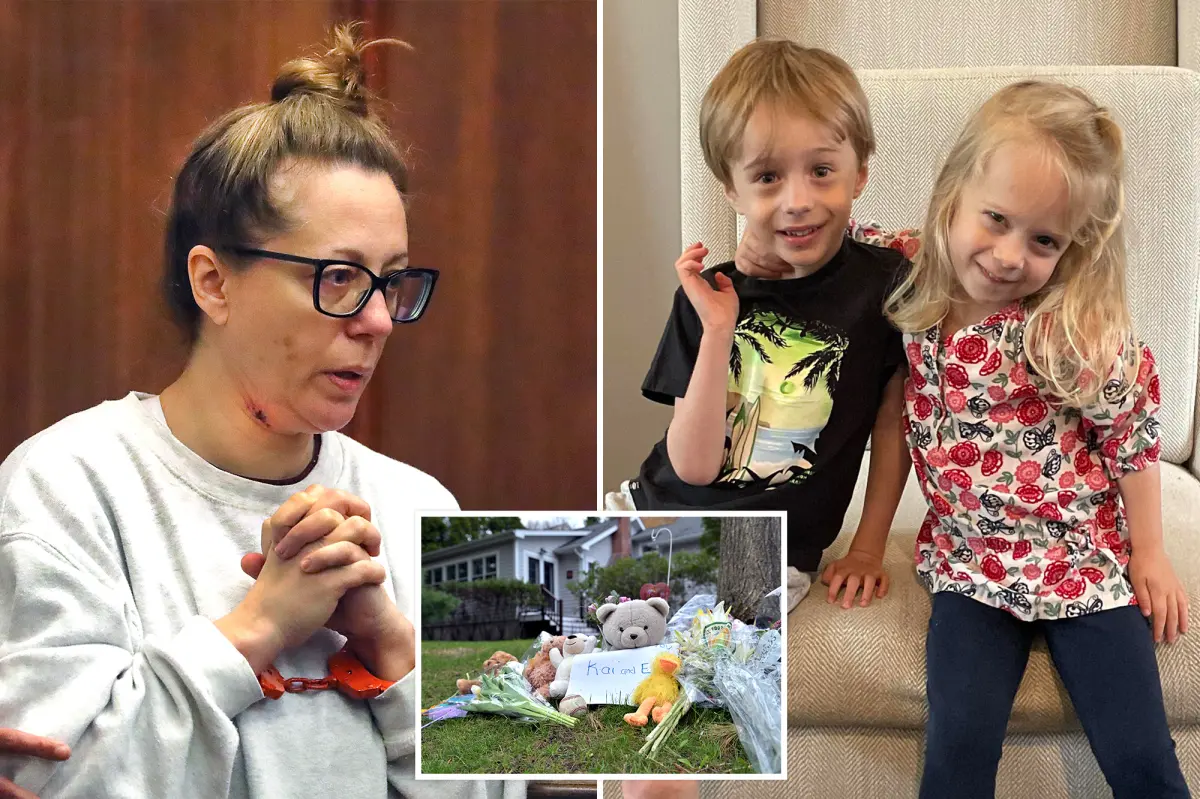
On an ordinary spring morning in Wellesley, Massachusetts, the kind of town where families move for excellent schools and safe, tree-lined streets, the unimaginable occurred. Police were called to a large, well-maintained home on a quiet residential street and found two young children unresponsive in a bedroom. The children were later identified as six-year-old Ella MacAusland and seven-year-old Kai MacAusland, a brother and sister whose lives ended far too soon. They were discovered in bed, side by side, a detail that has haunted everyone who has followed the case. For months, the precise cause of death remained a mystery, leaving room for questions and speculation. Then, in late October, medical examiners released their findings: the children died from mechanical asphyxia, or suffocation, combined with the toxic effects of a mixture of drugs in their systems. The substances included zolpidem, commonly prescribed for insomnia; lorazepam, an anti-anxiety medication; and the common pain relievers acetaminophen and ibuprofen. The combination of these medications, according to the medical examiner’s office, acted together with the physical obstruction of airflow to cause the children’s deaths. This is not a simple case of illness or accident; it is a scenario that suggests careful, if deeply disturbed, planning. The home in which the children died was valued at approximately $1.5 million, a place filled with toys, books, and the ordinary clutter of childhood. Now it stands empty, a monument to a family shattered by violence. The community, too, has been shaken. Parents who had walked their children to the same school, who had waved hello to the MacAusland family, now struggle to comprehend how such a thing could happen in their midst. The loss of Ella and Kai is not just a legal matter; it is a human tragedy that will be felt for generations, and the newly revealed details only deepen the sorrow.
The case took a more formal shape when a grand jury indicted the children’s mother, Janette MacAusland, on first-degree murder charges. MacAusland, a 49-year-old acupuncturist, had been in the middle of a bitter custody battle with her ex-husband, and the children were at the center of that conflict. According to court records, the couple’s relationship had deteriorated to the point where every decision, from schooling to holiday schedules, became a battleground. Friends and neighbors later described a family that seemed to be struggling, though no one suspected the depths of the crisis. MacAusland was not a person with a violent history; she was a licensed health care professional who had built a practice helping others find balance and healing. That makes the accusation all the more baffling. The indictment came just two days before the medical examiner’s findings were made public, suggesting that prosecutors were building their case based on evidence gathered from the scene, the autopsies, and MacAusland’s own statements. Under Massachusetts law, first-degree murder charges require proof of deliberate premeditation, extreme atrocity and cruelty, or murder committed during the commission of a certain felony. The combination of sedating drugs and asphyxia, if proven, would support an argument that the killings were planned. The children’s father, their grandparents, and the wider family have been left to grieve in public, forced to read reports about their loved ones in the news. The custody battle that once dominated their lives now seems meaningless; the children are gone, and no legal ruling can bring them back. The indictment is a necessary step toward accountability, but for those who knew Ella and Kai, it is also a painful reminder that their short lives were caught in the crossfire of a family in collapse.
In the aftermath of the alleged murders, Janette MacAusland fled Massachusetts, driving more than 140 miles to Bennington, Vermont, to the home of her aunt. She arrived in a state that witnesses described as hysterical, covered in blood, with a deep gash across her neck. The aunt, who later provided a statement to police, said MacAusland confessed immediately. She told her aunt that she had killed her children and then tried to take her own life, first attempting to jump from a bridge but finding herself unable to go through with it. The aunt contacted authorities, and when officers arrived at the property, MacAusland made the same admission. According to police documents, she said, “I strangled them and then I tried to kill myself.” Those words, spoken in a moment of absolute despair, are the closest thing to an explanation that has emerged. The image of a mother arriving at her relative’s door covered in the blood of her own children is almost too painful to process. It speaks to a level of mental anguish that is difficult for most people to comprehend, yet it also underscores the irreversible harm done to two innocent lives. The drive from Wellesley to Bennington would have taken roughly two and a half hours, winding through Massachusetts and into the hills of southern Vermont. That journey must have been a surreal nightmare, a final, desperate attempt to escape the consequences of an unthinkable act. Instead, MacAusland found herself in police custody, and the children she had allegedly killed remained behind in a silent house. The aunt’s decision to call authorities likely prevented further tragedy, but it could not undo what had already been done. The case had moved from a quiet suburban home to a cross-state manhunt, and then to a hospital, a police station, and eventually a jail cell.
The legal proceedings against Janette MacAusland are now moving through the Massachusetts court system. She is currently being held without bail at the Western Massachusetts Regional Women’s Correctional Center in Chicopee, a medium-security facility. Her next scheduled court appearance is an arraignment at Norfolk Superior Court on November 3, where she will formally face the first-degree murder charges. At her initial arraignment in May, at Dedham District Court, a plea of not guilty was entered on her behalf, as is standard procedure in cases where the defendant does not enter a plea herself. The case is likely to be long and complex, involving forensic testimony, psychiatric evaluations, and extensive review of the evidence. If convicted on first-degree murder charges, MacAusland faces a mandatory sentence of life imprisonment without the possibility of parole. That sentence, one of the harshest in the American legal system, reflects the seriousness with which the state regards the killing of a child. The prosecution will likely present evidence about the drugs found in the children’s bodies, the autopsy findings, and MacAusland’s alleged admissions to her aunt and to police. The defense, meanwhile, may argue that she was suffering from severe mental illness, that she was not in control of her actions, or that the evidence does not support a finding of premeditation. In cases like this, the line between legal responsibility and psychological devastation is often blurred. But for the family and the community, the legal outcome will not change the fundamental reality: two children are dead, and a mother is accused of ending their lives. The courts will decide her fate, but no verdict can ease the grief or answer the question of why this happened.
At its core, this case is a study in contradictions. Janette MacAusland was a healer by profession, someone who had trained to relieve pain and promote wellness. She lived in an affluent suburb, in a beautiful home, with the financial resources to give her children opportunities that many families can only dream of. Yet none of that prevented the tragedy. Custody battles are common, and divorce can be devastating, but the overwhelming majority of parents never harm their children. What leads a person to cross that line? Mental health professionals often point to a combination of factors: severe depression, anxiety, a sense of hopelessness, and a distorted belief that one’s children would be better off dead than living in a broken family. The presence of sedating drugs in the children’s bodies may have been an attempt to make their deaths painless, a twisted act of mercy in a mind overwhelmed by despair. That does not excuse the crime, but it may help explain it. The children were not strangers to their mother; they were her whole world, at least in her own delusion. She is accused of ending their lives to end her own suffering, but she survived. Now she sits in a jail cell, facing the rest of her life in prison, haunted by the memory of what she did. There are no winners in this story, only victims. Ella and Kai lost their futures, their laughter, their chance to grow up. Their father lost his children. The extended family lost grandchildren, nieces, and nephews. And even MacAusland, whatever the courts decide, has lost everything that gave her life meaning. It is a tragedy with no comforting lesson, only the reminder that the human mind can be a dark and dangerous place.
If there is any meaning to be found in this heartbreaking case, it may be in the conversations it can inspire about the support systems available to parents in crisis. Divorce and custody disputes are emotionally exhausting, and for parents who feel they are losing their children, the psychological toll can be overwhelming. Courts often focus on legal rights, visitation schedules, and child support, but they rarely ask whether a parent is struggling with suicidal thoughts or feelings of violence toward their own children. Mental health screenings, mediation, and intervention services could make a difference. Family members, friends, and even the other parent need to recognize warning signs: talk of suicide, giving away possessions, extreme withdrawal, or expressions of hopelessness. In this case, MacAusland showed up at her aunt’s door covered in blood; if that was the first sign, it was far too late. We may never know the full story of what happened inside that house in April. We will never hear Ella and Kai’s voices again, never see them grow up, never watch them chase their dreams. But we can honor their memory by being more attentive to the people around us, by taking mental health seriously, and by intervening before it is too late. The tragedy in Wellesley is a reminder that no amount of money, education, or social standing can protect a family from the ravages of untreated mental illness and domestic despair. It is a call to look after one another, to listen when someone is crying for help, and to understand that even the most beautiful house can hide the deepest pain. Ella and Kai deserved better, and so does every child caught in the shadow of a parent’s broken mind.