


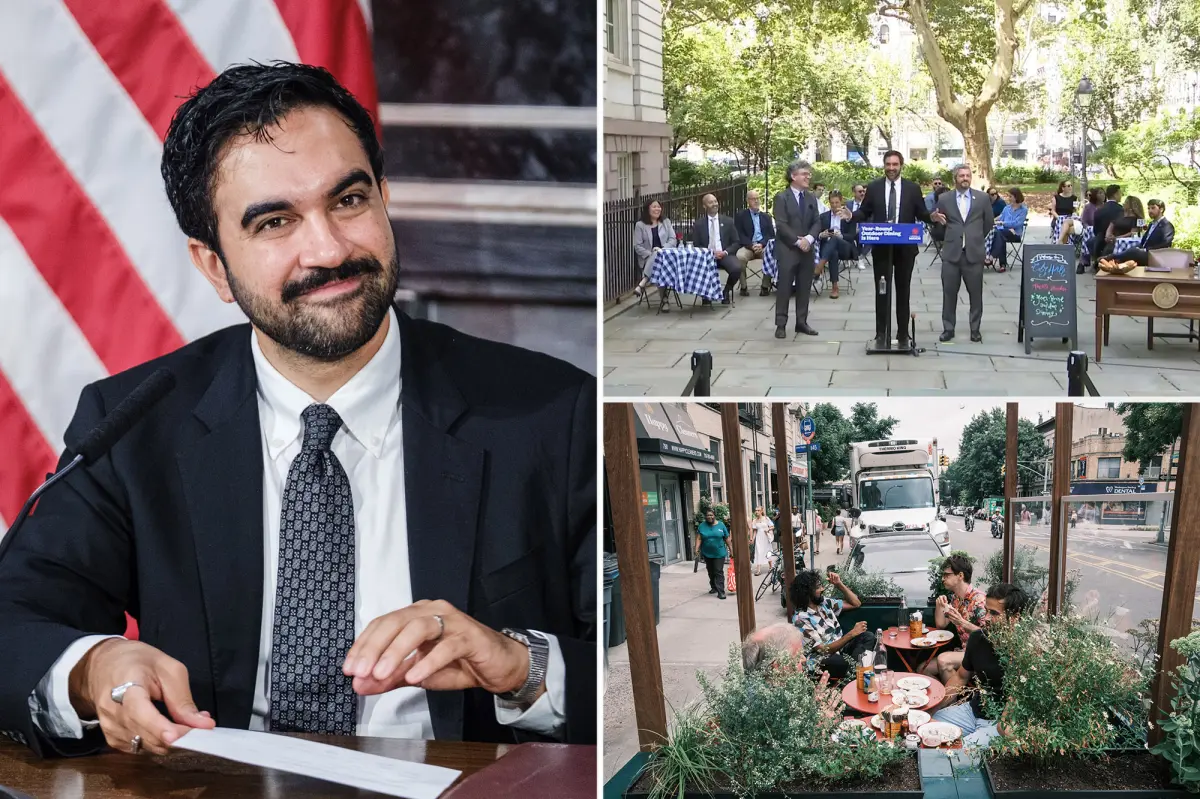
He had “one” job. Mayor Zohran Mamdani, who turned 35 on Sunday, has spent ten months in office and can point to exactly one bill he signed into law: a measure allowing year-round outdoor dining on city sidewalks, which he approved in August. That’s it. Since January, nearly a hundred bills passed by the City Council have piled up on his desk, waiting for a signature that never comes. It’s not that the bills die. Under a quirk of city law, a bill that sits unsigned on the mayor’s desk for four weeks automatically becomes law through a process known as “returned unsigned,” unless the mayor issues a veto. So in a technical sense, Mamdani hasn’t blocked legislation. But he also hasn’t embraced it. He has simply let the calendar do the work. It is a strange way to run the world’s most demanding city, and even stranger for a mayor whose public persona is built on being everywhere, saying everything, and performing the role of a people’s champion in short, punchy videos. The gap between his online energy and his offline paperwork has become impossible to ignore. Critics are beginning to ask whether the millennial socialist is more interested in social media stardom than in the daily grind of governing. The evidence, they say, is in the stack of unsigned legislation that keeps growing while his TikTok feed keeps glowing. His own allies are puzzled. His opponents are amused. And New Yorkers are left to wonder what the mayor is actually doing all day. The “returned unsigned” route may be legal, but it is not normal governance. It is, at best, a quiet way to avoid taking a stand, and at worst, a symptom of an administration that has confused the performance of leadership with the mechanics of it.
To understand why this matters, you have to understand what “returned unsigned” is supposed to mean. It exists as a pressure valve, a way for a mayor to signal displeasure with a bill without issuing a formal veto. In the past, mayors used it sparingly, usually for legislation they thought was bad policy or politically inconvenient. It was a deliberate, almost passive-aggressive act. But Mamdani has turned it into the default mechanism for his entire legislative agenda. The numbers are stark. At the same point in their terms, former Mayor Eric Adams had signed 30 laws, Bill de Blasio had signed 47, and Mike Bloomberg had signed 28. Mamdani has signed one. Not one that he personally championed, not one that reshaped the city’s future, but a sidewalk dining measure that had been in the works for years. The rest have become law through inertia. This is not how a mayor builds trust with the City Council. It is not how a mayor shows respect for the democratic process. And it is not how a mayor takes ownership of the ideas that voters sent him to implement. Instead, it creates a strange, detached style of governance: the city moves forward, but the mayor never really says yes. He just fails to say no. That may be enough for a bill to become law, but it is not enough for a city to feel led. It leaves everyone in an awkward position. Council members who worked for months on legislation get no ceremonial moment, no public celebration, no acknowledgment that their work mattered. The people who benefit from the laws get no sense of a mayor standing beside them. And the mayor himself gets to avoid any accountability if a law turns out to be unpopular. It is a win for him, but it is a loss for the city.
The more telling evidence is what Mamdani does with his time. While bills sit on his desk, the mayor appears in multiple carefully produced TikTok videos every day. The numbers are striking: two sketches on Monday, two on Saturday, two on Thursday. These are not off-the-cuff phone recordings. They are polished, comedic, often performative clips designed to generate likes, shares, and headlines. One source who often works with City Hall told The Post that the administration has become obsessed with becoming a “content farm,” with the mayor and his team constantly delaying or can-kicking boring governmental meetings so they can hold pitch sessions for social media videos. “The mayor gets pitched comedy sketches more than Lorne Michaels,” the source said. “There are lots of laughs, and there is very little work.” That quote is devastating because it captures the central contradiction of Mamdani’s administration: the man who promised to be a different kind of mayor has become a different kind of celebrity. He is not the first politician to use social media. But he is one of the first to make it the organizing principle of his office. The result is a City Hall that sometimes feels like a production studio with a government attached. The mayor is always on, always performing, always ready with a quip. But the quiet, unglamorous work of actually running a city—signing bills, meeting with officials, reviewing policy, making decisions—seems to be slipping through the cracks. The irony is that many of the bills waiting for his signature are the very progressive initiatives he campaigned on. They are not controversial to him. They are not politically dangerous. They are simply not as fun as making a video. And so they wait.
Consider one of the most obvious examples: the sanctuary city notification bill. In February, two months into Mamdani’s term, the City Council overwhelmingly passed a measure requiring that ICE-barring sanctuary rules be posted at schools and city-owned buildings. It was a perfect bill for a self-described socialist mayor who has made immigrant rights central to his political identity. It was introduced by his ally, Council Member Alexa Aviles. It was the kind of softball legislation that any mayor would sign in front of cameras, with advocates around him, celebrating a shared victory. Instead, Mamdani let it sit. When the bill arrived at his desk in June, he did nothing. Four weeks later, it became law through “returned unsigned.” No ceremony. No applause. No thank-you to the council. This pattern repeated with dozens of bills, including some from key Mamdani initiatives. A bill to expand free childcare programs? Left unsigned. A bill to create a rent-assistance program? Left unsigned. A bill requiring wellness checks on elderly New Yorkers during extreme heat? Left unsigned. These are not fringe proposals. They are the heart of the progressive agenda Mamdani ran on. They are the policies his voters expect. And they are being treated as afterthoughts. Some of his social media hits have made enormous headlines, even as valuable legislation sat waiting for his stamp of approval. That was exactly what happened in July, when Mamdani infamously called Israeli President Benjamin Netanyahu a “war criminal” and said he had looked into every avenue for New York City cops to arrest him. The video got attention. But the wellness-check bill, the childcare bill, and the rent-assistance bill were all still waiting for a signature he never gave them. It is almost as if the mayor is afraid of committing to anything on paper. Or perhaps he simply doesn’t see the value in a formal signature when he can get more attention from a video. But for the council members who sponsored these bills, it feels like a snub. For the New Yorkers who need these programs, it feels like a message: your problems are not my priority. And for anyone who cares about democratic institutions, it raises a troubling question: if the mayor won’t sign the laws he supports, what does he actually stand for?
The confusion is not limited to outsiders. Former City Council member Diana Ayala, who worked with Mamdani’s predecessors, said she hasn’t seen any evidence that Mamdani disagrees with the bills. “It is a little bit weird. It gives the impression that enough attention is being paid or they disagree, but they don’t. I haven’t seen anything he’s disagreed,” she said. “Those are his initiatives.” Ayala added that it would be nice for Mamdani to elevate the work of council members whose bills he has neglected. “It shows goodwill and that they are in alignment on specific issues.” Others are less diplomatic. A former City Hall staffer said, “It’s easier to govern by TikTok than to actually perform the duties of the job.” A former Bloomberg staffer noted that the administration apparently hasn’t found a way to make bill signings into “compelling social media content.” Another City Hall insider called the behavior “lazy government.” “It’s lazy in two ways—one is you are not taking a stand, easier to do nothing than figure out where you stand on something,” the insider said. “And lazy from a practical perspective—you can’t focus City Hall staff to hold the hearings, write the briefings and execute the bill signings.” That last point is crucial. Signing a bill is not just a ceremonial act. It requires staff to prepare briefings, schedule hearings, draft statements, and coordinate with the council. By skipping all of that, Mamdani is not just avoiding a photo op. He is avoiding the entire infrastructure of governance. The result is an administration that appears to be running on vibes, not policies. And the people who suffer are the ones who need government to work: the elderly, the poor, the immigrants, the parents, the renters. They don’t care about TikTok trends. They care about whether their city is being run by someone who takes the job seriously. City Hall did not respond to a request for comment.
In the end, the story of Mamdani’s first ten months is not just about one mayor’s work habits. It is about what happens when political performance replaces political substance. The “returned unsigned” process means that, technically, the bills become law. But democracy is more than a legal technicality. It is a series of public moments, shared commitments, and visible accountability. When a mayor signs a bill, he is saying to the public: I see this problem, I believe in this solution, and I am putting my name on the line. When a mayor lets a bill become law in silence, he is saying: I would rather not be associated with this. That is not leadership. It is avoidance. It is the political equivalent of taking credit for a group project you never showed up for. Mamdani may have a great social media team. He may be able to generate headlines with a single video. He may even believe in the progressive policies he lets slip through the back door. But until he learns to do the unglamorous work of actually governing, he will remain what his critics have started to call him: a mayor with one job, and no signature to show for it. The bills are still waiting. The city is still waiting. And somewhere in the back room of City Hall, there is probably a pitch deck for the next TikTok video, while a stack of papers gathers dust on the mayor’s desk. He had one job. The question is whether he will ever figure out what it is.