


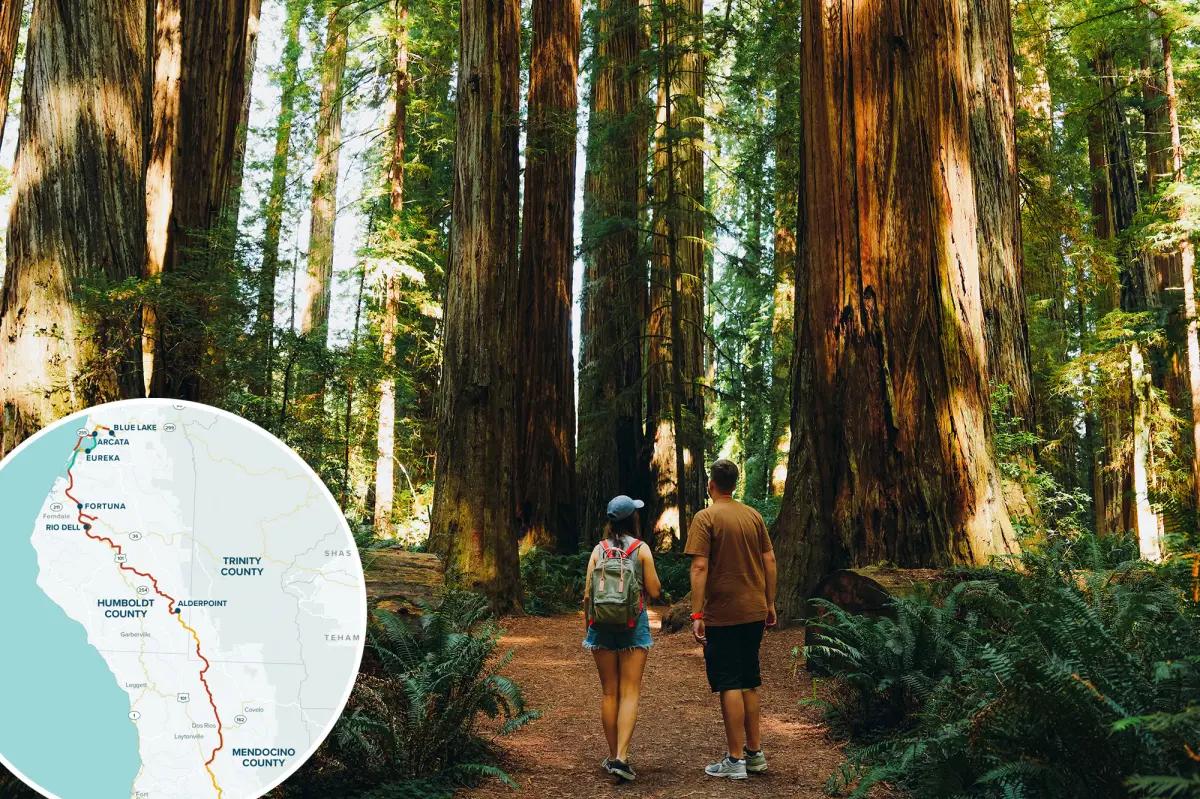
In the quiet green corridors of Northern California, beneath layers of ferns and moss, there are stories that cannot be excavated away. The Wailaki people know this. Their ancestors were buried along the Eel River long before the railroad came, long before the land was parceled out to timber companies and tourism promoters. Now, members of the Wailaki tribe are standing their ground against a project they say will turn sacred burial grounds into a scenic pathway for strangers. The Great Redwood Trail, planned to stretch 307 miles from San Francisco Bay to Humboldt Bay, would carry hikers, cyclists, and nature lovers directly over the graves of their relatives. What makes the pain sharper is that the project was granted an exemption from the California Environmental Quality Act, a law that normally requires public agencies to notify and consult with Native American tribes about projects that might affect them. For the Wailaki, this exemption feels less like a bureaucratic detail and more like another chapter in a long history of being erased from decisions about their own ancestral lands. The trail is already about 40 percent complete, and its construction has moved forward with momentum that many in the tribe say left them no meaningful opportunity to be heard. To walk that ground is to walk on memory itself, and for tribal members, the thought of visitors strolling past their ancestors’ resting places as if on a casual weekend outing is not just an inconvenience—it is a profound violation. It is as if the ground itself has been asked to forget what happened there, and the Wailaki are refusing to let it. They are not merely opposing a trail; they are defending a relationship between a people and a place that predates the state of California, a bond that cannot be measured in trail miles or visitor numbers. For them, land is not a commodity to be enjoyed by whoever gets there first; it is a responsibility carried across generations. Their resistance is rooted not in hostility to recreation but in loyalty to the dead, and that is a distinction the rest of us should try to understand.
The vision behind the Great Redwood Trail is grand enough to dazzle anyone who loves the outdoors. It follows the route of the long-defunct Northwestern Pacific Railroad, which closed in 1998 after severe El Niño storms battered the tracks and made the rail line no longer viable. The idea is to transform that abandoned corridor into a continuous ribbon of public access, winding from the San Francisco Bay up through coastal mountains, ancient redwood groves, and along the Eel River to Humboldt Bay. State Sen. Mike McGuire has become one of its loudest champions. “What this trail will do is open up some of the most spectacular landscapes on Earth,” he said. “Folks will be able to traverse past giant ancient redwoods to mighty rivers … through lush vineyards, golden rolling hills.” There is no denying the appeal. The trail agency, created in 2021 to manage the land along the railway, reports that more than one million people already walked, hiked or biked the southern segment last year. Environmental groups have also rallied behind the project, arguing that a well-managed trail can help restore riverbanks, remove derelict infrastructure, and give people a reason to protect wild places. Alicia Hamann, executive director of the nonprofit Friends of the Eel River, put it plainly: “It just is basically infeasible to imagine that this scale of restoration could happen” without the state taking charge. For many supporters, the trail is a rare chance to turn a scar on the landscape into a source of renewal. But the excitement of trail advocates is genuine, and so is their desire to share the beauty of the region. Yet the same landscape that inspires awe in visitors is a graveyard to the tribe, and the railroad itself was not just an engineering project; it was another wave of a history that pushed Indigenous people off their homelands. For the Wailaki, the arithmetic is different: every mile of trail brings more footsteps, more intrusion, and more erasure of a history that was never fully acknowledged.
When Perry Lincoln first heard about the trail, a few years ago, it was already well underway, and he felt blindsided. “You’re just kind of shoving it down our throats,” he told the Los Angeles Times. His words carry the weariness of someone who has watched too many decisions made from a distance by people who have never had to live with the consequences. The Wailaki tribe does not live on its ancestral land. Like many Native communities, they were displaced long ago, scattered by the same forces that brought settlers, railroads, and industry into the region. As a result, tribal members say they rarely have access to the places that matter most to them—the very places the trail would open to everyone else. Lincoln’s daughter, Tisanche Warren, voiced the painful irony: “We’re barely getting access to these areas ourselves, but we’re going to allow outside communities to have full access to these places? That doesn’t seem fair.” It is a question that cuts to the heart of the matter. For the Wailaki, this is not just about preserving a view or protecting a habitat; it is about the fundamental right to visit the graves of your ancestors without having to navigate around a crowd of tourists. The trail, as planned, would make the tribe’s own heritage into a public amenity, something to be consumed by anyone with a pair of hiking boots. And because the tribe is small, and because its members are not concentrated in one place, they have had to fight to make their voice heard at all. The emotional weight is compounded by generational trauma. This is not a distant historical grievance; it is a living wound, passed down through stories and silences, that resurfaces every time another decision is made without the Wailaki at the table. Every conversation about the trail reminds them that their ancestors are still not safe, still not respected, still not consulted.
The exemption from the California Environmental Quality Act is perhaps the most bitter pill. CEQA was designed, in part, to ensure that public agencies stop and listen before they build. It requires notification, review, and consultation with Native American tribes whose ancestors may lie in the path of a project. By exempting the Great Redwood Trail from that process, the state effectively told the Wailaki that their concerns did not matter enough to slow down construction. Steve Madrone, a Humboldt County supervisor, left the trail agency earlier this year partly because of that exemption. “Think about the trauma that these tribes have experienced,” he said. “That did not help remove that mistrust. It reinforced that mistrust.” His words are important because they come from someone who is not anti-trail but who understands that process is not just paperwork. Process is how a government shows respect. When the process is skipped, the message is unmistakable: your history is an obstacle, not a foundation. Elaine Hogan, executive director of the Great Redwood Trail Agency, told the Los Angeles Times that attempts to contact the tribe have been made. But Perry Lincoln says he and the tribal members he knows have never heard anything. This is the familiar pattern: promises to listen, but no listening; outreach that somehow never reaches the people who need to hear it. The agency may believe it has done its due diligence, but from the Wailaki perspective, the trail has been planned, funded, and largely built in a world that does not include them. That is not a misunderstanding; it is a continuation of a long and painful pattern. Respect would require more than a phone call or a letter; it would require a genuine invitation to shape the project, to identify sacred sites, to help decide where trails should go and where they should not go. That kind of respect cannot be retrofitted once the ground has been broken.
Still, the trail has powerful allies, and their arguments cannot be dismissed. Bruce Silvey of the Humboldt Trails Council speaks for many outdoor enthusiasts when he says, “I’m a big advocate for rail trails. They’re beautiful and they’re fun and they’re easy to ride. You can do 30 miles because they’re basically flat.” For people who have long dreamed of a connected network of public trails through one of California’s most stunning regions, the Great Redwood Trail is a once-in-a-generation opportunity. There is also a strong environmental argument: removing the old tracks, stabilizing the riverbanks, and managing public access may actually help the land heal from decades of industrial use. The restoration of the Eel River watershed is a goal that many people, including environmentalists, have worked toward for years, and they see the trail as the engine that can make it happen. Steve Madrone, despite his frustration with the process, ultimately supports the trail because he believes it will bring business to small towns along the route. Rural communities that have struggled since the timber industry collapsed see the trail as a potential lifeline, a way to attract visitors, support local shops, and keep young people from leaving. The tension is real: how do you balance the economic needs of living communities with the cultural responsibilities owed to the dead? How do you honor the desire to share beauty without trampling the people who have always held that beauty sacred? These are not easy questions, and they cannot be answered by treating the Wailaki as an inconvenience. The trail does not have to be built against them. It could be built with them, in a way that protects sacred sites and tells the truth about the land’s history. It could be a bridge, not just across miles, but across centuries—if the people building it are willing to slow down, listen, and acknowledge that some places are not just scenery. They are graveyards. They are homelands. They are sacred.
At its best, the Great Redwood Trail could be an invitation to reconnect with the natural world, a way for people to experience the ancient redwoods and the wild river in a manner that is gentle on the earth. At its worst, it could become another monument to the old way of doing things, where progress rolls over Indigenous voices and calls it consensus. The Wailaki are not asking for the trail to be cancelled. They are asking to be seen. They are asking for the same respect any human being would want when the bones of their family lie beneath a planned walking path. They are asking to be consulted not as an afterthought, but as the original stewards of the land. The California Environmental Quality Act exemption was a mistake, and it is not too late to correct it. The trail is only 40 percent complete. There is still time to pause, to bring tribal leaders into the room, to map the places that must never be disturbed, and to make sure that the story of this land is told with the Wailaki at the center, not on the margins. Healing is possible, but it begins with listening. It begins with acknowledging that the ground beneath the trail is not empty. It is full of memory, full of pain, full of ancestors who deserve more than a walkway overhead. Perhaps the most human thing we can do is imagine walking in their footsteps—feeling the weight of history in every step, knowing that the earth you stand on is not just land but a living record of a people’s existence. The Wailaki have stood their ground for a reason, and if the rest of us are paying attention, we will understand that the trail cannot be truly great until it honors the people who have been there all along. That is not an obstacle to progress. It is the only foundation strong enough to hold the future.