



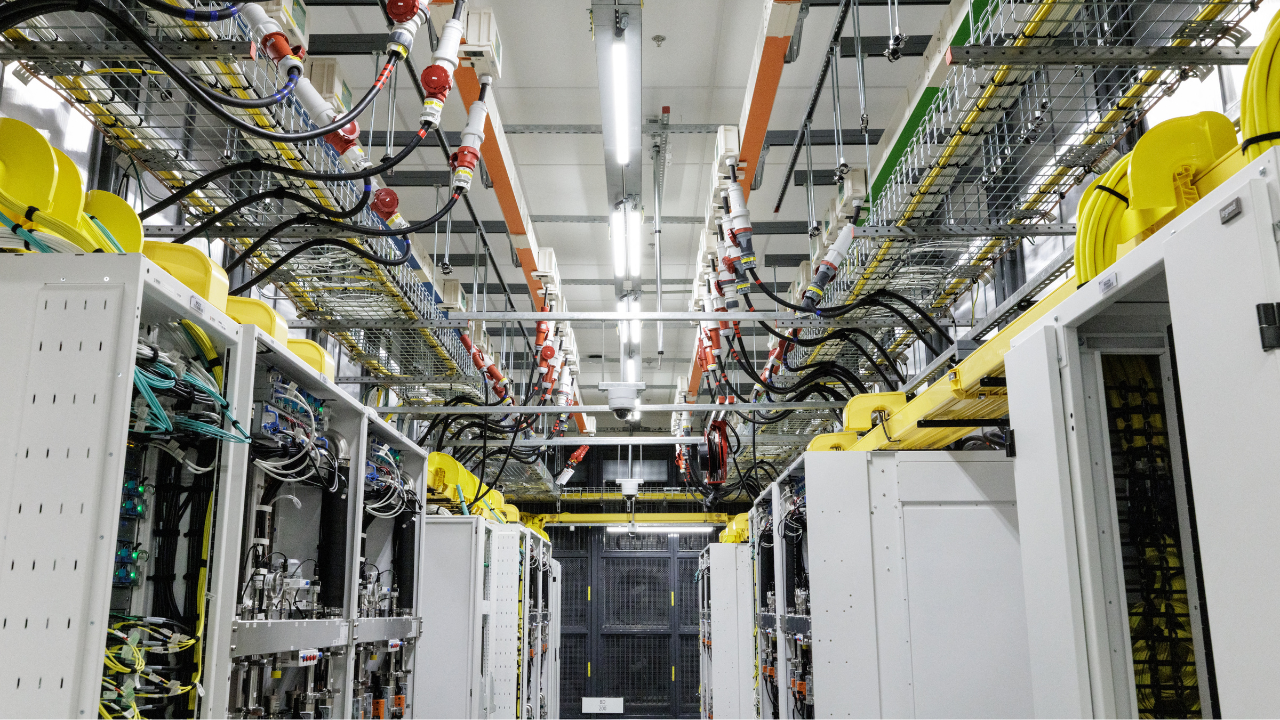
Just a few miles away from the sprawling suburban growth south of Dallas, a different kind of American landmark is rising from the Texas plains. In Red Oak, Texas, Compass Datacenters has built a massive campus that looks, from the outside, like a series of low-slung industrial buildings. But inside those unremarkable walls lies the throbbing nervous system of the modern digital world. Getting there took Fox News Digital roughly three months of approvals, and once on site, the experience felt more like entering a classified facility than touring a corporate office. Six layers of security stood between the outside world and the servers humming inside. Visitors had to don personal protective equipment, surrender any expectation of taking photographs, and move through checkpoints that felt both meticulous and purposeful. When the final door opened, the interior was almost startling in its cleanliness and calm. There was none of the clatter or chaos one might expect from an operation running around the clock. Instead, the vast space stretched quietly under bright lights, filled with row after row of towering server racks arranged with military precision. Cables ran in neat bundles, cooling pipes lined the ceilings, and the entire facility hummed with a low, steady energy that seemed almost alive. It was a reminder that behind every artificial intelligence chat, every cloud backup, every streaming show and financial transaction, there is physical infrastructure—concrete, steel, copper, and silicon—that most people will never see and rarely think about. Yet this quiet, spotless room is where the future of the American economy is being assembled, one rack at a time.
One of the most striking things about the Red Oak campus is not the sophisticated computer equipment but the simple fact that it has never used water to cool any of it. In North Texas, where drought and heat have long shaped the rhythm of daily life, water is not an endless resource to be taken for granted. Chris Crosby, the CEO of Compass Datacenters and a native North Texan, understands this better than most. Standing inside the facility, he explained the closed-loop cooling system that recirculates coolant rather than continuously drawing fresh water to cool the servers. “We haven’t used water since inception,” Crosby said, with a quiet note of pride. “Water is precious in North Texas.” It is not hard to understand why that matters. Traditional data centers have historically consumed millions of gallons of water each year to keep equipment from overheating, and in a region that has seen its lakes shrink and its aquifers strained, that kind of demand carries real consequences. Compass has chosen a different path, one that acknowledges the delicate balance between technological progress and environmental responsibility. The result is a facility that runs efficiently without draining the very community it depends on. It is easy to think of data centers as faceless, remote operations, but here in Red Oak, the choices made inside those walls reflect a deep awareness of place. Crosby’s words sounded less like corporate talking points and more like the conviction of someone who grew up with the Texas sun and knows exactly what a precious resource looks like. In an industry often criticized for its environmental footprint, this is a small but meaningful sign that innovation and stewardship can coexist.
The security at the Red Oak campus was extraordinary, and it raised an obvious question: why does a building full of servers need to be so impossible to enter? Crosby’s answer was simple and revealing. The layers of protection are not about keeping the existence of the facility secret. Rather, they are about safeguarding the sensitive information and indispensable infrastructure housed inside. “Hacking is real, attacks on infrastructure are real,” he said. “If people knew that a bank or a government was operating at a particular facility, they could infiltrate that facility. So that’s why the levels of security are so high at our campuses.” In other words, these buildings are not hidden because they are mysterious; they are locked down because they are vital. Somewhere inside those racks may live the records of a hospital, the accounts of a bank, or the communications of a government agency. A breach could ripple far beyond the walls of a single building, affecting the daily lives of millions of people who have no idea where their data actually lives. The men and women who walk those clean floors every day are not just technicians; they are guardians of a digital trust that underpins modern life. They know that when the lights go out elsewhere, someone will call. When a cyber threat emerges, someone will respond. And when the world demands more computing power, someone will be ready. There is a quiet dignity in that work, even if it is invisible to the public. It is easy to be cynical about big tech and the infrastructure boom, but standing inside that facility, surrounded by the hum of machines doing their jobs without fanfare, it is hard not to feel a sense of awe at the scale of human trust being placed in these anonymous walls.
Crosby, however, wants people to look beyond the servers and think about the people who build and operate these extraordinary places. For him, the data center boom is not really about artificial intelligence or cloud computing. It is about jobs—real, tangible, blue-collar jobs that can support a family and build a future. “Data centers are where the economic engine is going to be going forward,” he told Fox News Digital. The numbers behind that claim are substantial. The Red Oak campus is expected to eventually include ten data center buildings spread over roughly 2.6 million square feet. Right now, about 600 people work for Compass at the site, while another 300 work for Schneider Electric at a nearby manufacturing facility. Thousands of construction workers have cycled through the project since construction began in 2019. These are not just programmers and software engineers. They are electricians who wire massive power systems, welders who join steel and conduit, concrete workers who lay the foundations, and mechanics who keep the cooling equipment running. And the demand is far from being satisfied. “We can’t get enough people into this career,” Crosby said. His voice carried a sense of urgency, but also excitement. For decades, Americans were told that a four-year degree was the only path to success, that a trade was somehow less worthy. Crosby rejects that notion entirely. “There was a war on blue-collar jobs for a long time—everybody had to get a four-year degree,” he said. “I’m so glad that’s over with.” The pride in his voice was unmistakable. In Red Oak, those old assumptions are being replaced by a new reality: that the hands-on skills of workers who build and maintain our digital world are just as important as the algorithms that run on it.
To turn that philosophy into action, Compass has helped create MEI Pathways, a workforce development program built in partnership with Texas State Technical College. The $12.6 million training facility, located on the campus itself, offers a 12-week program designed to prepare electricians, mechanics, and technicians for careers in the data center industry. It is a direct response to a glaring need: as the industry grows, it cannot find enough qualified workers to fill the roles that keep these facilities running. The program is not just about handing out certificates; it is about changing lives. Someone who walks in with no experience can walk out with a skill set that is in high demand across the country. It offers a ladder to economic stability for people who might have been overlooked by the tech economy. And it is a message to communities across America that the data center boom is not reserved for Silicon Valley elites. It belongs to anyone willing to learn a trade, to show up, to work hard. The broader community has felt the impact as well. Compass has worked with local officials on roads, sewer systems, and other infrastructure improvements, and donated $15 million toward a new animal shelter after Ellis County’s previous shelter arrangement ended. These investments may not make headlines, but they matter deeply to the people who live there. They demonstrate that a company can build an enormous, high-tech facility without isolating itself from the community around it. Instead, the facility becomes part of the fabric of the town—employing its residents, training its workers, and supporting its institutions.
Of course, none of this comes without difficult conversations. Texas is grappling with how to accommodate the enormous electricity demands that data centers bring while ensuring the reliability of its power grid. On hot summer days, when air conditioners are running at full blast, every additional megawatt matters. Critics worry that the rapid growth of data centers could strain the system and push costs onto ordinary consumers. It is a legitimate concern, and one that deserves serious attention. But Crosby argues that the debate should not focus solely on the machines humming inside the buildings. “I am tired of the elitism that this doesn’t create jobs,” he said. It is easy for outsiders to look at a data center and see only a building full of computers, a drain on the power grid, a symbol of corporate wealth. But from the inside, it is something entirely different. It is a place where a young electrician can learn a career that will last a lifetime. It is a source of tax revenue that pays for roads, schools, and public safety. It is an anchor for an economic future that does not require every American to sit at a desk writing code. The artificial intelligence boom is real, and it is changing the world. But the infrastructure that makes it possible is built by human hands, and the benefits can be felt far beyond the server rooms. As the sun sets over the Texas prairie, the lights inside the Compass campus continue to glow, a quiet symbol of the tension between the old and the new, the physical and the digital, the challenge and the promise. The data center is not just a machine. It is a community of workers, a partner to a town, and a statement about what America can build when it embraces both technology and the people who bring it to life.