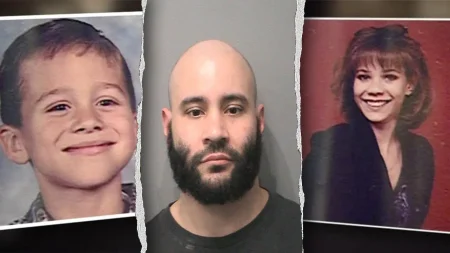



The O.J. Simpson double-murder case has haunted the American imagination for three decades, not only because of the brutal killings of Nicole Brown Simpson and Ronald Goldman but because so many pieces of that night never seemed to fit. Now a bombshell New York Times investigation has pulled back the curtain on a shadowy figure who may have been present in Simpson’s orbit on the night of the murders, and whose story—if true—could change how people understand what happened. The new reporting centers on Joseph “Joey” Ippolito, a convicted drug trafficker with ties to the mafia and a longtime associate of both Simpson and his close friend Al Cowlings. According to Joey’s brother, Sam Ippolito, Joey returned to a Los Angeles apartment around midnight on June 12, 1994, with blood on his hands and carrying a mysterious bag with a heavy object inside. Sam told the Times that his brother had left hours earlier to help a friend, and what he saw when Joey came back has stayed with him for years. The account is deeply unsettling and raises urgent questions: Was Simpson truly alone on the night of the killings? Did he have help disposing of evidence? And if so, why has that secret remained buried for so long? The investigation also uncovered previously sealed federal court records indicating that Joey Ippolito had told federal authorities about Simpson’s alleged disposal of the murder weapon—a weapon that has never been found. The Los Angeles Police Department has confirmed to the Times that the case remains an open investigation, meaning that even after Simpson’s acquittal, his civil liability, and his death in April 2024, the truth is still officially unfinished.
Sam Ippolito’s account is at the heart of this new reporting, and it is chilling in its specificity. He said that on the night of the murders, his brother left their shared Los Angeles apartment to go help a friend. When Joey returned around midnight, Sam noticed blood on his hands and immediately grew alarmed. Joey reportedly told Sam to help him get rid of a bag, and he stuffed his own clothes into it before taking a shower. Sam said he obeyed his brother’s instructions and threw the bag into a dumpster near a construction site on Doheny Drive in Los Angeles. He also claimed to have overheard Joey on the phone with Cowlings later, saying that he had been “helping” Simpson that night. Those words—if Sam heard them correctly—would place Joey Ippolito at the center of the aftermath of the murders, not as a bystander but as someone who was actively involved in covering up what Simpson had done. The image of a brother returning home with blood on his hands and a heavy object in a bag is difficult to shake, and it adds a new layer of darkness to a case that already seemed saturated with it. At the same time, Sam’s account has not been corroborated by any physical evidence, and the bag itself has never been recovered. The dumpster and the construction site are long gone, and no one has ever come forward to confirm that such a bag was found. Still, the report raises a troubling possibility: that the reason Simpson was able to escape conviction was not just brilliant legal maneuvering or reasonable doubt, but actual help from people who knew how to make evidence disappear.
Joey Ippolito was not some random acquaintance who happened to cross paths with Simpson. He was a convicted drug trafficker with genuine mafia connections, and his background made him someone who understood the value of silence and loyalty. Importantly, he had escaped from a Florida prison in May 1994, just weeks before the murders, and was a fugitive when the killings occurred. That made him a dangerous and compromised figure—someone who might be willing to do favors for powerful friends while trying to stay out of sight. After Simpson’s murder trial was nearing its conclusion in August 1995, Joey was arrested and became a federal informant. Prosecutors apparently saw him as a treasure trove of information. A December 1996 federal prosecution memorandum, which was recently unsealed at the Times’ request, described Ippolito as a valuable source who possessed information about Simpson’s alleged efforts to dispose of the murder weapon and his attempted flight from authorities. The phrase “attempted flight” almost certainly refers to the famous white Bronco chase that captivated the nation on June 17, 1994, when Simpson led police on a slow pursuit across Southern California before eventually surrendering. If Ippolito really did have inside knowledge about Simpson’s plans and actions during that desperate week, then he occupied a unique and privileged position in the Simpson universe. His life was marked by crime, escape, and betrayal—he was someone who had played both sides, loyal to his mafia associates but willing to share secrets when it served his own survival. That made him simultaneously a credible witness and a deeply unreliable one, and it helps explain why his information has remained hidden in sealed files for so long.
The newly unsealed records also reveal that Ippolito’s information went beyond rumor and innuendo. Then-federal prosecutor David Kelley described Ippolito in a letter as a “remarkable source of information” whose cooperation had proven valuable to investigators. That is a strong endorsement from a federal prosecutor, and it suggests that Ippolito did not merely spin tales; he gave law enforcement something they could use. The Times reported that the records show his information was shared with Los Angeles prosecutors during Simpson’s murder trial, although he was never called to testify. That is a key detail, because it means that prosecutors—at least at some level—knew about Joey Ippolito and his claims while the trial was ongoing. Yet former prosecutor Marcia Clark told the Times that she had no knowledge of Ippolito and insisted that she would have been informed if he had provided credible or relevant evidence. Her denial creates a strange and uncomfortable gap. Either the information never reached her, which would mean a serious failure in communication within the prosecution team, or she was told and has forgotten, which would also be troubling. Or perhaps the information was deemed too unreliable to present to a jury, especially in a trial already beset by allegations of police misconduct and prosecutorial mistakes. Kelley, for his part, told the Times that he did not believe Joey Ippolito was involved in the killings. That is a critical caveat. A federal prosecutor who worked with Ippolito and valued his cooperation still doubts the central allegation being made by Sam Ippolito. This is not a straightforward story of a hidden witness who could have changed everything; it is a messy, contradictory portrait of a convicted criminal whose word was never quite solid enough to stand on.
Given all of that, it should come as no surprise that the account from Joey Ippolito’s brother has come under sharp scrutiny. Sam Ippolito reportedly maintained his allegations for months, but then the story took a strange turn. According to the Times, he sought compensation from the newspaper and later attempted to retract his statements, claiming that he could no longer distinguish what was real from what was not. That is a devastating admission, because it undermines the very credibility of the account that started the investigation. It raises questions about whether Sam was motivated by money, attention, guilt, or some complicated mixture of emotions that made him embellish or invent details. At the same time, the fact that he tried to retract does not necessarily mean he was lying from the beginning. Memory is fragile, especially when it involves trauma, fear, and a brother who was involved in a world of crime and violence. It is entirely possible that Sam saw something real that night but later became confused or was pressured to change his story. Friends and relatives of Joey Ippolito, who died in 2006, have also disputed suggestions that he participated in the murders. They maintain that Joey was not capable of such violence, and they point to his later cooperation with authorities as evidence that he was not someone who would help cover up a double murder. Cowlings, who could potentially corroborate or deny the alleged phone call, did not respond to the Times’ request for comment. His silence leaves the story hanging in the air, unresolved and unverified. In a case where almost every witness had reason to lie or stay quiet, the absence of a direct response from Cowlings is itself significant.
What does all of this mean for a case that concluded legally but never concluded emotionally? Simpson was acquitted of the murders in 1995, a verdict that remains one of the most controversial in American history. He was later found liable for the deaths in a civil trial, which forced him to pay damages to the families of Nicole Brown Simpson and Ronald Goldman, but he never faced prison time. He died in April 2024 at age seventy-six, taking with him whatever he knew about the events of June 12, 1994. The newly uncovered information about Joey Ippolito does not prove that Simpson was guilty, nor does it prove that he had help. It simply reminds us that the truth about that night is more complicated than a single trial could ever capture. It reminds us that there were people on the edges of Simpson’s life who may have known more than they ever told, and who carried their secrets into the grave. The LAPD has confirmed that the case remains an open investigation, but after thirty years, it is hard to imagine any new charges will ever be filed. Still, for the families of Nicole Brown Simpson and Ronald Goldman, the case will never be closed. They have lived with the loss of two young people whose lives were cut short in a horrifying act of violence, and every new revelation—whether credible or not—reopens the wounds. The story of Joey Ippolito is not just a true crime footnote; it is a human story about a brother who says he saw something terrible, about a criminal who tried to use his knowledge to save himself, and about a system that could not or would not use that knowledge to find the full truth. It is a reminder that justice is not always neat, that memory is not always reliable, and that the past never really lets go.