


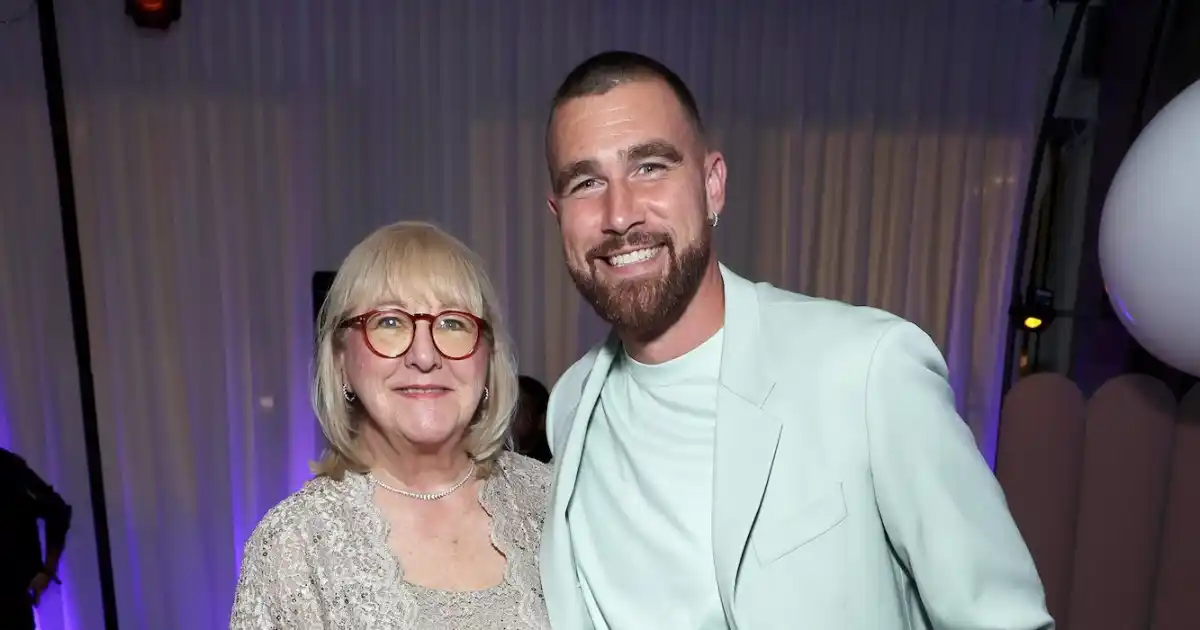
Few things in life are as visceral as a mother’s urge to stand between her child and the world’s judgment, and Donna Kelce gave the world a glimpse of that primal instinct on Saturday, October 17. When a fan tagged her in a tweet featuring some of the offensive posts that have been circulating online, the 74-year-old mother of two NFL sons did not hesitate. “Not Travis’ handle and not his account!!” she wrote on X, her capital letters carrying the unmistakable tone of a woman who has seen her children attacked before and refuses to let it pass quietly. It was a response that felt less like a celebrity statement issued by a publicist and more like a parent speaking from the heart, raw and immediate. For years, Donna has been a warm presence in the stands, cheering for Travis and his brother Jason, baking cookies for offensive linemen, and charming the public with her down-to-earth personality. But in that moment, all the cheerfulness fell away, replaced by something sharper—a protective clarity that any parent would recognize. The posts in question, allegedly sent from an X account with the handle “tkelce” between 2009 and 2011, had been shared in a flood of screenshots by media outlets and social media users alike. They were crude, juvenile, and at times deeply hurtful, and the implication that Travis might have written them threatened to tarnish the Kansas City Chiefs tight end’s carefully built public image. Yet Donna’s denial quickly became its own story, not because it offered definitive proof one way or another, but because it reminded everyone that behind every public figure is often a family member who sees the whole person, not just the headlines.
At the center of this storm are old messages that paint an unflattering portrait of a much younger, far less careful voice. According to multiple media outlets, the now-deleted tweets from the account “tkelce” included a 2010 post that read, “As a man, You have something wrong with you if your going for girls that weigh more then you!” Another allegedly mocked women’s curves with the line, “hahaha why cant girls hide they backfat? that s***s nasty!!!” A 2011 tweet reportedly suggested that aspiring cheerleaders “pass a beauty test” because “there’s too many ugly cheerleaders out here.” Yet another from 2011 allegedly used an ableist slur, and a message from 2009 referred to someone as “a fat prick with some homo tendencies.” These are the kinds of words that feel shockingly out of step with the Travis Kelce the public knows today—the charismatic tight end who celebrates his teammates, kisses his mother after big wins, and has become one of the most recognizably joyful faces in professional football. But the internet has a long memory, and these snippets, stripped of context and time, have resurfaced to cast doubt on his character. The New York Times previously reported in 2023 that Snopes, the fact-checking website that examines viral rumors, independently verified the tweets’ existence. Even so, Donna insists that her son was not connected to the account, and no amount of archived screenshots seems to have shaken her certainty. For fans who have followed Travis’s rise from a third-round draft pick to a three-time Super Bowl champion, the episode is a complicated reminder that the people we admire are never just their past mistakes, but also never fully protected from them.
The tweet controversy landed in the same week as a separate firestorm involving Travis, one that once again raised questions about what he finds amusing and how his actions are received by the public. Earlier in the week, the 37-year-old athlete “liked” a video of comedian Shane Gillis’s divisive monologue on Saturday Night Live from the weekend before. In the extended standup routine, Gillis, 38, sparked anger from viewers by mocking the way some women dress at the gym. “I haven’t been to the gym in so long, I didn’t realize women just dressed like whores now,” Gillis said, before going on to describe their workout clothing in graphic, sneering terms and complaining that women were filming TikToks nearby. The monologue was immediately labeled sexist by viewers and celebrities alike, and Travis’s social media activity made him a reluctant participant in the backlash. A “like” can certainly be read as endorsement, and many fans expressed disappointment that a player with such a prominent platform would publicly support material that so clearly demeaned women. Yet it also served as a strange convergence: the same week he was being attacked for problematic words from the past, Travis found himself in trouble again, this time for something as small and easy to do as tapping a heart icon on a video. It was a reminder that in the modern era of celebrity, every click, every like, and every gesture carries weight, even when it seems casual.
The backlash against Gillis’s monologue was fierce, and it came from some unexpected corners of the entertainment world. Former Saturday Night Live cast member Ego Nwodim, who had starred on the show, did not hide her displeasure, and Dan Levy of Schitt’s Creek became one of the most vocal critics. With a mix of frustration and sorrow, Levy took to his Instagram Story on Sunday, October 11, to make his feelings clear. “Women wearing short shorts to the gym does not make them whores,” he wrote. “It makes the men calling them whores misogynists. There’s a difference there.” Levy went on to note that he had “seen more men’s nipples at the gym than I’ve ever seen women showing their bodies off,” before making an even larger point about the consequences of allowing sexist comments to go unchallenged. “I’m speechless that something like that can exist on live national television,” he admitted. “And to be perfectly honest, more men need to be standing up in opposition to it because it’s complacency that has created the environment [in] which women are sexually assaulted, and it’s a conversation as opposed to a crime.” His words resonated with many because they shifted the focus from Gillis as an individual comic to the larger culture that allows such jokes to flourish. Levy’s plea was not just for women to speak out, but for men to do the same—to understand that objectification in the media is not a harmless punchline but part of a broader pattern that shapes how women are seen and treated. For Travis, whose “like” had been seen by millions, Levy’s message served as an implicit challenge: what does it mean to be a man with influence, and how should that influence be used?
Donna’s fierce defense of her son adds another layer to the story, because it highlights the very human tension between public accountability and family loyalty. To the outside world, Travis is a celebrity, a role model, a brand. To Donna, he is simply her son—someone she watched grow up, stumble, learn, and become the person he is today. She has not responded to the Gillis criticism directly, and Travis has not commented publicly on either controversy. Instead, Donna has chosen to focus on what she feels is the truth: that the offending tweets were not his. Whether she is right remains to be proven, but her willingness to step into the spotlight and defend him is a testament to the bond they share. It also makes her one of the most relatable figures in the entire saga, because what parent hasn’t wanted to shield their child from a mistake they made long ago, especially one that follows them into adulthood? The internet may see a star’s worst moments in high definition, but a mother sees the whole messy journey—the good choices, the bad ones, the growth that happens quietly over years. In a world that often demands swift condemnation and refuses to allow room for redemption, Donna’s instinct to protect is a reminder that we are all more than the worst things we have ever said or done. It does not excuse harmful words, but it does complicate the easy narratives that dominate social media.
Ultimately, this episode is about more than old tweets or a liked video. It is about how we treat people when they fail, and how we allow them to learn from the past. Travis Kelce has spent years building a reputation as a generous teammate, a beloved football star, and a compelling public figure. One “like” and a batch of decade-old messages cannot erase that history entirely, but they also cannot be waved away without acknowledgment. The most honest response, whether from Travis or anyone else, would be to address the pain those words may have caused and to make clear where he stands now, rather than letting silence do the talking. Donna’s dismissal of the account may be enough for some, but others will continue to ask questions, and that is the nature of being in the public eye. What matters most, perhaps, is the way this moment is used. Growth is not about pretending the past doesn’t exist; it’s about looking at it honestly, understanding how far you’ve come, and doing better going forward. Travis has not yet offered that kind of reflection, and whether he ever does is up to him. But one thing is certain: no matter what the headlines say, Donna will be in his corner, ready to stand between her son and the world’s judgment, just as she has always done. In an era of outrage, that kind of unshakable love is rare, complicated, and strangely human.